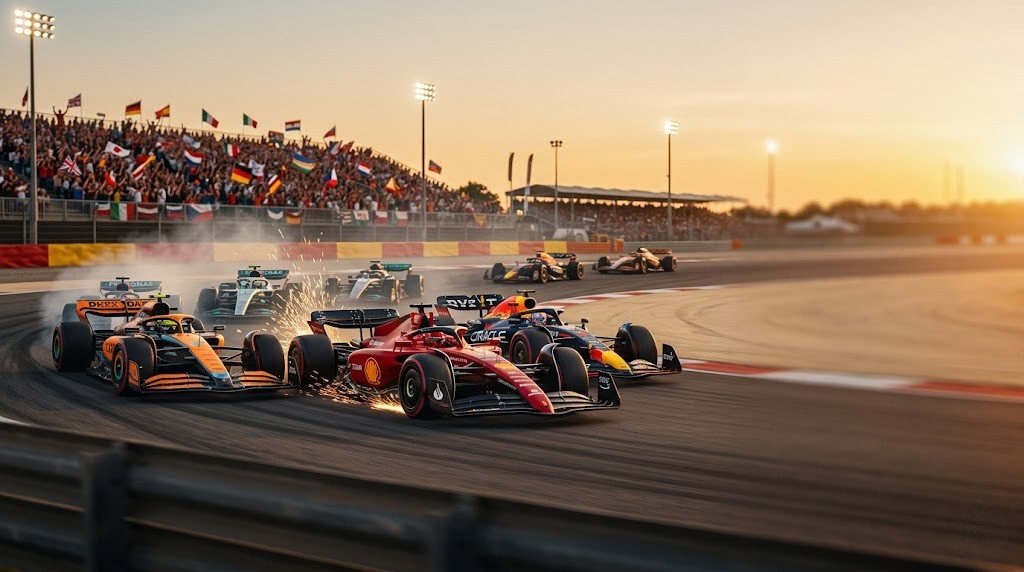
Formula One represents the absolute apex of global motorsport. It is a high-stakes, multi-billion-dollar arena where elite engineering converges with raw human talent. If you are new to the sport or returning to understand the sweeping changes that reshape the grid, navigating the intricacies of a Grand Prix weekend can feel overwhelming. From complex aerodynamic strategies to stringent financial caps and intricate race procedures, modern grand prix racing is as much a chess match at 200 mph as it is a physical battle.
What Is Formula 1?
Meaning of Formula 1
The “Formula” in Formula 1 refers to a strict, standardized set of technical, sporting, and financial rules compiled by the sport’s governing body. Every single car competing on the grid must comply with this exact framework. The “1” denotes its status as the absolute top tier of international single-seat racing, positioning it at the very peak of the global motorsport pyramid.
History and Origins
Formula 1 traces its lineage back to the European Grand Prix motor racing championships of the 1920s and 1930s. The championship as we recognize it today was formalized in 1946, with the inaugural FIA World Drivers’ Championship race taking place at the historic Silverstone Circuit in England on May 13, 1950.
The Pinnacle of Motorsport
Formula 1 is considered the pinnacle of motorsport because it is not a spec series. Unlike championships where every driver uses identical machinery, F1 requires teams to design, manufacture, and develop their own chassis and aerodynamic components from scratch.
How Does Formula 1 Work?
The Formula 1 World Championship operates as an annual global tour, running from early March to December. The competition is structured around two distinct, concurrently contested world titles.
Drivers and Teams
The grid is composed of 10 teams, with each team required to enter two cars, creating a highly competitive field of 20 permanent drivers. These drivers are backed by hundreds of engineers, aerodynamicists, mechanics, and strategists working both trackside and at high-tech factory headquarters.
The World Championships
- The World Drivers’ Championship (WDC): This title is awarded to the individual driver who accumulates the highest number of points over the course of the season.
- The World Constructors’ Championship (WCC): This title is awarded to the team that scores the highest combined points total across both of their entered cars. The WCC is intensely contested because a team’s final position in this championship directly dictates their share of the sport’s massive prize money distribution and commercial revenues.
How Many Races Are in the F1 Season?
The modern Formula 1 championship features a robust 24-race calendar, representing a global tour across Europe, the Americas, Asia, and the Middle East.
Calendar Strategy and Sustainability
In recent years, the FIA and Formula One Management (FOM) have actively regionalized the schedule. By grouping geographically close races together—such as linking Australia, China, and Japan into an early-season Asian leg—the sport has significantly minimized transatlantic freight travel. This logistical optimization serves as a key pillar in F1’s broader corporate commitment to achieving a net-zero carbon footprint by 2030.
The Sprint Weekend Footprint
Within the 24-race calendar, six select venues are chosen to host a “Sprint” weekend format. The Sprint is a short, 100-kilometer dash held on Saturday morning before the main Grand Prix. It offers a smaller allocation of world championship points and provides fans with competitive racing action on all three days of the event.
Major and Historic Grands Prix
The schedule strikes a deliberate balance between hyper-modern, high-revenue street spectacles and deeply historic road circuits:
- The Historic Classics: Tracks like Silverstone (Great Britain), Spa-Francorchamps (Belgium), and Monza (Italy) offer high-speed, traditional challenges that test aerodynamic efficiency and pure bravery.
- The Crown Jewel: The Monaco Grand Prix remains a prestigious test of precision, requiring drivers to thread ultra-wide cars through armco-lined, narrow streets.
- The Modern Commercial Destinations: Events such as the night races in Las Vegas and Singapore, alongside established US stops like Austin and Miami, have expanded the sport’s global commercial presence.
Complete Formula 1 Schedule Overview
The following table provides a chronological look at the world championship trail, detailing the circuits, host locations, and key structural milestones across the racing year.
| Round | Grand Prix | Circuit | Location | Characteristic |
| 1 | Australian GP | Albert Park Circuit | Melbourne, Australia | Temporary, high-speed street circuit |
| 2 | Chinese GP | Shanghai International Circuit | Shanghai, China | Technical, front-limited layout |
| 3 | Japanese GP | Suzuka International Racing Course | Suzuka, Japan | Figure-eight layout with legendary corners |
| 4 | Miami GP | Miami International Autodrome | Miami, USA | Hard-braking, temporary street track |
| 5 | Canadian GP | Circuit Gilles Villeneuve | Montréal, Canada | Semi-permanent, barrier-lined venue |
| 6 | Monaco GP | Circuit de Monaco | Monte Carlo, Monaco | Ultra-narrow street track; emphasis on qualifying |
| 7 | Barcelona GP | Circuit de Barcelona-Catalunya | Montmeló, Spain | Traditional European test track |
| 8 | Austrian GP | Red Bull Ring | Spielberg, Austria | Short lap time, steep elevation changes |
| 9 | British GP | Silverstone Circuit | Silverstone, UK | High-speed, high-downforce historic venue |
| 10 | Belgian GP | Circuit de Spa-Francorchamps | Stavelot, Belgium | Longest track on the calendar; highly unpredictable weather |
| 11 | Hungarian GP | Hungaroring | Mogyoród, Hungary | Tight, twisty layout; “Monaco without walls” |
| 12 | Dutch GP | Circuit Zandvoort | Zandvoort, Netherlands | Old-school, high-banking coastal track |
| 13 | Italian GP | Autodromo Nazionale Monza | Monza, Italy | The “Temple of Speed”; lowest downforce configurations |
| 14 | Spanish GP | Circuito de Madrid | Madrid, Spain | Hyper-modern semi-urban venue |
| 15 | Azerbaijan GP | Baku City Circuit | Baku, Azerbaijan | Extreme 2km main straight combined with tight castle sections |
| 16 | Singapore GP | Marina Bay Street Circuit | Singapore | Grueling, humid night race |
| 17 | United States GP | Circuit of the Americas | Austin, USA | Purpose-built track inspired by iconic global corners |
| 18 | Mexico City GP | Autódromo Hermanos Rodríguez | Mexico City, Mexico | High-altitude venue affecting engine cooling and aero |
| 19 | São Paulo GP | Autódromo José Carlos Pace | Interlagos, Brazil | Anti-clockwise classic with a natural amphitheater feel |
| 20 | Las Vegas GP | Las Vegas Strip Circuit | Las Vegas, USA | High-speed street racing under neon lights |
| 21 | Qatar GP | Lusail International Circuit | Doha, Qatar | Fast, flowing, high-G-force track |
| 22 | Abu Dhabi GP | Yas Marina Circuit | Abu Dhabi, UAE | Purpose-built evening season finale |
Formula 1 Weekend Format Explained
A standard Formula 1 race weekend spans three consecutive days (Friday through Sunday), structured to build sporting drama while giving teams ample time to optimize mechanical setups.
The Standard Format
- Friday – Free Practice 1 & 2 (FP1 & FP2): Two 60-minute sessions. Teams run high-fuel simulations to evaluate race pace and low-fuel trims to test outright speed. Strategists gather vital data on tire degradation.
- Saturday Morning – Free Practice 3 (FP3): A final 60-minute session used to fine-tune car setups before mechanical configurations are legally locked under strict Parc Fermé rules.
- Saturday Afternoon – Grand Prix Qualifying: A knockout session split into three segments to determine Sunday’s starting grid:
- Q1 (18 minutes): All 20 cars compete. The 5 slowest are eliminated and fill grid slots 16–20.
- Q2 (15 minutes): The remaining 15 cars compete. The 5 slowest are eliminated to take grid slots 11–15.
- Q3 (12 minutes): A top-10 shootout for pole position (the first grid slot).
- Sunday – The Grand Prix: The main event. Cars complete a minimum race distance calculated as the fewest number of laps needed to exceed 305 kilometers (190 miles), typically lasting between 80 to 100 minutes. Monaco is the sole exception, with a shorter distance of 260 kilometers.
The Sprint Format
When a Sprint weekend occurs, the schedule changes significantly to prioritize competitive sessions over extended practice time:
- Friday: Includes one single Free Practice 1 session, followed immediately by Sprint Qualifying (using shortened SQ1, SQ2, and SQ3 segments) to set the grid for Saturday’s short race.
- Saturday: Starts with the Sprint Race, a 100km flat-out dash with no mandatory pit stops. Later in the afternoon, the traditional Grand Prix Qualifying takes place to set the grid for the main race on Sunday.
- Sunday: The traditional full-distance Grand Prix remains unchanged.
Current Formula 1 Rules Explained
The rules dictating the sport are divided into three core pillars managed by the FIA: Sporting, Technical, and Financial.
Sporting Regulations
The Sporting Regulations govern how track sessions are run, how points are distributed, and how safety measures are deployed.
The Core Points System
Points are awarded to the top 10 finishers in Sunday’s Grand Prix. An additional 1 bonus point is awarded to the driver who sets the single fastest lap of the race, provided they finish inside the top 10.
| Position | Points | Position | Points |
| 1st (Winner) | 25 points | 6th | 8 points |
| 2nd | 18 points | 7th | 6 points |
| 3rd | 15 points | 8th | 4 points |
| 4th | 12 points | 9th | 2 points |
| 5th | 10 points | 10th | 1 point |
Sprint Race Points
In Saturday Sprints, points are awarded purely on merit to the top 8 finishers, with no bonus point available for the fastest lap:
- 1st Place: 8 points
- 2nd Place: 7 points
- 3rd Place: 6 points… descending sequentially down to 1 point for 8th place.
Driver Penalties and Stewarding
On-track infractions—such as causing a collision, forcing a rival off the track, or speeding in the pit lane—are assessed by a panel of independent FIA stewards. Penalties range from minor time deductions to severe sporting exclusions:
- 5-Second or 10-Second Penalties: Added to a driver’s total time during their next scheduled pit stop, or tacked onto their final race time if they do not pit again.
- Drive-Through / Stop-Go Penalties: The driver must enter the pit lane, decelerate to the pit lane speed limit (typically 80 km/h), and either drive straight through or stop for 10 seconds without their mechanics touching the car.
- Grid Penalties: Applied to the next race event, usually resulting from exceeding the season’s strict mechanical component allocations (engines, turbochargers, or gearboxes).
Safety Car and VSC Procedures
When an accident or heavy rain compromises track safety, race control deploys one of two safety mechanisms:
- Virtual Safety Car (VSC): Digital light panels around the track display “VSC.” Drivers must immediately reduce their speed by at least 30% and adhere to a strict minimum lap time mapping calculated by the FIA.
- Physical Safety Car: A high-performance Mercedes-AMG or Aston Martin safety car enters the track ahead of the leader. The entire field must bunch up behind it at a reduced speed, neutralizing all time gaps between competitors.
Red Flag Procedures
If an accident heavily damages track barriers or creates a severely blocked circuit, a red flag is waved to suspend the session. All cars must slowly return to the pit lane and line up in fast-lane single file. Teams are legally permitted to change tires and make minor repairs or structural adjustments while the race is suspended.
Technical Regulations
The Technical Regulations dictate the physical architecture, dimensions, and powertrain design of the cars.
Hybrid Power Units
Formula 1 cars are propelled by highly sophisticated hybrid power units. The core combustion engine is a 1.6-liter turbocharged V6 limited to 15,000 RPM. This internal combustion engine operates alongside advanced electrical energy recovery systems.
These hybrid components harvest thermal energy from exhaust gases and kinetic energy generated under braking. This stored energy is then redeployed back through an electric motor directly to the rear wheels, yielding a highly efficient powertrain capable of producing around 1,000 total horsepower.
Aerodynamics and Control Systems
The outer body of an F1 car is meticulously sculpted to manipulate airflow. Aerodynamicists use front and rear wings, intricate floor profiles, and rear diffusers to generate downward vertical force, known as downforce. This force pushes the tires firmly into the track surface, allowing the cars to corner at lateral forces exceeding 5G.
To encourage overtaking on long straights, cars utilize the Drag Reduction System (DRS). When a trailing driver is within one second of the car ahead at a designated tracking point, they are permitted to open a hinged flap in their rear wing. This mechanical opening sheds aerodynamic drag, boosting straight-line speed by up to 10–12 km/h.
Race Regulations & Pit Stops
Success on Sunday requires flawless operational execution during the race.
Pit Stops and Tire Strategy
A modern Formula 1 pit stop is a highly coordinated feat of human synchronization. A crew of roughly 20 mechanics can replace all four wheels on a car in under 2.5 seconds.
- Tire Requirements: During a dry Grand Prix, every driver must use at least two different dry tire compounds. This rule introduces a mandatory strategic layer, forcing teams to make at least one tactical pit stop.
- Wet Weather Options: If rain falls, teams transition to treaded tires: Intermediates for damp tracks with minor standing water, or Full Wets to maximize water clearing and prevent dangerous hydroplaning in heavy downpours.
Track Limits
Drivers must keep all four wheels within the solid white lines defining the edges of the track surface. If a driver crosses these boundaries during qualifying, their lap time is immediately deleted. During the main race, drivers receive warning flags for repeated track limit violations; a fourth offense triggers an immediate 5-second time penalty.
FIA and Formula 1 Governance
Understanding Formula 1 requires distinguishing between the two distinct organizations that manage its commercial expansion and sporting integrity.
The Role of the FIA
The Fédération Internationale de l’Automobile (FIA) is the independent, non-profit governing body for world motorsport. Based in Paris, the FIA regulates safety standards, issues driver super-licences, drafts technical and sporting regulations, and manages the trackside race control and stewarding operations at every Grand Prix.
Commercial Rights and Rule Creation
While the FIA governs the sport, the Formula One Group (owned by Liberty Media) holds the commercial rights. They focus on expanding the global fan base, negotiating TV broadcast contracts, selecting race promoters, and shaping the annual calendar.
New regulations are not passed arbitrarily. They must progress through the F1 Commission, a collaborative legislative body composed of representatives from the teams, the commercial rights holder, and the FIA, ensuring that major structural changes are debated thoroughly before being officially codified into law.
Current Formula 1 Teams and Drivers
The grid features 10 historical and automotive manufacturers, each fielding an elite two-driver lineup.
| Team Name | Power Unit Supplier | Notable Current Grid Drivers |
| Oracle Red Bull Racing | Honda RBPT | Max Verstappen |
| Mercedes-AMG Petronas F1 Team | Mercedes | George Russell |
| Scuderia Ferrari | Ferrari | Charles Leclerc, Lewis Hamilton |
| McLaren Formula 1 Team | Mercedes | Lando Norris, Oscar Piastri |
| Aston Martin Aramco F1 Team | Mercedes | Fernando Alonso |
| Alpine F1 Team | Renault | Pierre Gasly, Esteban Ocon |
| Williams Racing | Mercedes | Alex Albon |
| Visa Cash App RB (VCARB) | Honda RBPT | Liam Lawson |
| Stake F1 Team Kick Sauber | Ferrari | Valtteri Bottas |
| Haas F1 Team | Ferrari | Nico Hülkenberg |
Key Facts About Formula 1
To keep the structural foundation of the world championship clear, look at this concise snapshot of the sport’s baseline operating metrics.
Championship Blueprint
- Inaugural World Championship Season: 1950
- Governing Body: Fédération Internationale de l’Automobile (FIA)
- Current Number of Active Teams: 10
- Total Active Drivers on the Grid: 20
- Total Calendar Championship Rounds: 24
- On-Track Overtaking Aid: Drag Reduction System (DRS)
- Mandatory Fuel Composition: 100% Advanced Sustainable Fuel
Conclusion
At its core, Formula 1 remains a captivating blend of human endurance and advanced engineering. It is a world where a tenth of a second represents the difference between championship glory and midfield anonymity. Whether you are watching tactical execution in the pit lane, tire management strategies on a drying track, or flat-out wheel-to-wheel overtaking, you are witnessing a premier global sport operating at the absolute limit of technical capability.