Who Is Favourite to Win the FIFA World Cup 2026? Top Contenders
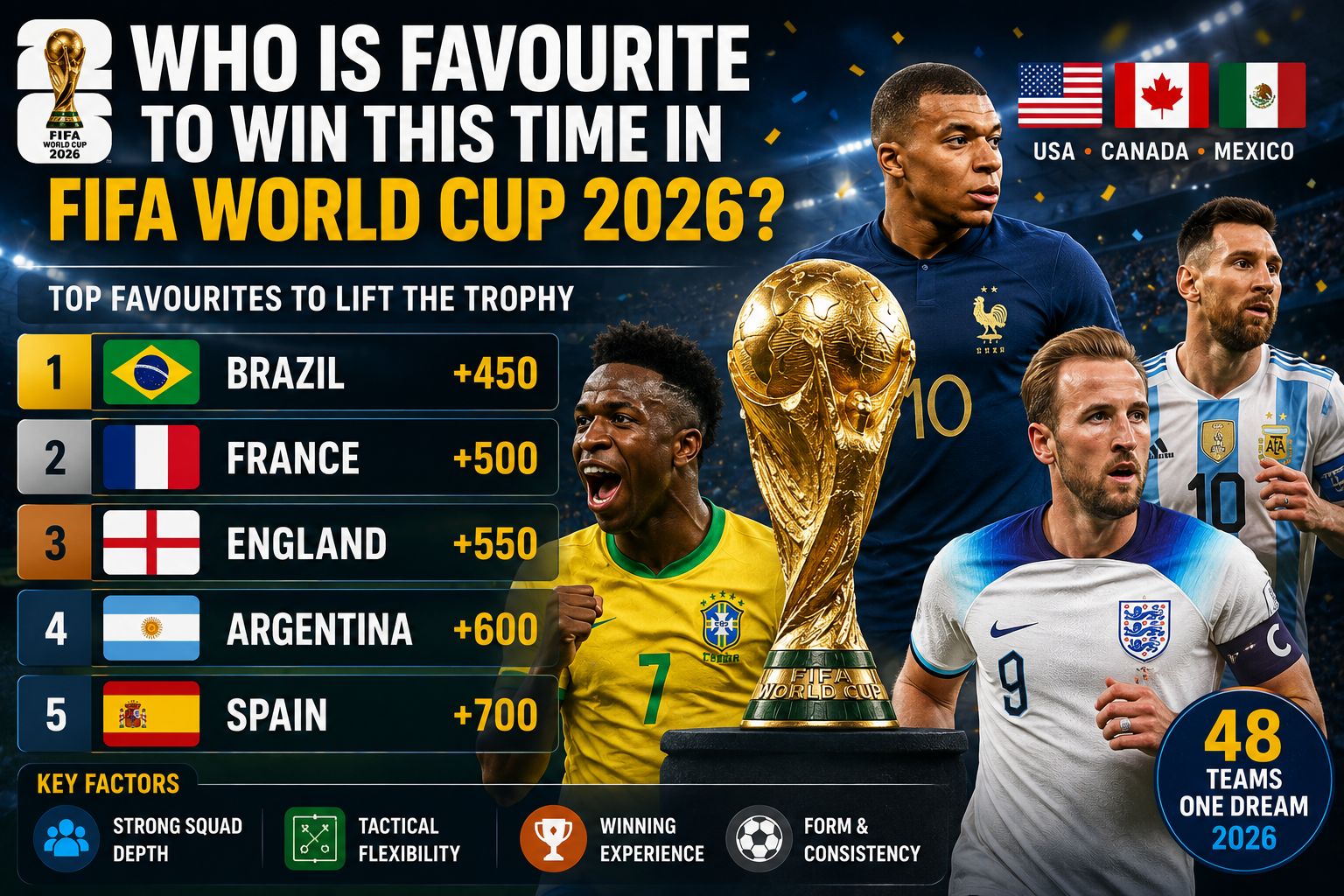
The global game has finally arrived at its most expansive and unpredictable destination. As the opening whistle blows for the FIFA World Cup 2026, international football enters uncharted territory. Spanning three host nations—the United States, Mexico, and Canada—this edition introduces a heavily debated 48-team framework, giving birth to a relentless 104-match gauntlet.
For football analysts and fans alike, this expansion completely shatters traditional tournament forecasting. Navigating a tournament of this scale requires looking past historical pedigree. Contenders must now survive an extra knockout layer, endure extensive travel across regional clusters, and adapt to varying microclimates.
FIFA World Cup 2026 Overview
The 2026 iteration is a monumental milestone in modern sports entertainment, permanently altering the competitive balance of international football.
- Host Countries: Jointly delivered by the United States, Canada, and Mexico.
- Tournament Format: 12 groups of four teams. The top two sides from each group, alongside the eight best third-placed finishers, advance to a brand-new Round of 32 knockout stage.
- Number of Teams: 48 national teams (expanded from 32).
- Key Dates: June 11 to July 19, 2026.
Which Teams Are Favorites to Win the FIFA World Cup 2026?
Predicting a world champion across an eight-match gauntlet requires evaluating structural chemistry and structural bench depth. Bookmakers and sports analysts have locked in a highly competitive top tier.
Spain
Since dominating their way to continental silverware at Euro 2024, La Roja has maintained a remarkable standard of tactical consistency. They enter the tournament as narrow co-favorites with data models, having not lost a competitive match in regulation time since October 2023.
- Squad Strength: Luis de la Fuente has successfully moved Spain away from sterile, low-tempo possession toward a devastatingly direct, high-pressing system. The midfield remains an area of complete technical dominance.
- Key Players: The irrepressible Rodri dictates the game’s tempo from deep, while the explosive wing pairing of Lamine Yamal and Nico Williams provides unmatched isolation threats on the flanks.
- Chances of Success: Extremely high. Spain possesses the most clearly defined tactical identity in international football. If their central defensive partnership holds firm under physical pressure, they are positioned to replicate their 2010 golden era.
France
Les Bleus remain the ultimate tournament benchmark. Having reached the final in two of the last three World Cups, Didier Deschamps’ side knows exactly how to manage tournament momentum.
- Depth and Experience: France boasts an incredibly deep pool of elite talent. They can field two entirely separate, world-class starting elevens without a noticeable drop in athletic quality.
- Star Players: Kylian Mbappé enters the tournament in his absolute physical prime. Supported by the physical dominance of Aurélien Tchouaméni and the attacking versatility of Antoine Griezmann, France can overwhelm opponents in transition.
- Strengths and Weaknesses: Their greatest strength is individual brilliance and tactical pragmatism. However, their tendency to occasionally drop into a passive low-block can isolate their forward line if the midfield fails to connect cleanly.
England
The Three Lions arrive in North America carrying the tag of consistent podium challengers, determined to break their long-standing tournament hoodoo.
- Squad Depth: England features an incredibly high-value collection of attacking midfielders and transitional wingers, making them one of the primary World Cup 2026 contenders.
- Major Strengths: The spine of the team is world-class. Declan Rice provides defensive coverage, while Jude Bellingham offers late-running goal threats from the half-spaces. Up front, Harry Kane remains a lethal finisher.
- Recent Tournament Performances: Back-to-back European Championship finals and consistent deep runs under high-pressure scenarios have provided this squad with invaluable tournament experience, though questions linger over their ability to dictate tempo against elite midfields.
Argentina
The defending world and continental champions refuse to relinquish their crown easily. Lionel Scaloni’s side dominated the grueling CONMEBOL qualifying cycle, finishing comfortably clear at the top of the South American standings.
- Defending Champions’ Aura: Argentina plays with a fierce collective resilience. They outclassed rivals Brazil 4-1 in a March 2025 qualifier without relying heavily on individual icons, proving their collective system is built to last.
- Squad Strength & Key Players: Alexis Mac Allister, Enzo Fernández, and Rodrigo De Paul form a highly combative, technically sound midfield engine room. Up front, Lautaro Martínez and Julián Álvarez present a relentless defensive pressing frontline.
- Chances of Retaining the Title: Strong. While public focus centers on Lionel Messi’s physical availability, Scaloni has successfully engineered a self-sustaining system that does not collapse under individual absences.
Brazil
The Seleção carries the permanent weight of expectation. Despite facing inconsistent form spikes during their structural rebuilding phases, Brazil’s raw talent ceiling keeps them firmly among the World Cup 2026 title favorites.
- Traditional Powerhouse Dynamics: Now under stabilized leadership, Brazil remains capable of unpicking any low defensive block in world football through individual variation.
- Emerging Talents: Real Madrid’s Vinícius Júnior and Barcelona’s Raphinha anchor a devastatingly quick attacking unit. They are supplemented by emerging young talents ready to make their definitive global mark.
- Expectations for 2026: A semi-final appearance is considered the baseline requirement. For Brazil, the tournament hinges on whether their veteran full-backs can withstand elite European transitional counters.
Germany
Under the modern tactical guidance of Julian Nagelsmann, Germany has quietly reconstructed its tournament identity, moving past their recent group-stage disappointments.
- Rebuilding Process: Nagelsmann has integrated a highly dynamic, vertical passing style that emphasizes aggressive counter-pressing inside the opponent’s half.
- Experience & Tactical Identity: The team revolves around the generational playmaker pairing of Florian Wirtz and Jamal Musiala. Supported by Joshua Kimmich’s tactical leadership, Germany possesses the creative tools to unlock elite structures. Their primary hurdle remains the lack of an elite, proven traditional number nine.
Portugal
Portugal enters the tournament boasting one of the single deepest rosters in modern football, positioning them as a highly dangerous threat to the traditional favorites.
- Golden Generation Depth: From defense to attack, Roberto Martínez commands an elite group of footballers playing at the absolute pinnacle of European club competition.
- Key Players: Rúben Dias anchors the backline, while Vitinha and Bruno Fernandes form a highly creative midfield hub. The legendary Cristiano Ronaldo remains heavily involved, bringing unmatched tournament experience to a hungry young core.
Other Dark Horses
- Uruguay: Managed by the tactically demanding Marcelo Bielsa, their high-intensity, vertical pressing style makes them a tactical nightmare for possession-heavy European sides.
- Netherlands: Always capable of outperforming expectations, the Dutch possess an elite defensive foundation led by Virgil van Dijk and a technical midfield built to control games.
- Ecuador: A highly intriguing dark horse. They conceded a meager five goals across 18 Conmebol qualifiers, boasting a rock-solid defensive spine featuring Moisés Caicedo and Piero Hincapié.
- Morocco & Senegal: The African vanguard. Senegal recently claimed a decisive friendly victory over England and secured an intense AFCON crown, while Morocco looks to build on their historic 2022 semi-final run.
Factors That Could Decide the Winner
The sheer scale of this expanded tournament means that tactical diagrams alone will not determine the champion.
- The Expanded 48-Team Gauntlet: Winning requires surviving an additional knockout round. Squad rotation is no longer a luxury strategy; it is an absolute physical necessity.
- Travel and Microclimates: Teams must manage intense geographical transitions, bouncing between the high altitude of Mexico City, the intense summer heat of Miami, and the indoor climates of Texas.
- Sports Science and Injury Management: Coming off a grueling domestic European calendar, the nations whose medical and sports science wings optimize recovery windows between long-haul flights will hold a distinct advantage.
Players Who Could Define World Cup 2026
The battle for global supremacy will ultimately be decided by individual star quality executing under extreme pressure:
- Lamine Yamal (Spain): The teenage sensation enters his first World Cup as a fully realized global superstar, capable of winning matches single-handedly through his elite 1v1 dribbling.
- Kylian Mbappé (France): Standing just five goals shy of Miroslav Klose’s all-time World Cup scoring record (16), his explosive direct transitions remain the most terrifying sight for opposing defenders.
- Jude Bellingham (England): His physical robustness, late box arrivals, and emotional leadership make him the engine upon which England’s title ambitions rest.
- Vinícius Júnior (Brazil): His devastating pace and clinical execution from the left wing will dictate whether Brazil can break their 24-year tournament drought.
Expert Analysis: Why Predictability Is Gone
From an analytical perspective, this is the most difficult World Cup to forecast in history. Mathematical simulations highlight that no single country commands more than a 12% probability of lifting the trophy.
The introduction of the Round of 32 completely eliminates the safety net for traditional giants. In previous 32-team setups, a heavyweight could suffer an opening-day shock and still comfortably calibrate their route through the group.
In 2026, because the best third-placed teams advance, goal difference across entirely separate groups becomes a live variable. Teams cannot afford to coast or play for low-intensity draws.
Historically, highly structured, defensively resilient units that don’t rely on a single superstar tend to survive long tournaments. That is why Spain, with their possession-based control, and Argentina, with their combative collective synergy, feel marginally safer than an individual-heavy side like England or a rebuilding Brazil.
Historical World Cup Winners and Favorites
To understand tournament trends, look at how the pre-tournament favorites or holders performed in recent history:
| Edition | Pre-Tournament Favorite / Holder | Ultimate Winner | Key Tournament Narrative |
| 2010 | Spain | Spain | Lost opening game to Switzerland before dominating via Tiki-Taka. |
| 2014 | Brazil / Germany | Germany | Hosts Brazil collapsed 7-1 in the semi-final to a ruthless German machine. |
| 2018 | Germany (Holders) | France | Germany suffered the notorious “holders’ curse,” crashing out in the groups. |
| 2022 | Brazil | Argentina | Brazil fell in the quarter-finals to Croatia; Messi cemented his legacy. |
| 2026 | Spain / France | TBD | First-ever 48-team expanded field across North America. |
Key Facts About FIFA World Cup 2026
| Dimension | Tournament Specification & Operational Details |
| Host Countries | United States, Canada, and Mexico |
| Total Participating Teams | 48 Nations |
| Total Matches | 104 Matches |
| Opening Match Date | Thursday, June 11, 2026 |
| Final Match Date | Sunday, July 19, 2026 |
| Final Venue | New York New Jersey Stadium (MetLife Stadium) |
| Tournament Format | 12 Groups of 4; 32 teams advance to single-elimination knockouts |
Frequently Asked Questions
Q.1 Who is the favorite to win the FIFA World Cup 2026?
According to data models and futures markets, Spain and France enter the tournament as narrow co-favorites, closely chased by England, Brazil, and Argentina.
Q.2 Is France among the favorites?
Absolutely. France possesses the deepest roster pool in world football and has reached the final match in two of the last three World Cup editions.
Q.3 Which team is the biggest dark horse?
Uruguay under Marcelo Bielsa and a defensively robust Ecuador side are widely considered the most dangerous dark horses from South America, alongside African powerhouses Senegal and Morocco.
Q.4 How does the new format affect favorites?
The introduction of the Round of 32 means favorites must play eight matches instead of seven to win the title, making squad rotation and bench depth critical.
Q.5 Who are the key players to watch?
Kylian Mbappé (France), Lamine Yamal (Spain), Jude Bellingham (England), and Vinícius Júnior (Brazil) are projected to be the defining superstars of the tournament.
Conclusion
The race for the FIFA World Cup 2026 is wide open. While Spain’s tactical chemistry and France’s individual depth position them at the vanguard of the conversation, the expanded format rewards adaptability over historical pedigree. Surviving the multi-time-zone journey through the United States, Mexico, and Canada requires a modern, deep roster capable of tactical variation. As the opening stage matches unfold, the line between favorite and contender will blur, setting the stage for a dramatic month of international football.