England vs New Zealand 2nd Test 2026: Day 2 Stumps Analysis
Test cricket, in its purest form, is a game of momentum swings, psychological battles, and grinding attrition. Day 2 of the second Test between England and New Zealand at the Kennington Oval delivered exactly that, offering a masterclass in how a match can slip away from a team in the space of a few crucial sessions. As the London shadows lengthened and the umpires called stumps, the reality of the scoreboard made for grim reading for the home supporters.
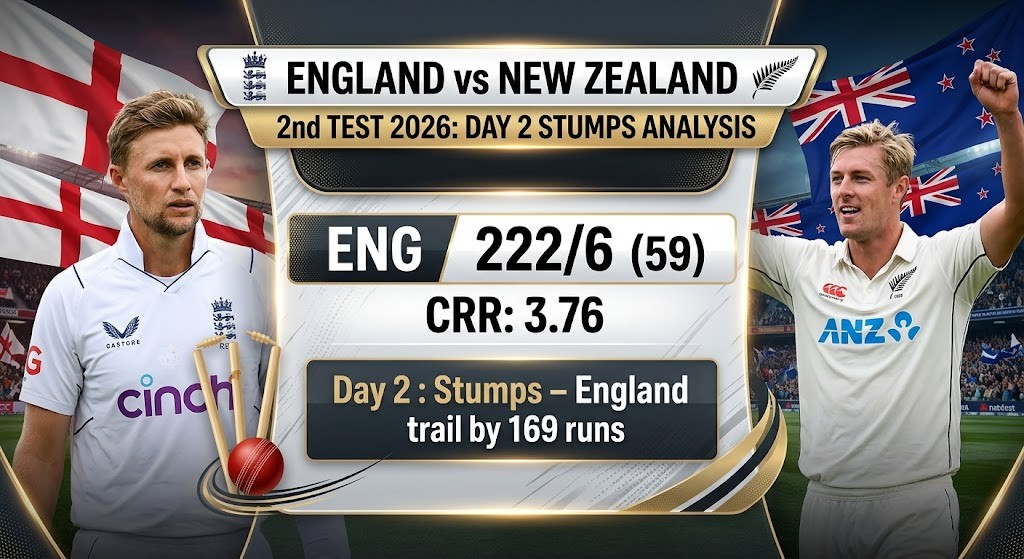
England closed the day at a precarious 222/6, trailing New Zealand’s commanding first-innings total of 391 by exactly 169 runs. With Jordan Cox fighting to stay at the crease on 22 not out, and an uncomfortable Jofra Archer surviving the final few deliveries to remain unbeaten on zero, the Black Caps walked off the turf knowing they had firmly seized control of this contest.
Coming into this match riding the high of a comprehensive 115-run victory at Lord’s, a heavily depleted England side—led by interim captain Joe Root—hoped to press their advantage. Instead, they ran headfirst into a resilient New Zealand outfit eager to define a new era. The story of Day 2 is one of brilliant counter-attacking batting from the Kiwis and a relentless, suffocating display of pace bowling that has left England searching for answers.
Match Summary
The day began with New Zealand looking to consolidate their overnight position and push toward a formidable total. They achieved exactly that, largely thanks to a breathtaking maiden Test century from Glenn Phillips, who treated the English pace attack with disdain. Supported by the steadfast Tom Blundell and a highly irritating lower-order cameo from Kyle Jamieson, the tourists dragged their total up to 391 before Jacob Bethell surprisingly wrapped up the tail.
Faced with a massive first-innings deficit, England’s makeshift top order started with immense promise. Ben Duckett was his usual bustling self, and debutant Emilio Gay played an incredibly mature knock for his 53. Even Joe Root looked utterly imperious during his stay at the crease. However, promise rarely wins Test matches without partnerships. Every time England seemed poised to string together a defining stand, New Zealand’s seamers struck. Matt Henry was immaculate with the new ball, while Will O’Rourke used his imposing height to terrorize the middle order, eventually removing the young James Rew late in the day. By the time stumps were drawn, England had lost six wickets and their grip on the Test match.
New Zealand’s Lower Order Frustrates England
Test matches are often decided by the runs scored by the lower middle-order and the tail. While Phillips played the starring role, the supporting cast ensured that New Zealand posted a total that was practically out of reach for a struggling batting lineup.
Tom Blundell’s gritty 51 was a masterclass in strike rotation and risk mitigation, perfectly complementing Phillips’ aggression. But it was the towering Kyle Jamieson who truly twisted the knife. Striding to the crease and scoring a rapid 41 off just 48 balls (featuring seven boundaries), Jamieson frustrated the English bowlers who were desperate to return to the pavilion. Daryl Mitchell had already softened the ball earlier with a methodical 44, meaning by the time Jacob Bethell (3 for 26) eventually spun out the final wickets, the psychological damage to England had already been done.
England’s Reply: Promise But No Big Partnership
Chasing 391 on a wearing Oval pitch requires a foundation. For a fleeting moment, England looked like they were going to build a skyscraper. Ben Duckett flew out of the blocks, blazing his way to 36 off just 25 balls, striking at an incredible 144.00. But his aggressive intent was his undoing, bringing Emilio Gay to the forefront.
For a debutant, Gay showed remarkable temperament. Against a relentless bowling attack, he accumulated 53 runs off 114 deliveries, acting as the anchor England desperately needed. He looked organized, leaving the ball well on length and playing straight.
Alongside him, Joe Root looked destined for a massive score. Root’s 46 off 57 balls featured eight pristine boundaries, and the interim captain appeared entirely in control of the match’s tempo. Yet, just as the duo looked to assert dominance, the momentum shifted. Harry Brook came and went for a quickfire 24 off 32 balls, failing to convert a start. England repeatedly built platforms of 40 or 50 runs, but in Test cricket, it is the 100-run partnerships that win games. The lack of a defining stand has left them critically exposed.
Key Turning Points of Day 2
- The Morning Counter-Punch: Phillips surviving the early barrage and accelerating to his century immediately took the wind out of England’s sails.
- Joe Root’s Dismissal: At 143/2, England looked solid. Root’s sudden departure for 46 triggered a middle-order wobble that the hosts never fully recovered from.
- The Late Strike: James Rew and Jordan Cox had battled hard to stabilize the innings. Will O’Rourke’s hostile bouncer to remove Rew just before stumps exposed the English tail and effectively dashed hopes of reaching parity.
Tactical Analysis
The stark contrast in bowling tactics defined Day 2. England’s rookie seam attack—composed of Jofra Archer, Matthew Fisher, Sonny Baker, and Josh Tongue—opted for aggressive, short-pitched lengths. While this tactic yielded some wickets, it bled runs, particularly against Phillips and Jamieson, who were happy to use the pace of the ball.
Conversely, New Zealand bowled a much fuller length. Matt Henry and Nathan Smith targeted the top of off stump, forcing the English batters to play forward. When Will O’Rourke was introduced, the short ball was used as a deliberate shock tactic rather than a stock delivery. Joe Root, burdened with the captaincy in Ben Stokes’ absence, struggled to find the right rotational balance for his bowlers, resulting in an overworked and fatigued attack by the time the Kiwis reached 391.
Player Performances
| Player | Team | Performance | Impact |
| Glenn Phillips | New Zealand | 100 off 135 balls (18 fours) | Shifted the momentum with an aggressive counter-attack. |
| Matt Henry | New Zealand | 2/57 in 16 overs | Provided crucial breakthroughs and stifled the scoring rate. |
| Will O’Rourke | New Zealand | 2/61 in 17 overs | Extracted hostile bounce to dismiss key middle-order batters. |
| Emilio Gay | England | 53 off 114 balls | Showed incredible grit on debut to hold the innings together. |
| Jacob Bethell | England | 3/26 in 10 overs | The surprise package for England, cleaning up the Kiwi tail. |
| Joe Root | England | 46 off 57 balls | Looked sublime but failed to convert, exposing the lower order. |
What England Need on Day 3
The morning session of Day 3 will dictate the fate of this Test match for the hosts. Jordan Cox (22*) has shown good application, but he will need to play the innings of his life. Crucially, Jofra Archer must survive the early onslaught from Henry and O’Rourke.
England’s primary objective must be survival rather than scoring. They need to bat out the first session, drag themselves past the 250-mark, and try to bring the deficit down below 70 runs. If they are bowled out quickly, handing New Zealand a lead of 150+, the Black Caps will bat them out of the game by Day 4.
Can New Zealand Push for Victory?
Absolutely. With a 169-run lead already in the bank, Tim Southee’s men (or whoever is pulling the strings on the field) are in the driver’s seat. The pitch at The Oval is beginning to show signs of wear, and batting in the fourth innings will be a nightmare. If New Zealand can wrap up the English tail swiftly on the morning of Day 3, they will look to grind out a lead of around 350-400 runs. From there, their pace attack, combined with whatever spin they can extract from the deteriorating surface, should be enough to level the series.
Key Stats
- New Zealand 1st Innings Total: 391 all out (96.2 Overs)
- England 1st Innings Score: 222/6 (59 Overs)
- Current Deficit: England trail by 169 runs.
- Glenn Phillips: Scored exactly 100 off 135 balls, hitting 18 fours.
- Emilio Gay: Top scorer for England so far with a gritty 53 off 114 balls on debut.
- England Bowling Figures: Jacob Bethell (3/26), Jofra Archer (2/61), Matthew Fisher (2/62), Sonny Baker (2/94).
- New Zealand Bowling Figures: Matt Henry (2/57), Will O’Rourke (2/61).
FAQ
Q.1 What is the score of England vs New Zealand 2nd Test after Day 2?
New Zealand scored 391 all out in their first innings. At stumps on Day 2, England is struggling at 222/6 in 59 overs.
Q.2 Who scored a century for New Zealand?
Glenn Phillips scored a brilliant maiden Test century, making 100 off 135 balls with 18 boundaries to help New Zealand post a commanding total.
Q.3 How many runs does England trail by?
At the end of Day 2, England trails New Zealand by 169 runs with only 4 wickets remaining in their first innings.
Q.4 Who were the standout bowlers?
For England, young spinner Jacob Bethell impressed by taking 3 wickets for 26 runs, while Jofra Archer and Matthew Fisher took 2 wickets each. For New Zealand, Matt Henry (2/57) and Will O’Rourke (2/61) have been the standout performers, dismantling the English middle order.
Q.5 Can England still win the Test?
While not impossible, it is highly unlikely. England must first heavily minimize the 169-run deficit early on Day 3. They then need to bowl New Zealand out cheaply in their second innings and chase down the target on a deteriorating Day 4 or 5 pitch. New Zealand is currently firmly in the driver’s seat.
Final Thoughts
Test cricket is unforgiving to those who do not capitalize on their starts. England’s Day 2 was a story of ‘almost’—almost breaking the partnership, almost building a massive score, almost surviving to stumps. New Zealand, however, were clinical. They seized their moments through Glenn Phillips’ blade and Matt Henry’s seam. As we look toward Day 3, the home side requires nothing short of a miracle to save this Test, while New Zealand smells the blood in the water.