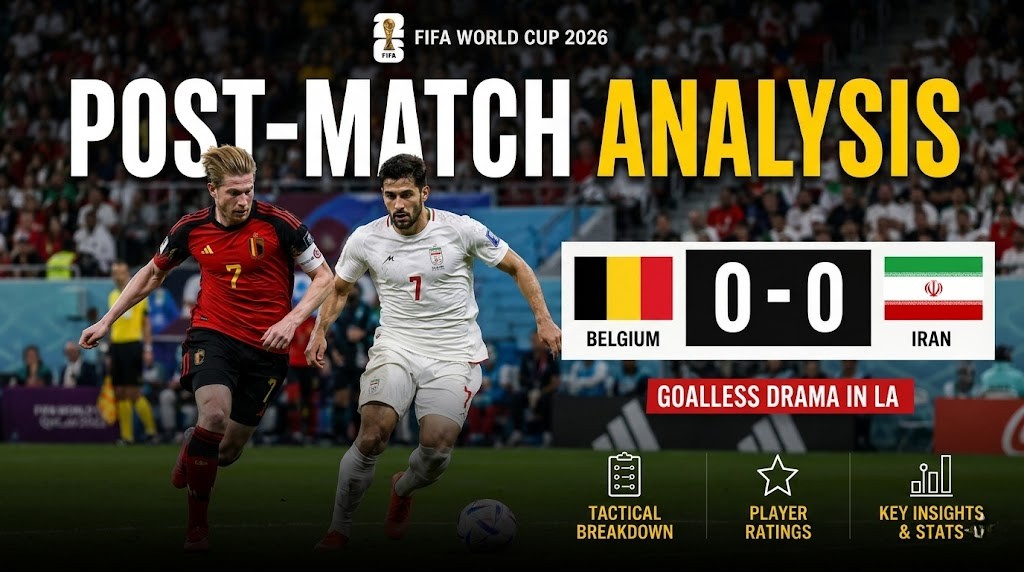
Belgium vs Iran Post-Match Analysis: Goalless Drama in LA
Introduction
The 2026 FIFA World Cup group stage continues to throw up enthralling, high-stakes narratives that mock pre-tournament predictions. In a packed Group G, the clash between the Belgium football team and the Iran football team promised to be a showcase of European attacking flair against disciplined Asian pragmatism. Entering the tournament with immense expectations, both nations came into Matchday 2 desperately hunting for their first maximum points haul.
What transpired at the Los Angeles Stadium was 90 minutes of captivating, chaotic, and ultimately goalless drama. While the final scoreline reads 0-0, the match was anything but dull. It featured a sensational individual goalkeeping clinic, a dramatic VAR intervention that broke Iranian hearts, a costly red card for an emerging Belgian defender, and structural issues that suggest Belgium’s legendary “Golden Generation” has officially transitioned into a rebuilding era.
Final Score and Match Summary
- Venue: Los Angeles Stadium, California, USA
- Competition: FIFA World Cup 2026™ (Group Stage — Group G)
- Final Score: Belgium 0 – 0 Iran
- Goalscorers: None
- Player of the Match: Alireza Beiranvand (Iran)
The Belgium vs Iran result leaves both nations in a fascinating state of limbo. Managed by Rudi Garcia, Belgium dominated the lion’s share of territory and possession, unleashing an astonishing 23 shots across the 90 minutes. Yet, their historic vulnerability in front of goal remained uncorrected.
Amir Ghalenoei’s Team Melli executed their defensive game plan to near perfection, weathering an aggressive first-half storm, finding the net via a disallowed set-piece routine, and eventually failing to exploit a numerical advantage after Belgium went down to ten men in the 66th minute. Ultimately, a masterclass by Iranian keeper Alireza Beiranvand secured a vital point, ensuring that Group G remained entirely wide open heading into the final matchday.
First-Half Analysis
The opening exchanges established a clear, distinct pattern. Stripped of the blistering pace of Jeremy Doku due to a sudden bout of illness, Rudi Garcia lined up the Red Devils in a fluid 4-2-3-1 system. The objective was clear: control the tempo through Youri Tielemans and Kevin De Bruyne, move the ball swiftly to the flanks, and isolate Romelu Lukaku against Iran’s central defensive pairing.
Conversely, Iran matched the challenge by adopting a compact, deep-lying 4-3-3 shape, morphing effortlessly into a low-block 4-5-1 when out of possession. They left minimum space between their defensive line and midfield bank. Within the first two minutes, the tone was set when Lukaku caught Beiranvand while challenging for an early De Bruyne cross, earning an immediate yellow card.
The loudest roar of the first half occurred in the 25th minute through a beautifully designed, inventive free-kick routine. Ehsan Hajisafi slid a low ball directly into the wall to Mehdi Taremi, who spun beautifully and fired a low shot past Courtois. However, the stadium fell silent as a quick VAR review confirmed that Taremi had strayed marginally offside, keeping the score deadlocked at 0-0 at the interval.
Second-Half Analysis
The second half began with immediate tactical adjustments. Amir Ghalenoei introduced the experienced Alireza Jahanbakhsh for his milestone 100th international cap, aiming to provide more composure on the counter-attack. The substitution immediately bore fruit, as Iran started the second half on the front foot. Taremi nearly broke the deadlock again, firing a thunderous volley from another long throw that required Courtois to be at his absolute best.
Sensing a breakthrough, Garcia made a triple tactical substitution in the 57th minute, bringing on Timothy Castagne, Hans Vanaken, and Dodi Lukébakio. However, just as Belgium threatened to overwhelm the opposition, catastrophe struck in the 66th minute.
Forced into damage control, Garcia sacrificed Lukaku for defender Arthur Theate to preserve defensive stability. Despite being down to ten men, a wasteful Belgium continued to push forward. De Bruyne, cutting a frustrated figure, attempted to orchestrate an opening, but uncharacteristic misplaced passes hampered their efficiency. Deep into stoppage time, Beiranvand came to Iran’s rescue one final time, denying a late De Cuyper drive to secure an incredibly hard-fought point.
Key Turning Points
1. The 25th-Minute VAR Offside Intervention
Had Taremi’s clever free-kick goal stood, Belgium would have been forced to abandon their patient buildup and commit numbers forward even earlier, potentially exposing themselves to Iran’s deadly transitional speed.
2. The 66th-Minute Nathan Ngoy Red Card
Ngoy’s defensive error completely halted Belgium’s mounting momentum. The dismissal forced Rudi Garcia to substitute his primary striking outlet, Romelu Lukaku, completely blunting Belgium’s late-game attacking threat.
3. Beiranvand’s Goal-Line Scramble
The extraordinary sequence where Beiranvand and his defenders blocked three successive Belgian shots in a matter of seconds completely broke the spirit of the Red Devils’ frontline.
Belgium’s Tactical Performance
This Belgium vs Iran tactical analysis exposes worrying structural deficiencies in Rudi Garcia’s system. While a 4-2-3-1 setup allowed them to register 23 shots, their attacking efficiency was dangerously low. The team lacked the natural width and explosive dynamism that an isolated Jeremy Doku usually provides.
With Lukaku struggling significantly with his first touch and looking short of match sharpness, Belgium routinely settled for predictable crosses into an overloaded box.
In midfield, Nicolas Raskin and Youri Tielemans maintained control over the tempo, but they failed to provide line-breaking passes into the half-spaces. Defensively, the lack of coordination between Ngoy and Brandon Mechele against long throw-ins remains an issue that elite opposition will look to exploit.
Iran’s Tactical Performance
Amir Ghalenoei deserves immense credit for his masterclass in defensive resilience. Setting up Team Melli in a compact block, they effectively forced Belgium to play around them rather than through them.
The defensive organization was superb, with full-backs Saleh Hardani and Ali Nemati tucked in tightly to minimize space for Leandro Trossard and Alexis Saelemaekers.
Their counter-attacking approach, primarily orchestrated through the intelligence of Mehdi Taremi and the long-throw variations, constantly kept Belgium’s backline honest.
The only criticism of Iran’s tactical performance lies in their inability to maximize their numerical advantage for the final 24 minutes. After Ngoy’s dismissal, Iran struggled to transition from a low block into a possession-based attacking shape, failing to adequately test Courtois in the game’s final sequences.
Standout Players
Alireza Beiranvand (Iran)
The absolute undisputed star of the evening. Registering seven crucial saves—including two sensational low stops against De Cuyper—Beiranvand was a literal wall, earning his Michelob Ultra Superior Player of the Match honors.
Mehdi Taremi (Iran)
The Inter Milan forward put on a clinic in lone-striker play. He held up the ball brilliantly, drew the red card from Nathan Ngoy, and was incredibly unlucky to see his brilliant first-half goal chalked off by VAR.
Maxim De Cuyper (Belgium)
On a night of immense frustration for the favorites, the young left-back was a bright spark. He was solid defensively and forced two excellent saves from Beiranvand through his intelligent overlapping runs.
Player Ratings
Belgium
- Thibaut Courtois (7.5/10): Made two world-class saves from long-throw scenarios to bail out his defense.
- Nathan Ngoy (4.0/10): A night to forget. His critical miscontrol led directly to his red card.
- Kevin De Bruyne (6.0/10): Created a few exceptional openings, but cut a deeply frustrated figure and misplaced several key passes.
- Romelu Lukaku (5.0/10): Lacked sharpness, picked up an early booking, and was isolated before being sacrificed.
Iran
- Alireza Beiranvand (9.0/10): Flawless. Seven saves and complete command of his penalty area.
- Hossein Kanaanizadegan (8.0/10): Impeccable defensive positioning, registering numerous blocks and clearances.
- Saeid Ezatolahi (7.0/10): Anchored the midfield with great physicality, despite picking up a first-half yellow card.
- Mehdi Taremi (8.0/10): The primary threat. His movement caused the Belgian defense continuous problems.
Match Statistics
The data from the Belgium vs Iran match report clearly reflects a story of Belgian territorial dominance countered by an incredibly stubborn, efficient Iranian defense.
| Match Statistics | Belgium | Iran |
| Possession | 63% | 37% |
| Shots (Total) | 23 | 8 |
| Shots on Target | 7 | 3 |
| Expected Goals (xG) | 1.84 | 0.65 |
| Corners | 9 | 3 |
| Fouls Committed | 11 | 14 |
| Yellow Cards | 1 | 1 |
| Red Cards | 1 | 0 |
What This Result Means
This goalless draw leaves Group G perfectly poised for a dramatic final matchday. Both Belgium and Iran now sit on two points from their opening two matches.
For Belgium, the path ahead is straightforward but highly pressured. They will square off against New Zealand on June 27, where nothing less than a victory will guarantee passage to the knockout phases.
For Iran, this point represents a massive psychological boost. Team Melli will face Egypt in their final group fixture. Given their solid goal-differential position and defensive structural stability, a victory against the Pharaohs will see them script history by reaching the round of 32.
Manager Reactions and Talking Points
In his post-match press conference, Rudi Garcia did not hide his profound frustration over Belgium’s attacking inefficiencies:
“We could have won by three goals against Iran but we weren’t efficient enough. We dominated, so tactically we played as we wanted to play. But we were wasteful. Playing 30 minutes down a man is very difficult in a World Cup.”
The major talking point in the mixed zones centered around an astonishing Opta statistic: Belgium have fired 69 shots at World Cup finals since a Belgian player last found the back of the net (Michy Batshuayi against Canada in 2022). This historic drought highlights that Belgium’s biggest concern isn’t creation, but execution.
Key Takeaways
- The Golden Era is Over: Belgium lacks the fear factor of old; their possession is high, but their clinical edge is missing.
- Beiranvand is Elite: The Iranian shot-stopper thrives on the world stage and remains their biggest asset.
- Doku Dependency: Without Jeremy Doku’s structural verticality, Belgium’s attack looks incredibly one-dimensional.
- Resilient Low Blocks Work: Iran proved that a highly disciplined defensive unit can completely neutralize elite individual talent.
- Group G Drama: With all teams dropping points, the final matchday will be an absolute test of nerves.
FAQs
1. What was the final Belgium vs Iran score?
The match ended in a 0-0 draw at the Los Angeles Stadium.
2. Who was named Player of the Match?
Iranian goalkeeper Alireza Beiranvand won the award after pulling off seven crucial saves.
3. Why did Belgium receive a red card?
Nathan Ngoy received a straight red card in the 66th minute for pulling down Mehdi Taremi as the last defender.
4. Why did Mehdi Taremi’s goal not count?
His 25th-minute goal was ruled out by a semi-automated VAR check for a marginal offside.
5. What do both teams need to qualify?
Both teams have 2 points. Belgium must beat New Zealand on June 27, while Iran needs a victory over Egypt to secure a knockout spot.
Conclusion
The latest Belgium vs Iran highlights will showcase a game of missed chances, but the tactical reality is much deeper. Iran showed they have the heart and structural discipline to survive against the world’s best. Belgium, meanwhile, must undergo a rapid soul-searching process before June 27. If Rudi Garcia cannot solve his team’s chronic wastefulness in the final third, one of Europe’s modern heavyweights could be facing an early flight home.