Tunisia vs Netherlands Post-Match Analysis: Oranje Cruise 3-1
Introduction
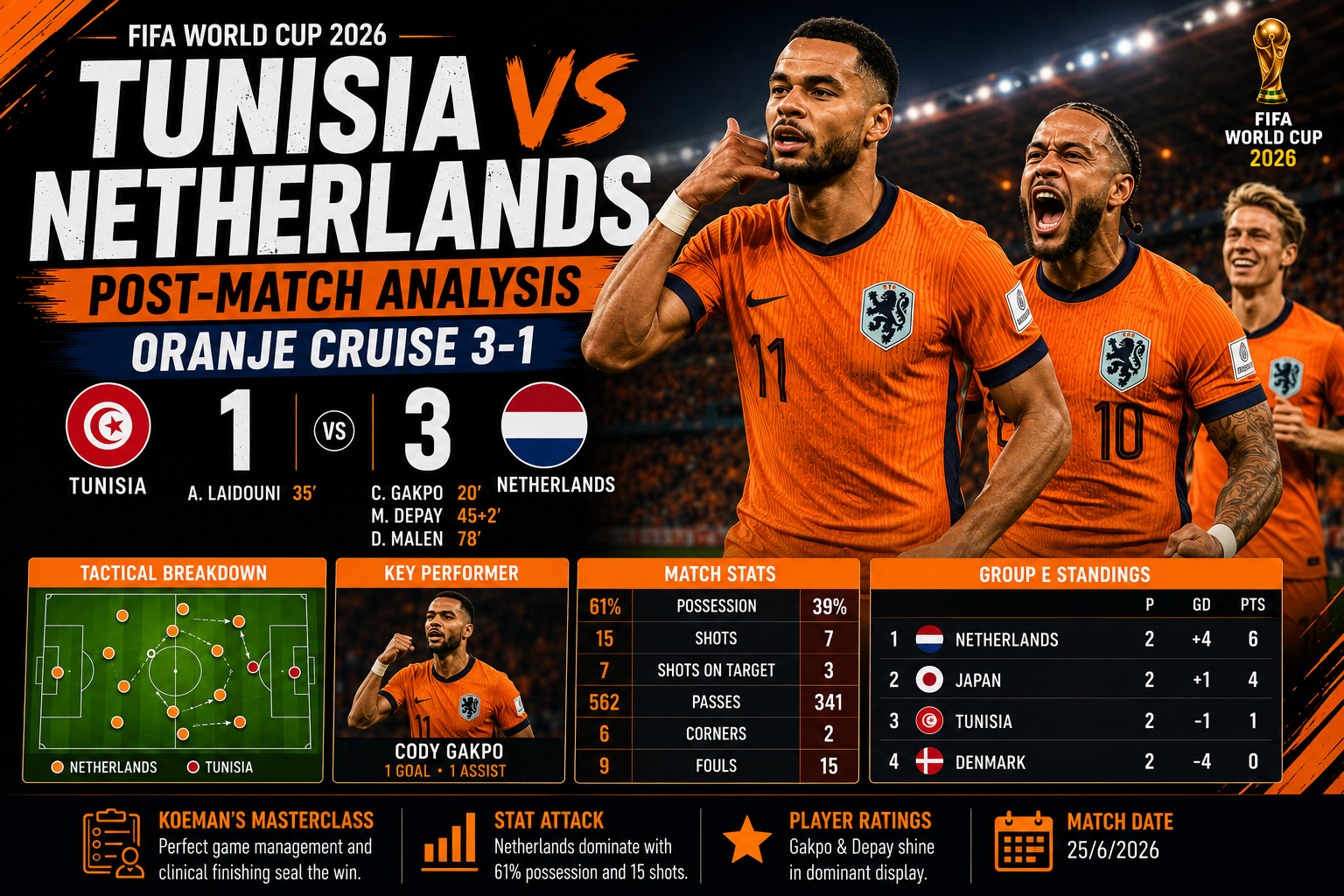
The script seemed almost pre-written under the stormy skies of Kansas City Stadium, but the tactical execution on the pitch was a modern masterclass. Ronald Koeman’s Netherlands officially secured the top spot in Group F of the FIFA World Cup 2026 with a highly convincing 3-1 dismantling of an embattled Tunisia side. Entering the final group-stage matchday level on points with Japan, the Oranje needed not just a victory, but an authoritative performance to cement their status as genuine tournament favorites and avoid a nightmare Round of 32 clash against Brazil.
They delivered exactly that. While Tunisia showed flashes of fighting spirit under newly appointed veteran coach Hervé Renard, their defensive vulnerabilities during rapid transitions proved terminal. Led by fluid structural rotations, a commanding midfield performance, and relentless attacking tempo, the Dutch comfortably booked their progression to the knockout phase. For Tunisia, a chaotic and difficult group campaign draws to a close, leaving the Eagles of Carthage to reflect on structural shortcomings that left them exposed at the absolute highest level of global football.
Match Summary
- Final Score: Tunisia 1-3 Netherlands
- Tournament: FIFA World Cup 2026
- Group: F
- Match Venue: Kansas City Stadium (Arrowhead Stadium), Kansas City, Missouri, USA
The game unfolded as a narrative of immediate punishment and calculated control. Before the rainy conditions could even settle, the Netherlands found themselves two goals up within seven minutes. An early own goal from Tunisia captain Ellyes Skhiri was swiftly followed by a clinical strike from Brian Brobbey.
Tunisia responded with a wave of emotional energy early in the second half, pulling a goal back via a bullet header from debutant Hazem Mastouri. However, any potential jitters inside the stadium were put to bed just eight minutes later when Jan Paul van Hecke registered his first international goal to restore the two-goal cushion, allowing the Dutch to cruise across the finish line with tactical maturity.
First-Half Analysis
The match began with a chaotic sequence that foreshadowed the tactical disparity between the two sides. Within the opening 120 seconds, Tunisia arguably should have taken a shock lead. Ismaël Gharbi found himself with space inside the penalty area following a loose ball, but he rushed his effort and fired over the crossbar from close range.
The miss proved fatal. Merely a minute later, the Netherlands illustrated their ruthless transitional threat. Denzel Dumfries found space on the right flank following a crisp vertical sequence and drilled a dangerous, low cross into the six-yard box. In an absolute nightmare scenario for the North Africans, Tunisian captain Ellyes Skhiri attempted to clear the danger but inadvertently sliced the ball into his own net.
Before Tunisia could regroup, Ronald Koeman’s side struck again in the 7th minute. After winning a free kick roughly 25 yards out, Tijjani Reijnders delivered an inviting cross into the box. Virgil van Dijk used his imposing physical frame to head the ball across the face of goal, where the predatory Brian Brobbey was perfectly placed to chip a finish past a stranded Aymen Dahmen.
Second-Half Analysis
Hervé Renard clearly used the halftime interval to instill a direct tactical blueprint. Tunisia emerged with vastly superior structural aggression, deploying a much higher mid-block to contest the second balls that they had surrendered so easily in the first half.
The tactical shift bore fruit in the 54th minute. Following an aggressive sequence down the left flank, Tunisia earned a corner kick. Burnley’s Hannibal Mejbri whipped a magnificent, bending delivery toward the near post. Hazem Mastouri timed his vertical leap to perfection, rising above the Dutch zonal marking scheme to power a majestic header beyond Bart Verbruggen. The goal breathed instant life into the African side, sending a wave of belief through their dugout.
However, elite tournament contenders are defined by how they manage adversity. Instead of panicking, the Netherlands immediately went through the gears, reclaiming possession and utilizing their high-pressing structure to force multiple turnover mistakes.
Tactical Breakdown
Netherlands’ Attacking Structure and Positional Rotations
Ronald Koeman set up the Oranje in a highly fluid 4-3-3 formation that functioned closer to a 3-2-4-1 in possession.
- Midfield Control and Tempo: Xavi Simons and Tijjani Reijnders operated as dual advanced playmakers in the half-spaces. Their ability to read spaces between Tunisia’s midfield bank of three ensured the Dutch always had an open vertical passing lane.
- Cody Gakpo’s Dynamic Movement: While starting on the left wing, Gakpo spent large portions of the match drifting centrally. This movement drew Yan Valery inside, leaving a massive vacancy for Nathan Aké to exploit via late overlapping runs.
- High Pressing and Ball Recovery: The moment possession was surrendered, Ryan Gravenberch and Frenkie de Jong locked down the central channels, executing a highly efficient counter-press that choked Tunisian counter-attacks before they could develop past the halfway line.
Where Tunisia Struggled
Tunisia’s tactical undoing came down to structural organization during defensive transitions.
- Defensive Fragmentation: Operating with a back five requires impeccable horizontal communication. On both early goals, the gaps between Montassar Talbi and his wing-backs were far too wide, allowing Dumfries and Gakpo to penetrate at will.
- Midfield Desynchronization: Skhiri and Hannibal worked tirelessly, but they were regularly pulled out of position by the fluid drop-ins of Xavi Simons, leaving huge expanses of space directly in front of their penalty area.
- Lack of Direct Final-Third Quality: While Mastouri provided a stellar physical presence up front, Tunisia’s attacking patterns were overly reliant on isolated individual actions from wide areas rather than cohesive combinational play.
Player Ratings and Performance Analysis
Netherlands
- Cody Gakpo (8.5/10): A masterful display of attacking variation. While he didn’t get on the scoresheet, his progressive carries and off-the-ball runs unzipped the Tunisian low block repeatedly.
- Xavi Simons (8.0/10): Displayed spectacular spatial intelligence. He controlled the game tempo with absolute composure, identifying the exact moments to accelerate play.
- Brian Brobbey (8.0/10): A true number nine performance. He pinned his markers physically, linked up exceptionally well, and took his first-half goal with clinical precision.
- Jan Paul van Hecke (7.5/10): Stood tall defensively against Schick-style physical forwards and capped off a highly composed performance with his maiden international goal.
Tunisia
- Hazem Mastouri (7.5/10): The lone bright spot for the Eagles of Carthage. Scoring a bullet header on his World Cup debut against Virgil van Dijk is a milestone he will never forget.
- Hannibal Mejbri (6.5/10): Displayed immense heart and combativeness in the engine room, providing a world-class assist from a corner kick.
- Ellyes Skhiri (5.0/10): A heartbreaking afternoon for the captain. The early own goal shook his confidence, and he struggled to handle the positional rotations of the Dutch midfield.
Turning Point of the Match
While the two early goals set the baseline, the true turning point occurred in the 62nd minute. Tunisia had completely altered the psychological momentum of the stadium following Mastouri’s header and were actively pressing for a dramatic equalizer.
Van Hecke’s thunderous header from a set-piece just eight minutes later completely snapped Tunisia’s structural resistance. It served as a tactical reminder of the Netherlands’ capacity to go through the gears at a moment’s notice, effectively killing off the contest and shifting the match into total game management for Ronald Koeman.
FAQs
1. What was the final score of Tunisia vs Netherlands?
The Netherlands defeated Tunisia 3-1 to secure the top spot in Group F at the FIFA World Cup 2026.
2. Who scored the goals in the match?
For the Netherlands, the goals came via a 3rd-minute own goal by Ellyes Skhiri, a 7th-minute strike from Brian Brobbey, and a 62nd-minute header from Jan Paul van Hecke. Tunisia’s lone goal was scored by Hazem Mastouri in the 54th minute.
3. Who will the Netherlands face in the Round of 32?
By finishing first in Group F with seven points, the Netherlands have booked a highly anticipated knockout round date against Group C runners-up Morocco in Guadalajara.
4. Who was named Player of the Match?
While forward Brian Brobbey and midfielder Tijjani Reijnders delivered stellar performances, winger Cody Gakpo was widely praised by tactical analysts for his flawless positional rotations and progressive passing lines.
5. What does this result mean for Tunisia?
Tunisia finishes fourth in Group F with 1 point, officially exiting the FIFA World Cup 2026. They will return home to focus on tactical rebuilding under coach Hervé Renard.
Conclusion
Ultimately, June 25 belonged exclusively to the tactical sophistication of the Netherlands. Ronald Koeman has engineered an Oranje squad that balances classic Dutch total football with defensive steel. By locking down top spot in Group F with seven points, they have mapped out a fascinating Round of 32 clash against Morocco in Guadalajara. For Tunisia, a winless World Cup campaign draws to a close, but the emergence of debutant goalscorer Hazem Mastouri offers a foundational stone for the future of Tunisian football under Hervé Renard.