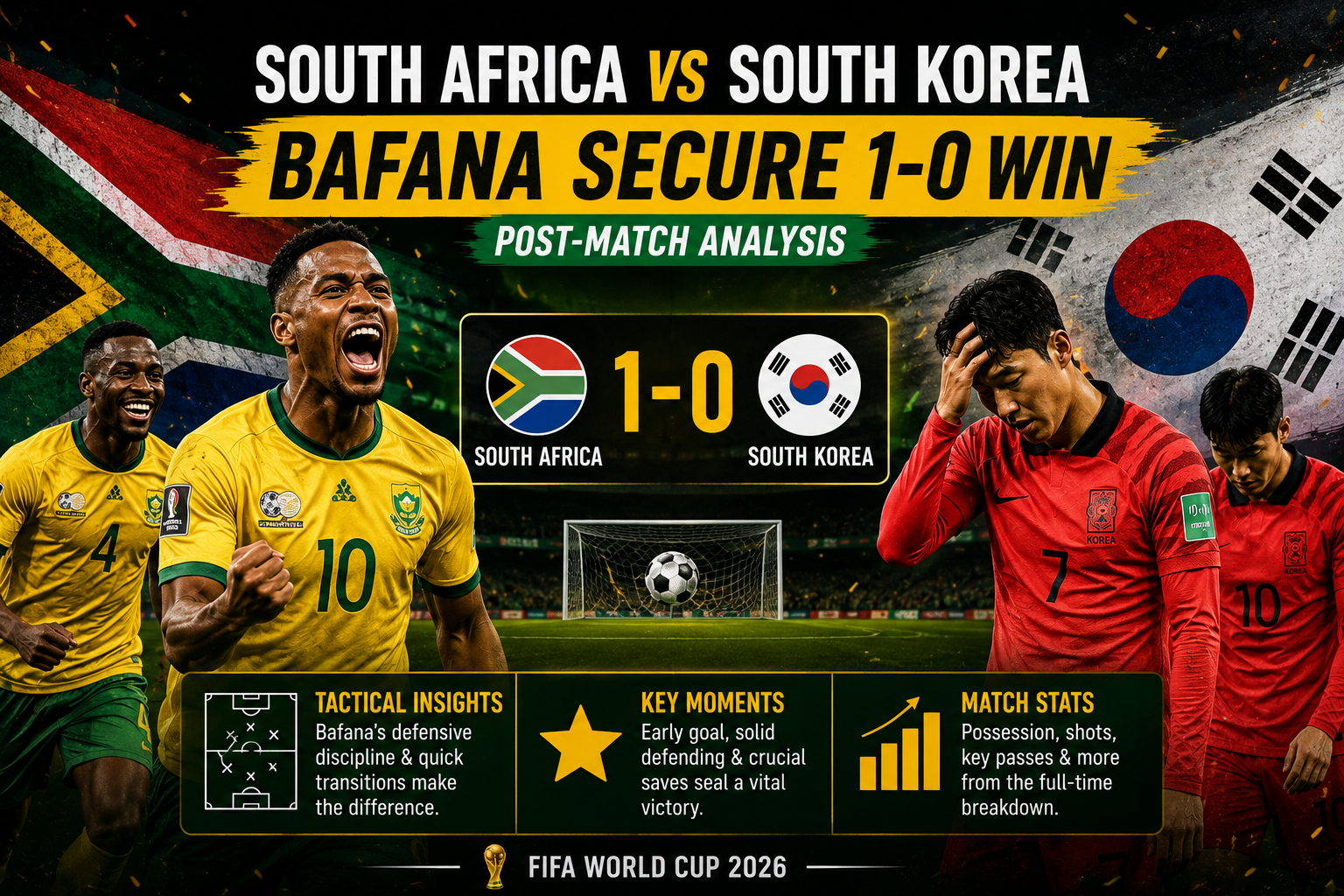
South Africa vs South Korea: Bafana Secure 1-0 Win
Introduction
The group stage of the FIFA World Cup 2026 has thrown up its fair share of high-stakes drama, but few encounters matched the sheer narrative weight and tactical intensity of the Group A finale between South Africa and South Korea. Convening at a sweltering Monterrey Stadium, both nations walked onto the pitch knowing that their tournament destinies rested on a knife-edge. For South Africa, a nation that had never crossed the threshold of the group stage in their previous three World Cup appearances, history beckoned. For South Korea, a seasoned knockout-stage regular, the pressure to assert their continental pedigree was immense.
When the final whistle blew, it was Hugo Broos’s resilient Bafana Bafana side that wheeled away in rapturous celebration, having locked down a grueling, hard-fought 1-0 victory. This triumph stands as a historic milestone for South African football, catapulting them into the Round of 32 for the very first time. The match was defined by a classic clash of tournament ideologies: South Korea’s patient, possession-heavy dominance met with South Africa’s impeccably drilled low block and lightning-fast transitional threat.
Match Summary
- Final Score: South Africa 1-0 South Korea
- Tournament: FIFA World Cup 2026
- Group: A
- Match Date: June 24, 2026
- Venue: Monterrey Stadium (Estadio BBVA), Guadalupe, Mexico
The match was a masterclass in modern tournament pragmatism. South Korea assumed immediate territorial control, enjoying the lion’s share of possession right from the opening kickoff. The Asian giants created high-quality openings in the opening stages, testing the structural resolve of the South African backline almost immediately.
However, South Africa gradually found their footing, absorbing waves of Korean pressure before launching lethal, vertical counter-attacks. After a tense, tactical stalemate in the opening 45 minutes, the defining moment materialized just after the hour mark. Winger Thapelo Maseko produced a moment of pure magic to break the deadlock. Despite a late, multi-pronged attacking onslaught from a star-studded South Korean side, Bafana Bafana displayed immense defensive grit to preserve their clean sheet and secure passage to the knockout phases.
First-Half Analysis
The opening exchanges belonged firmly to South Korea, who emerged from the tunnel with clear intentions of overloading the wide channels. Operating under the tactical instruction of manager Hong Myung-bo, the Taegeuk Warriors nearly opened the scoring in just the second minute of play. Following a beautifully whipped corner delivery, Bayern Munich’s world-class defender Kim Min-jae unleashed a powerful, towering header that beat goalkeeper Ronwen Williams. Just as the Korean contingent prepared to celebrate, South African left-back Aubrey Modiba showcased phenomenal defensive anticipation, executing a heroic, goal-line clearance to keep the score level.
Sensing vulnerability, South Korea sustained their high-pressing trap, and moments later, Paris Saint-Germain playmaker Lee Kang-in found a pocket of space inside the penalty box, only to slice his effort narrowly over the crossbar. South Africa, operating in a highly disciplined out-of-possession 4-2-3-1 that regularly flattened into a deeply compact 4-5-1, weathered this initial storm with immense maturity.
As the first half progressed, Bafana Bafana began to decipher South Korea’s pressing triggers. In the 19th minute, a rapid transitional sequence saw Thapelo Maseko race clean through on a defense-splitting pass.
Second-Half Analysis
Recognizing his team’s glaring lack of inspiration in the final third, Hong Myung-bo made a massive statement at the interval, introducing talismanic captain Son Heung-min alongside Kim Jin-Kyu and Jens Castrop. The arrival of the Tottenham Hotspur forward immediately shifted the gravity of the match, forcing South Africa’s defensive line deeper to account for his electric movement in behind.
Yet, despite South Korea monopolizing up to 70% of the ball, it was South Africa who struck the decisive blow in the 63rd minute. After structural patient defending, Bafana Bafana transitioned with breathtaking vertical efficiency. Tshepang Moremi, who had replaced Oswin Appollis just moments prior, found a pocket of space in the half-space and slipped a perfectly weighted, rolling pass into the path of Maseko. The Mamelodi Sundowns winger showcased world-class technical composure, shifting the ball onto his preferred left foot, bypassing his marker, and drilling a devastatingly low finish into the bottom right-hand corner.
The goal completely altered the tactical ecosystem of the stadium. Forced to throw caution to the wind, South Korea loaded the penalty box, introducing Cho Gue-sung to establish a physical aerial presence. What followed was a 20-minute defensive blockade from South Africa that Hugo Broos later described as “heart-stopping.” Son Heung-min tested Ronwen Williams with a curling, left-footed effort from the edge of the box in the 88th minute, but the Bafana Bafana captain tipped it around the post with authoritative execution.
Tactical Breakdown
South Africa’s Winning Strategy
Hugo Broos engineered a tactical blueprint centered on structural discipline, horizontal compression, and exploiting the space behind an advancing Korean defensive line.
- Low-Block Perfection: Bafana Bafana maintained a strict distance between their defensive and midfield lines, completely eliminating the pockets of space that players like Lee Kang-in love to exploit.
- Flawless Counter-Press Prevention: Sithole and Mbatha acted as absolute warriors in the engine room. Instead of attempting high-risk short passes under pressure, they played vertically into the channels, shifting the physical burden onto the Korean defenders.
- Clinical Transitional Execution: Broos utilized his substitutes perfectly. The introduction of Moremi provided the exact fresh leg needed to exploit a tiring Korean transition, directly yielding the match-winning assist.
South Korea’s Challenges
Despite boasting some of the most recognizable names in global football, South Korea fell victim to predictable positional structures and systemic inefficiencies.
- Attacking Predictability: South Korea moved the ball with immense technical accuracy but completely lacked vertical variation. Their possession was largely academic, moving sideways across the face of South Africa’s compact block without pulling defenders out of position.
- The Son Heung-min Paradox: Leaving Son on the bench in the first half was designed to exploit a tiring South African defense. However, it allowed Bafana Bafana to settle into an unbreakable defensive rhythm without having to worry about an elite threat in the opening stanza.
- Defensive Transition Vulnerability: While building with a high line, Korea’s central defenders were repeatedly left isolated against the sheer pace of Maseko and Makgopa, a flaw that ultimately decided the outcome.
Key Turning Points
- Modiba’s 2nd-Minute Clearance: Conceding a goal within 120 seconds would have forced South Africa out of their compact shell. Modiba’s goal-line intervention kept the foundational game plan alive.
- The Introduction of Tshepang Moremi: Replacing Appollis in the 61st minute, Moremi’s very first major involvement was the micro-engineered assist that sliced open the Korean defense for Maseko’s goal.
- Williams’s 88th-Minute Save: Son Heung-min’s late, viciously curling effort looked destined for the top corner. Williams’s fingertip deflection preserved the clean sheet and avoided a heartbreaking late equalizer.
Standout Performers
South Africa
- Thapelo Maseko: The undeniable hero of the nation. Beyond his brilliantly executed goal, his explosive acceleration and ball retention pinned South Korea’s full-backs deep, offering his defense vital breathing room.
- Aubrey Modiba: A flawless defensive display. His match-saving clearance in the opening moments set the tone for a gritty performance, punctuated by disciplined tracking of Lee Kang-in.
- Ronwen Williams: Captained his side with ultimate authority, organizing his backline through relentless communication and pulling off a world-class save to deny Son late on.
South Korea
- Kim Min-jae: Despite the defeat, the imposing center-back won the vast majority of his individual duels, launching several attacks from deep and threatening constantly on set-pieces.
- Lee Kang-in: The only real source of creative spark for the Taegeuk Warriors in the first half, continually trying to find vertical passing angles against a crowded midfield.
Match Statistics Analysis
| Match Statistic | South Africa | South Korea |
| Possession | 31% | 69% |
| Shots (Total) | 13 | 11 |
| Shots on Target | 5 | 3 |
| Corners | 4 | 6 |
| Passing Accuracy | 74% | 89% |
| Fouls Committed | 7 | 9 |
The numbers display a compelling narrative of clinical efficiency versus territorial dominance. South Korea’s $69\%$ possession and high $89\%$ passing accuracy paint a picture of a team that controlled the geography of the pitch. However, South Africa actually outshot their opponents 13 to 11 and registered 5 shots on target compared to Korea’s 3. This illustrates that while South Korea held the ball, South Africa created significantly cleaner, higher-probability opportunities on the counter-attack, rendering Korea’s possession largely ineffective.
Expert Verdict
The 1-0 scoreline was a completely fair and accurate reflection of the tactical battle executed in Monterrey. South Korea possessed elite individual talent, but football is fundamentally an exercise in spatial control and execution. South Africa defined the spaces where the match would be contested, restricted South Korea to speculative options, and executed their singular golden opportunity with world-class precision. Bafana Bafana thoroughly deserved their history-making afternoon.
Key Lessons from the Match
- Possession Without Penetration is Hollow: Dominating the ball means nothing if it is circulated exclusively in safe, non-threatening horizontal areas.
- Defensive Discipline Wins Tournaments: A perfectly synchronized back four can bridge massive gaps in individual transfer value or club pedigree.
- The Value of In-Game Freshness: Substitutes must enter the match with explicit tactical briefs; Moremi’s instant spatial awareness proved to be the literal key that unlocked the match.
FAQ
1. What was the final score of South Africa vs South Korea?
South Africa defeated South Korea 1-0 in their final Group A match of the FIFA World Cup 2026.
2. Who scored the winning goal?
The match-winning goal was scored by Mamelodi Sundowns winger Thapelo Maseko in the 63rd minute, assisted by substitute Tshepang Moremi.
3. How does the result affect Group A?
South Africa finishes second in Group A with 4 points and automatically qualifies for the Round of 32. South Korea finishes third with 3 points and must wait for other group results to determine if they qualify as a wild card.
4. Who was the Player of the Match?
Thapelo Maseko was awarded Player of the Match honors for his blistering display on the flank and his clinical, history-making goal.
5. What are the next fixtures for South Africa and South Korea?
South Africa will face Canada in the Round of 32 in Los Angeles on June 28, 2026. South Korea’s next fixture is entirely dependent on whether they advance via the tournament’s third-place wild-card rankings.
Final Thoughts
June 24, 2026, will forever remain etched in the folklore of South African sport. Anchored by the tactical resilience of Hugo Broos, the leadership of Ronwen Williams, and the clinical boot of Thapelo Maseko, Bafana Bafana proved that heart, structure, and execution can move mountains on the grandest stage of them all.