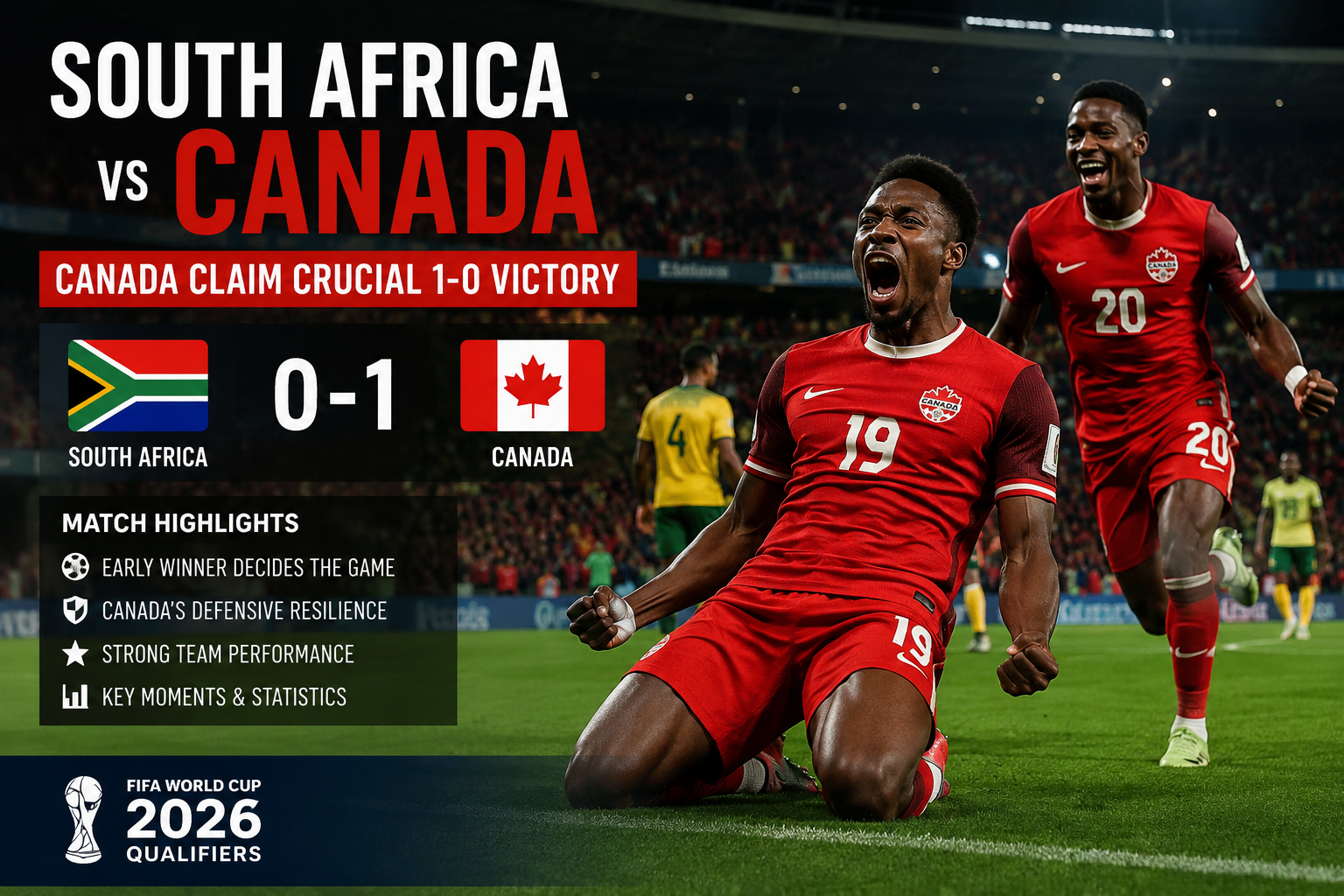
South Africa vs Canada: Canada Claim Crucial 1-0 Victory
Introduction
The knockout rounds of the 2026 FIFA World Cup commenced with an absolute pressure cooker of a match at the Los Angeles Stadium. In a tournament defined by shifting paradigms and historic breakthroughs, the Round of 32 clash between South Africa and Canada delivered a tactical chess match of extraordinary intensity. Ultimately, it was a 92nd-minute moment of pure technical execution from midfield general Stephen Eustaquio that broke South African hearts and sealed a dramatic 1-0 victory for the North American co-hosts.
With this triumph, Canada advances to the Round of 16 for the first time in their history, setting up a tantalizing clash against either the Netherlands or Morocco in Houston. For South Africa, the defeat marked the end of an extraordinary journey that captured the hearts of neutrals, having reached the knockout phase of a World Cup for the very first time.
Match Overview
- Final Score: South Africa 0-1 Canada
- Tournament: FIFA World Cup 2026 (Round of 32)
- Match Date: Sunday, June 28, 2026
- Kickoff Time (Local Time): 12:00 PM PT
- Kickoff Time (Indian Standard Time – IST): Monday, June 29, 2026, at 12:30 AM IST
- Venue: Los Angeles Stadium, Inglewood, California
- Attendance: 70,000 (Capacity Crowd)
The match opened under the bright California sun with Canada immediately seizing the initiative. Bafana Bafana were more than content to allow the Canadians comfortable possession inside their own half, dropping into an incredibly compact 4-5-1 defensive shape. The first half unfolded as a systematic siege, with Canada knocking repeatedly at the door. Moïse Bombito, returning to the starting lineup to shore up the backline, saw a towering header cleared off the goal line, while Tajon Buchanan was denied from close range by the heroic reflex saves of Ronwen Williams.
As the second half progressed, tension swelled inside the stadium. Canada controlled territory, but their build-up frequently lacked the requisite quickness to shift South Africa’s horizontal lines. A series of desperate clearances and last-ditch blocks kept the game on a knife-edge. Just as extra time felt like an inevitability, a bouncing ball fell to Eustaquio on the edge of the 18-yard box. His crisp, low half-volley found the bottom corner, evading the fingertip stretch of Williams and settling a historic contest.
First-Half Analysis
The early tactical battle was defined by structural rigidity from South Africa and high-energy geometric rotations from Canada. Jesse Marsch opted for a modified 4-2-3-1 setup that frequently transformed into a 4-2-4 in possession. With Alphonso Davies fit enough only for the bench, Richie Laryea and Alistair Johnston were tasked with holding the width. Tajon Buchanan moved inside from the right wing to partner Tani Oluwaseyi and Jonathan David in an aggressive central press designed to trap South Africa during their rare attempts to build out from the back.
Hugo Broos countered with a deeply disciplined 4-5-1 or a compact 4-1-4-1, relying on Teboho Mokoena to shield the center-backs. South Africa’s pressing system was purely passive and position-oriented; they compressed the space between their defensive and midfield lines to less than 15 meters.Despite Canada commanding over 64% of first-half possession, South Africa’s transitional threat kept the co-hosts honest.
Canada’s best opportunities arrived right on the cusp of halftime. A well-worked corner routine found Bombito, whose downward header beat Williams but was sensationally hooked off the line by Aubrey Modiba. Seconds later, a ricochet fell to Buchanan six yards out, but Williams threw his torso in front of the ball to make a magnificent block. Canada appealed vehemently for a penalty when Laryea went down under pressure from Khuliso Mudau, but a swift VAR review confirmed no clear and obvious error, preserving the 0-0 deadlock at the interval.
Second-Half Analysis
The second half resumed with an identical structural pattern, though Canada played with a heightened sense of urgency. Marsch adjusted his team’s build-up, instructing Eustaquio to drop deeper between the center-backs to create a back-three mutation, which allowed both full-backs to push high simultaneously. This tactical adjustment pinned South Africa even deeper into their own box, transforming the match into a game of attack versus defense.
Realizing his team was beginning to look predictable, Marsch made the defining gamble of the match in the 75th minute. Amid a deafening roar from the 70,000 fans, Alphonso Davies entered the pitch.
As five minutes of stoppage time were flashed, South Africa appeared to be successfully shepherding the game toward extra time. However, in the 92nd minute, a cleared Canadian cross was recycled to the edge of the area. Eustaquio arrived completely unmarked, meeting the bouncing ball with a perfectly controlled technical strike that nested into the bottom-right corner. Forced to abandon their low block, South Africa threw numbers forward in a frantic final two minutes, but Canada managed the closing moments with maturity to see out the win.
Tactical Breakdown
Canada’s Tactical Performance
Jesse Marsch’s tactical blueprint relied on sustained counter-pressing and overload principles out wide. Without Ismaël Koné, Canada’s build-up lacked its usual vertical punch through the center, prompting Marsch to emphasize wide overloads via Richie Laryea and Tajon Buchanan.
- Build-up Play: Canada utilized a 2-4-4 structural shape during initial phases, with Eustaquio orchestrating tempos. When South Africa refused to press, Canada struggled to break the first line at pace, often reverting to safe lateral recycling.
- Midfield Control: Eustaquio and Saliba functioned brilliantly as a double-pivot. They completely suppressed South Africa’s transition opportunities by maintaining a high rest-defense posture, suffocating any potential counter-attacks at source.
- The Alphonso Davies Factor: The introduction of Davies completely transformed Canada’s attacking variance. By threatening the outside shoulder of Mudau, Davies pinned the South African defensive line back, creating a pocket of space on the edge of the box that Eustaquio eventually exploited for the winner.
South Africa’s Tactical Performance
Hugo Broos implemented a masterclass in defensive containment. Knowing that matching Canada’s athletic profile in an open-ended game would be suicidal, Bafana Bafana chose a passive defensive strategy that was executed with absolute military discipline.
- Defensive Low Block: Siyabonga Ngezana and Nkosinathi Sibisi formed an unyielding wall in central defense, constantly supported by Mokoena dropping deep. They restricted Canada to low-value shots from distance for the majority of the match.
- The Low-Block Conundrum: While the defensive setup was nearly flawless, it completely neutered South Africa’s attacking capacity. Lyle Foster was completely isolated against Bombito and Cornelius, meaning Bafana Bafana lacked the ability to relieve sustained pressure.
- Areas for Improvement: When defending deep for 90 minutes, a single structural lapse can prove fatal. In the 92nd minute, the midfield line failed to pull back fast enough to cover the zone-14 edge of the box, giving Eustaquio the pocket of space he needed to deliver the decisive blow.
Key Turning Points
1. The Halftime Double-Save and Goal-Line Clearance
In the 44th minute, Canada looked certain to break the deadlock. Moïse Bombito’s powerful header off a corner eluded Ronwen Williams but was cleared off the line by Aubrey Modiba’s outstanding reading of the game. The rebound fell directly to Tajon Buchanan, whose point-blank shot was brilliantly blocked by Williams’ chest. Keeping the score at 0-0 heading into the interval gave South Africa the psychological belief needed to sustain their defensive effort deep into the second half.
2. The 75th-Minute Substitution of Alphonso Davies
With Canada’s attack stalling against South Africa’s low block, Marsch introduced captain Alphonso Davies for his tournament debut. Having missed the group stage through injury, Davies brought an immediate psychological boost to his teammates and shifted the tactical balance, forcing South Africa to expand their defensive shape.
3. Eustaquio’s Stoppage-Time Masterpiece (92nd Minute)
The defining moment of the match arrived deep in stoppage time. A semi-cleared cross bounced to the edge of the box. Stephen Eustaquio didn’t rush the opportunity; he kept his composure, adjusted his body shape, and struck a crisp half-volley into the bottom corner, completely bypassing a crowded penalty box and breaking South Africa’s resistance.
Standout Performers
Canada
- Stephen Eustaquio (Midfielder): The undisputed Player of the Match. Beyond his historic winning goal, the captain completed 91% of his passes, recovered possession eight times, and completely dictated the tempo of the match.
- Moïse Bombito (Center-Back): Returning to the starting XI, Bombito provided immense athletic coverage. He won all four of his aerial duels, completely neutraliszed Lyle Foster, and was a constant threat on set-pieces.
- Alphonso Davies (Full-Back/Winger): In just 15 minutes of action, Davies completely altered the tactical landscape of the game with his gravity, acceleration, and direct dribbling.
South Africa
- Ronwen Williams (Goalkeeper): The South African skipper delivered an inspirational performance, making four high-caliber saves, including a remarkable double-intervention right before halftime.
- Aubrey Modiba (Left-Back): Modiba was spectacular defensively, registering a crucial goal-line clearance, four tackles, and keeping Canada’s right flank relatively quiet for most of the night.
- Mbekezeli Mbokazi (Defender): Coming off the bench, his last-ditch slide to deny Jonathan David from converting a tap-in was one of the finest defensive highlights of the entire tournament.
Match Statistics Analysis
| Statistic | South Africa | Canada |
| Possession | 35% | 65% |
| Total Shots | 4 | 14 |
| Shots on Target | 1 | 5 |
| Expected Goals (xG) | 0.28 | 1.82 |
| Passing Accuracy | 74% | 89% |
| Corners | 2 | 8 |
| Fouls Committed | 12 | 9 |
| Yellow Cards | 2 | 1 |
The statistics paint an incredibly clear picture of a tactical siege. Canada’s 65% possession and 14 total shots highlight their territorial dominance, but the most telling metric is the expected goals (xG). Canada accumulated 1.82 xG, with the majority generated from high-value opportunities inside the penalty box, emphasizing that they eventually found ways to breach South Africa’s rigid defensive structure.
South Africa’s low xG of 0.28 highlights their struggle to establish any meaningful attacking transitions. They prioritized defensive solidity over offensive ambition, a gamble that came within three minutes of forcing extra time. Canada’s superior passing accuracy (89%) allowed them to maintain sustained pressure, gradually wearing down Bafana Bafana’s physical reserves.
Key Lessons
- Patience Wins Tournament Knockouts: Canada proved they can win ugly. They avoided forcing dangerous vertical passes into crowded areas, trusting their positional structure until the opening arrived.
- Attacking Outlets Are Essential: South Africa’s complete lack of a secondary transition threat allowed Canada’s center-backs to step deep into the midfield, creating an overwhelming territorial advantage.
- Squad Depth Is Everything: Having a world-class player like Alphonso Davies available to break open a tired defense is a luxury that separates true contenders from dark horses in the later stages of the World Cup.
FAQ
1. What was the final score of South Africa vs Canada?
Canada defeated South Africa 1-0 in the Round of 32 at the 2026 FIFA World Cup.
2. Who scored the winning goal?
Stephen Eustaquio scored the decisive winning goal in the 92nd minute of stoppage time.
3. Who won Player of the Match?
Canadian captain Stephen Eustaquio was named the Player of the Match for his outstanding midfield performance and game-winning goal.
4. What was the kickoff time in India (IST)?
The match kicked off on Monday, June 29, 2026, at 12:30 AM Indian Standard Time (IST).
5. How does this result affect the FIFA World Cup 2026 standings?
Canada eliminated South Africa to advance to the Round of 16, where they will face either the Netherlands or Morocco in Houston.
Final Thoughts
Stephen Eustaquio’s dramatic strike did more than just win a football match; it validated Canada’s arrival as a legitimate force on the international stage. Winning a tight, high-stakes knockout match at a home World Cup requires tactical discipline and immense character. As Jesse Marsch and his team head to Houston, this Canadian squad has shown it has the grit, depth, and resilience to compete with the very best.