Senegal vs Iraq: Senegal Cruise to Dominant 5-0 Victory
Introduction
The final matchday of the group stage delivered history, tactical theater, and a masterclass in attacking efficiency as Senegal dismantled Iraq 5-0 at Toronto Stadium. For the Lions of Teranga, this was far more than a routine victory; it was a high-stakes rescue mission. Having suffered consecutive defeats to France and Norway in their opening fixtures, Senegal entered this encounter knowing that only a commanding, high-margin win would give them a fighting chance of advancing as one of the best third-placed teams. They understood the assignment perfectly, delivering the largest-ever winning margin by an African nation in the history of the FIFA World Cup.
The primary talking point of this encounter was the stark contrast between a tense, structurally rigid first half and an explosive, liquid-fluid second half. Senegal’s tactical coach Pape Thiaw made bold squad choices that initially met a stubborn Iraqi low block, but a critical red card inside the opening quarter-hour broke Iraq’s structural spine. While Iraq displayed immense defensive discipline to head into the interval trailing by just a single goal, the floodgates opened entirely after the restart. Fueled by a historic cameo from substitute Pape Gueye and the record-breaking exploits of Ismaïla Sarr, Senegal turned a stressful must-win game into a historic celebration. This spectacular 5-0 victory significantly boosts Senegal’s goal difference, completely altering the complex qualification matrix and keeping their World Cup dreams firmly alive.
Match Overview
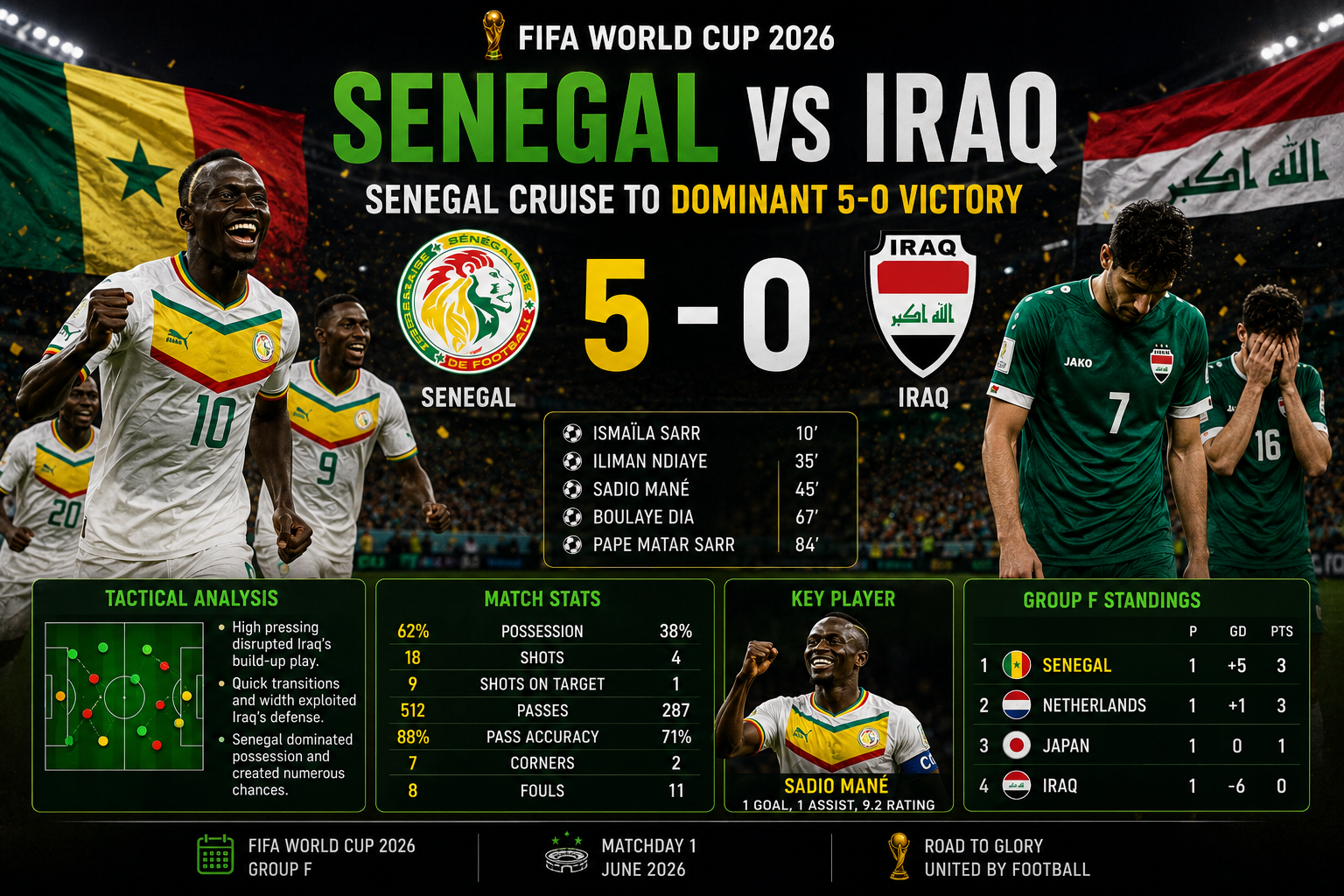
- Final Score: Senegal 5-0 Iraq
- Tournament: FIFA World Cup 2026
- Group: F
- Match Date: Friday, June 26, 2026
- Venue: Toronto Stadium, Toronto, Canada
- Referee: Anthony Taylor (England)
- Player of the Match: Ismaïla Sarr (Senegal)
The match began under intense atmospheric pressure, with both nations desperate for their first points of the tournament. Senegal’s intention was clear from the opening whistle: utilize their blistering wide pace to disrupt Iraq’s compact lines. An early goal within four minutes handed Senegal the dream start, but the game truly pivoted in the 13th minute when referee Anthony Taylor upgraded an initial caution to a straight red card for Iraq’s central defender Rebin Sulaka following a VAR review.
First-Half Analysis
Pape Thiaw set up Senegal in a highly offensive 4-1-2-3 formation, designed to flood the half-spaces and create overloads on the flanks. Iraq, conversely, lined up in a disciplined 4-4-2 block under the guidance of their technical staff, attempting to deny central spaces to Sadio Mané and force Senegal into low-percentage crosses from deep.
Senegal’s tactical plan bore fruit almost immediately. In the 4th minute, the Lions of Teranga earned an early corner. Lamine Camara delivered a teasing, outswinging ball that was met by the towering Abdoulaye Seck. The defender’s powerful downward header took a sharp, decisive deflection off Sunderland midfielder Habib Diarra, completely wrong-footing Iraq’s starting goalkeeper Ahmed Basil to ripple the net.
With Iraq reduced to ten men, their manager immediately sacrificed attacker Ahmed Qasem to bring on central defender Manaf Younis to restore structural balance. Paradoxically, this card triggered a massive momentum shift. Iraq dropped into an ultra-dense 4-4-1 low block, clogging the penalty box. Senegal dominated possession, reaching nearly 70%, but their build-up play grew sluggish, predictable, and devoid of vertical tempo. Aside from a fierce Sadio Mané free-kick that was superbly tipped away by Ahmed Basil, Senegal failed to break through Iraq’s heroic defensive wall, heading into the locker rooms with a slender and unconvincing 1-0 advantage.
Second-Half Analysis
Recognizing the lack of penetration, Iraq made a proactive change at halftime, replacing goalkeeper Ahmed Basil with the experienced Jalal Hassan. Senegal, meanwhile, emerged with a renewed sense of urgency, moving the ball with much quicker lateral switches to stretch Iraq’s ten men.
The dam finally broke in the 56th minute due to severe structural fatigue from Iraq. Iraq tried to respond by refreshing their tired frontline, introducing Ali Yousif and Ahmed Maknzi, but Senegal’s midfield dominance was absolute. In the 71st minute, Pape Gueye turned provider to score once more. Collecting a bouncing layout from Iliman Ndiaye, Gueye struck a thunderous, 30-yard half-volley that clocked a staggering top speed of 132 kilometers per hour, leaving Jalal Hassan completely motionless as it tore into the back of the net.
The final gloss on a historic afternoon arrived in the 82nd minute. Everton’s Iliman Ndiaye picked up the ball out wide, danced past two exhausted Iraqi defenders, and curled a sublime, looping effort from an acute angle into the far corner, finalizing a flawless second-half performance.
Tactical Breakdown
Senegal’s Winning Blueprint
Senegal’s tactical layout shifted dynamically between a 4-1-2-3 and a 2-3-5 in possession, exploiting their numerical advantage through several key mechanisms:
- Asymmetric Flank Overloads: Krépin Diatta and Ismaïla Sarr consistently pinned Iraq’s left-back, creating a massive pocket of space for central midfielders to underlap into the penalty area.
- Aggressive Counter-Pressing: Led by Idrissa Gueye, Senegal suffocated Iraq’s transition options the second they lost the ball, limiting Iraq to speculative long clearances.
- Impactful Vertical Substitutions: The introduction of Pape Gueye and Iliman Ndiaye added dynamic ball-carrying ability and elite long-range shooting profiles that an exhausted, deep-set defensive block could not close down.
Iraq’s Tactical Performance
Iraq set up in a standard 4-4-2 structural block, but their blueprint was entirely derailed by the early red card. Their structural performance revealed clear tactical themes:
- Heroic Low-Block Resilience: In the first half, the backline shifted horizontally with exceptional discipline, effectively cutting off central passing lanes to Sadio Mané.
- Midfield Fatigue and Structural Collapse: Playing with ten men for over 75 minutes took a severe physical toll. By the 55th minute, the midfield line could no longer cover the lateral width of the pitch, leading directly to the turnover for Senegal’s second goal.
- Isolation of the Frontline: With Ali Al-Hamadi and Ali Jasim completely cut off from midfield support, Iraq lacked any operational outlet to hold up the ball and relieve defensive pressure.
Key Turning Points
- The 4th-Minute Opener: Habib Diarra’s heavily deflected goal broke Iraq’s pre-match tactical plan inside the opening moments, forcing them to chase the game earlier than expected.
- The 13th-Minute Red Card: Rebin Sulaka’s dismissal entirely transformed the landscape of the match. While it temporarily turned Iraq into a defensive fortress, it ultimately doomed them to a night of endless physical exertion.
- The 56th-Minute Sarr Goal: Breaking Iraq’s resistance ten minutes into the second half shattered the Asian nation’s morale. It forced them to abandon their low block, opening up the floodgates for Senegal’s clinical finishers.
- Pape Gueye’s 59th-Minute Screamer: Coming just 89 seconds after his substitution, this spectacular strike officially ended any faint hopes of an Iraqi comeback and unlocked Senegal’s absolute creative freedom.
Standout Performers
Senegal
- Ismaïla Sarr (9.5/10): A history-making performance. Sarr became the first-ever Senegalese player to both score and assist in a single World Cup match, while simultaneously becoming his nation’s outright top scorer in World Cup history with 4 goals. His movement out wide was world-class.
- Pape Gueye (9.5/10): One of the greatest substitute cameos in tournament history. Coming off the bench to score two world-class goals from long range—including a 132km/h half-volley—showed staggering technical quality.
- Iliman Ndiaye (9/10): Made history as the first substitute ever to score, assist, record five opposition-box touches, and complete five successful dribbles in a single World Cup match.
Iraq
- Jalal Hassan (6/10): Despite conceding four goals, the veteran substitute goalkeeper made three exceptional close-range saves to prevent an even heavier deficit.
- Amir Al-Ammari (6/10): Showed incredible resilience in the heart of midfield, covering an immense amount of ground to shield his depleted backline.
Match Statistics Analysis
| Statistic | Senegal | Iraq |
| Possession | 68% | 32% |
| Total Shots | 24 | 2 |
| Shots on Target | 11 | 0 |
| Passing Accuracy | 92% | 74% |
| Corners | 9 | 1 |
| Fouls Committed | 10 | 12 |
| Yellow Cards | 2 (Seck, P. Gueye) | 2 (Al-Ammari, Doski) |
| Red Cards | 0 | 1 (Rebin Sulaka) |
The statistics highlight a match defined by utter territorial and operational dominance. Senegal’s 68% possession and astonishing 92% passing accuracy underline how perfectly they controlled the tempo against ten men. Iraq was completely suffocated offensively, failing to register a single shot on target across the 90 minutes. Senegal’s 24 total shots reflected a relentless attacking intent that wore down Iraq’s defensive block until it completely fractured.
What This Result Means for Group F
This historic victory completely resuscitates Senegal’s 2026 World Cup campaign. Finishing their group campaign in third place with 3 points, the Lions of Teranga secured a positive +2 goal difference (conceding 4 across their first two matches and scoring 5 here). This massive goal-differential boost moved them to a strong position among the third-placed teams fighting for the final eight knockout spots in the Round of 32.
For Iraq, the defeat marks a tragic conclusion to their World Cup journey. Losing all three group matches with zero points, the Asian nation was officially eliminated from the tournament, extending their wait for their first-ever World Cup point since 1986.
Key Lessons from the Match
- Squad Depth Wins Tournaments: The fact that Senegal’s bench contributed three goals and two assists highlights the frightening depth available to Pape Thiaw.
- The Perils of Over-Indexing Central Blocks: Iraq’s low block held firm initially, but failing to contest the wide half-spaces allowed Senegal’s wingers to comfortably pick their targets.
- Clinical Execution Altering Group Metrics: In tournament football, you cannot take your foot off the gas. Senegal’s relentless hunt for a fourth and fifth goal demonstrated an elite tournament mentality that could save their World Cup.
FAQ Section
1. What was the final score of Senegal vs Iraq?
Senegal defeated Iraq 5-0 at the Toronto Stadium in Canada.
2. Who scored Senegal’s goals?
The goals were scored by Habib Diarra (4′), Ismaïla Sarr (56′), Pape Gueye (59′, 71′), and Iliman Ndiaye (82′).
3. Who won the Player of the Match award?
Ismaïla Sarr won the Player of the Match award after recording a historic goal and an assist.
4. How does this result affect Group F?
Senegal finished third in Group F with 3 points and a +2 goal difference, putting them in a prime position to qualify for the Round of 32. Iraq finishes fourth with 0 points and is eliminated.
5. What are the next matches for Senegal and Iraq?
Senegal awaits confirmation of their Round of 32 opponent depending on other group results, while Iraq has been eliminated from the tournament.
Final Thoughts
Senegal’s 5-0 thrashing of Iraq will be remembered as a historic milestone—the first time an African nation has ever scored five goals in a single FIFA World Cup match. It was an clinical demonstration of tactical patience and ruthless efficiency. While Iraq bowed out of the tournament with their heads held high after a brave first-half stand, Senegal proved to the world that when their attacking gears click into place, they remain an unmitigated force on the global stage.