Portugal vs DR Congo FIFA World Cup 2026: Tactical Preview
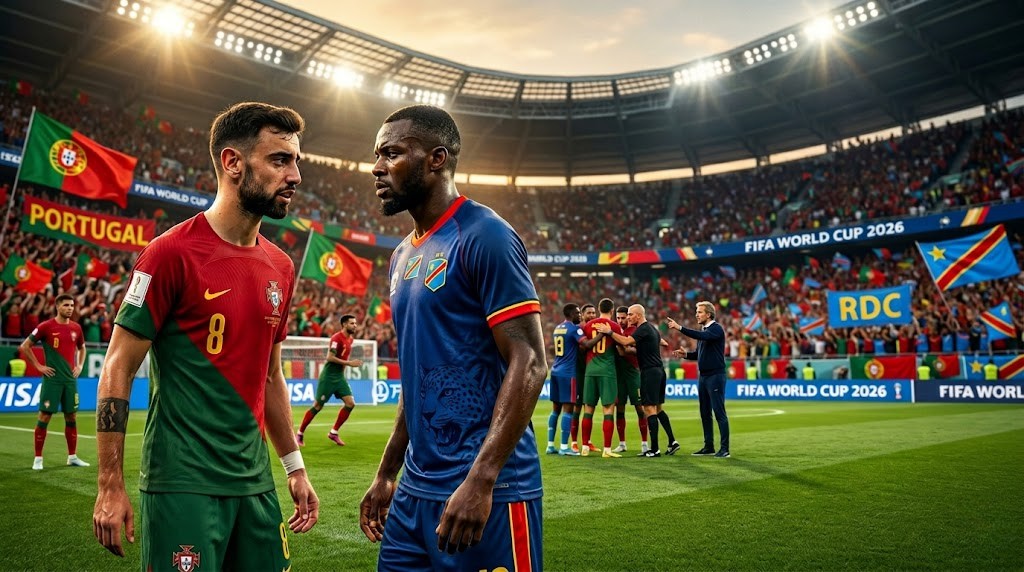
The opening match of Group K at the FIFA World Cup 2026 brings together two footballing narratives separated by experience but united by ambition. For the Portugal national football team, this tournament marks the beginning of what is widely expected to be the international swansong for their iconic 41-year-old captain, Cristiano Ronaldo, who is appearing in a historic sixth World Cup. Under the stewardship of Roberto Martínez, Portugal enters the competition as one of the definitive heavyweights, boasting a squad laden with elite European talent and aiming for nothing less than a deep run toward global glory.
In stark contrast, the DR Congo national football team arrives in Texas carrying the emotional weight of a 52-year World Cup absence. Having last graced the tournament in 1974 as Zaire, the Leopards have endured decades of near-misses before navigating a grueling qualification route that culminated in a dramatic play-off victory over Jamaica in Guadalajara.
Match Overview
| Match Parameter | Fixture Details |
| Tournament | FIFA World Cup 2026™ (Group Stage — Group K) |
| Matchup | Portugal vs. DR Congo |
| Date | Wednesday, June 17, 2026 |
| Kick-off Time | 12:00 PM Local (Houston) / 10:30 PM IST / 6:00 PM BST |
| Venue | Houston Stadium (NRG Stadium), Houston, Texas, USA |
| Broadcast Partners | FOX (US), beIN SPORTS (MENA), ZEE5 / Unite8 Sports (India) |
How the Tactical Battle Will Unfold
First Half: Positional Dominance vs. Low-Block Restraint
From the opening whistle, the tactical blueprint will be clearly defined by the contrasting philosophies of Roberto Martínez and Sébastien Desabre. Portugal is expected to establish immediate positional dominance, utilizing a fluid 4-3-3 or 3-4-2-1 structure designed to pin the Congolese defense deep inside their own half. The early attacking patterns will focus heavily on creating overloads in the wide areas, with Nuno Mendes pushing high down the left flank to drag DR Congo’s wide midfielders out of position.
Second Half: Momentum Swings and Substitution Strategies
As the match progresses, the physical toll of sustaining a low block in the Texas heat will test DR Congo’s structural integrity. If Portugal struggles to breach the Congolese line, Martínez will likely look to his bench, introducing high-impact wide options such as Pedro Neto or Francisco Conceição to inject raw pace and isolate tired full-backs in 1-on-1 situations.
Closing Stages: Late Drama and Defensive Resilience
The final fifteen minutes will demand maximum mental fortitude from both sides. If Portugal holds a narrow lead, their focus will shift to game management—using the technical security of Vitinha and João Neves to choke out the tempo and deny DR Congo any sight of the ball. Should the game remain deadlocked, expect DR Congo to play with increasing bravery, using set-pieces and long throw-ins to test a Portuguese central defense that is missing its primary organizer.
Portugal Performance
Attacking Structure & Possession Patterns
Portugal’s attacking identity under Roberto Martínez centers on structural fluidity and dominant possession phases. They consistently aim to choke opposition teams by maintaining an average possession share well north of 60%. The build-up play originates from deep, with goalkeeper Diogo Costa acting as an auxiliary playmaker, splitting the center-backs to create a clean passing diamond. Bruno Fernandes operates as the chief creative architect, floating freely between the lines to drag opposing defensive midfielders out of position and create pockets of space for inverted wingers.
Defensive Organization & The Rúben Dias Conundrum
While Portugal’s attacking wealth is undisputed, their defensive organization faces an immediate and severe test due to a significant pre-tournament setback. Manchester City’s world-class center-back Rúben Dias has been ruled out of this opening fixture after failing to recover from a heavy knock sustained in a recent warm-up match.
In his absence, the defensive responsibility falls on the young shoulders of Sporting CP’s Gonçalo Inácio and Benfica’s António Silva. While both possess exceptional technical ability and passing ranges, their lack of a seasoned partnership at the absolute highest level of international football represents a potential vulnerability against a physical, direct strike force.
DR Congo Performance & Tactical Analysis
Tactical Discipline & The Low-Block Shield
Sébastien Desabre has instilled a rigorous sense of tactical discipline within the Congolese squad. Recognizing the disparity in individual technical quality against European elite sides, the Leopards rely heavily on a highly organized 4-2-3-1 defensive shape. The backline boasts extensive English Premier League and top-flight European experience, with West Ham’s Aaron Wan-Bissaka and Burnley’s Axel Tuanzebe providing robust athleticism alongside Marseille captain Chancel Mbemba.
Counterattacking Threat & Verticality
DR Congo’s primary attacking weapon is their devastating vertical transition game. Rather than building patiently through short passes, they look to win the ball in their defensive third and immediately launch direct diagonal balls.
The tactical focal point of this system is Yoane Wissa. Operating either centrally or cutting in sharply from the left wing, Wissa’s electric pace and intelligent diagonal movements are specifically designed to catch out high-lined defenses. Supported by the veteran presence of Cédric Bakambu, DR Congo possesses the precise profile of attackers required to severely punish any lapses in Portugal’s makeshift central defense.
Key Tactical Matchups to Watch
Cristiano Ronaldo vs. Chancel Mbemba
At 41, Cristiano Ronaldo has evolved from an explosive, touchline-hugging winger into a hyper-clinical, positional number nine. He no longer seeks to beat three defenders on the dribble; instead, his elite movement within the penalty box remains unmatched. Tasked with neutralizing this constant threat is Chancel Mbemba. The Marseille defender is an aggressive, physically imposing center-back with exceptional aerial timing. If Mbemba can remain disciplined and avoid being dragged out of the penalty box by Ronaldo’s decoy runs, he can cut off Portugal’s primary goal route.
Yoane Wissa vs. Gonçalo Inácio
With Rúben Dias sidelined, Gonçalo Inácio must step up as the leader of the Portuguese defensive line. He will directly cross paths with Yoane Wissa, whose primary objective will be to isolate Inácio in open space during transition phases. If Inácio fails to read the triggers for DR Congo’s long balls, Wissa’s raw acceleration could force the young defender into desperate, card-inducing challenges.
Projected Lineups & Pre-Match Tactical Profiles
Portugal National Football Team (4-3-3)
- Diogo Costa (GK): Crucial for building out from the back; must remain alert to long-range sweeping situations.
- Diogo Dalot (RB): Expected to balance high overlapping runs with defensive duties against Wissa.
- Gonçalo Inácio (CB): Technical center-back stepping into a massive leadership role in Dias’ absence.
- António Silva (CB): Young, athletic defender who must match Bakambu’s physical presence.
- Nuno Mendes (LB): A vital attacking outlet destined to push high and create 2-on-1 wide overloads.
- João Neves (DM): The defensive anchor tasked with snuffing out Congolese transitions before they start.
- Vitinha (CM): The midfield engine responsible for retaining possession and controlling the tempo.
- Bruno Fernandes (AM): The primary creative force; must break the Congolese double pivot.
- Bernardo Silva (RW): Inverted playmaker who will drift inside to create numerical superiorities.
- Cristiano Ronaldo (ST): The clinical focal point hunting for space inside the 18-yard box.
- Rafael Leão (LW): Explosive wide threat eligible to start and look to beat Wan-Bissaka in 1-on-1s.
DR Congo National Football Team (4-2-3-1)
- Lionel Mpasi-Nzau (GK): Will face sustained pressure; command of his six-yard box is critical.
- Aaron Wan-Bissaka (RB): Elite 1-on-1 slide-tackling specialist tasked with stopping Rafael Leão.
- Chancel Mbemba (CB): The defensive bedrock and captain; must marshal the deep defensive line.
- Axel Tuanzebe (CB): Physical presence who must provide cover when Mbemba engages Ronaldo.
- Arthur Masuaku (LB): Experienced full-back who will face a heavy workload against Bernardo Silva.
- Noah Sadiki (DM): Youthful energy in midfield acting as a defensive shield to disrupt pass lanes.
- Samuel Moutoussamy (DM): The veteran partner in the pivot; crucial for second-ball recoveries.
- Nathanaël Mbuku (RW): Must track back diligently to help contain Nuno Mendes’ overlapping runs.
- Meschack Elia (AM): The central connector expected to trigger rapid counter-attacks.
- Yoane Wissa (LW): The primary dynamic attacking threat utilizing electric pace on the break.
- Cédric Bakambu (ST): Experienced forward tasked with holding up the ball to allow midfielders to join the rush.
Group K Context & Pre-Match Statistics
The historical data and recent form indicate a significant gulf between the two nations, further raising the stakes for this Group K opener.
Form and Rankings Comparison
- FIFA World Ranking: Portugal (5th) vs. DR Congo (45th).
- Head-to-Head History: This fixture represents the first-ever international football meeting between Portugal and DR Congo.
- Portugal Recent Form: Unbeaten across their final warm-up phase (WWDWW), concluding their preparations with clinical victories over Nigeria and Chile.
- DR Congo Recent Form: Exhibiting great defensive resilience but patchy offensive output, highlighted by a notable 0-0 draw against European opposition Denmark.
Technical Comparison Table
| Tactical Metric | Portugal National Team | DR Congo National Team |
| Primary Formation | 4-3-3 / 3-4-2-1 (Fluid) | 4-2-3-1 (Compact Low Block) |
| Key Tactical Strength | High-level positional overloads & chance creation | Rapid vertical transitions & athletic defense |
| Identified Weakness | Vulnerability to pace on counter-attacks without Dias | Limited depth to sustain 90 minutes of heavy pressure |
| Pressing Intensity | High counter-press in opposition third | Passive mid-to-low block pressing trigger |
Key Numbers at a Glance
- 52 Years: The length of time DR Congo has waited to return to a FIFA World Cup tournament.
- 6 World Cups: The historic milestone Cristiano Ronaldo achieves by stepping onto the pitch in Houston.
- 20 Goals: The ruthless attacking tally amassed by Portugal across their six primary qualification fixtures.
- 0 Previous Meetings: The absolute blank slate defining the competitive history between these two nations.
Five Biggest Tactical Takeaways
- The Rest Defense Test: Portugal’s ability to protect their defensive line during attacking phases will dictate whether they avoid being punished by Congolese transitions.
- Wan-Bissaka vs. Leão: The individual battle on Portugal’s left flank pits one of the world’s most explosive dribblers against an elite 1-on-1 defensive specialist.
- Midfield Suffocation: The main objective for DR Congo is to prevent Bruno Fernandes from turning and facing their defensive line with the ball at his feet.
- Managing Without Dias: How quickly Gonçalo Inácio and António Silva can find structural chemistry will define Portugal’s defensive stability.
- The Impact of the Heat: Playing in Houston will demand efficient physical output; the team that manages its energy levels better in the final third of the game will find late opportunities.
Winners and Losers of the Tactical Setup
Potential Winners
- Yoane Wissa (DR Congo): If Portugal’s young center-backs fail to coordinate their depth, Wissa’s direct running style could thrive in the space behind them.
- Vitinha (Portugal): The central midfielder is perfectly suited to games requiring high structural security and metronomic passing patience against low blocks.
Potential Losers
- Cristiano Ronaldo (Portugal): If the service from wide areas is successfully cut off by DR Congo’s defensive block, Ronaldo could find himself isolated among physically imposing center-backs.
- Nathanaël Mbuku (DR Congo): The wide midfielder faces a grueling tactical assignment tracking the relentless overlapping runs of Nuno Mendes..
Frequently Asked Questions (FAQs)
Q1: Where and when is the Portugal vs DR Congo match being played?
The match took place at the Houston Stadium (NRG Stadium) in Houston, Texas, on Wednesday, June 17, 2026.
Q2: Why is Rúben Dias missing from the Portugal squad?
Dias was ruled out of the opening fixture due to a hard knock sustained during one of Portugal’s warm-up matches.
Q3: How many World Cups has Cristiano Ronaldo played in?
By playing in this match, Cristiano Ronaldo officially kicks off his historic sixth FIFA World Cup tournament appearance.
Q4: When was the last time DR Congo qualified for the World Cup?
DR Congo is making its first appearance at a FIFA World Cup finals tournament since 1974, ending a 52-year absence.
Q5: Who are the key tactical players to watch for DR Congo?
Marseille defender Chancel Mbemba anchors the defense, while forward Yoane Wissa provides the primary counterattacking pace.
Q6: How can I watch the match live?
The match will be broadcast live via FOX in the United States, beIN SPORTS across France and the MENA region, and streamed via ZEE5 in India.
Conclusion
As the hours countdown to kick-off in Houston, the tactical equations are set. Portugal possesses the undeniable technical superiority and depth required to break down rigid defensive structures, but the absence of Rúben Dias introduces an unpredictable variable into their backline. For Sébastien Desabre and his DR Congo side, the blueprint for an upset requires a flawless defensive performance from Chancel Mbemba and absolute efficiency from Yoane Wissa during transition phases.