Jordan vs Algeria Post-Match Analysis: Al-Nashama Victory
Introduction
The FIFA World Cup 2026 has already delivered some unforgettable narratives, but few matches carried as much raw, suffocating pressure as the Group J showdown between Jordan and Algeria at the San Francisco Bay Area Stadium (Levi’s Stadium) in Santa Clara, California. With both teams entering Matchday 2 on the heels of opening-day defeats—Jordan having put up a valiant fight in a 3-1 loss to Austria, and Algeria thoroughly dismantled 3-0 by a Lionel Messi-inspired Argentina—this fixture was a literal survival battle.
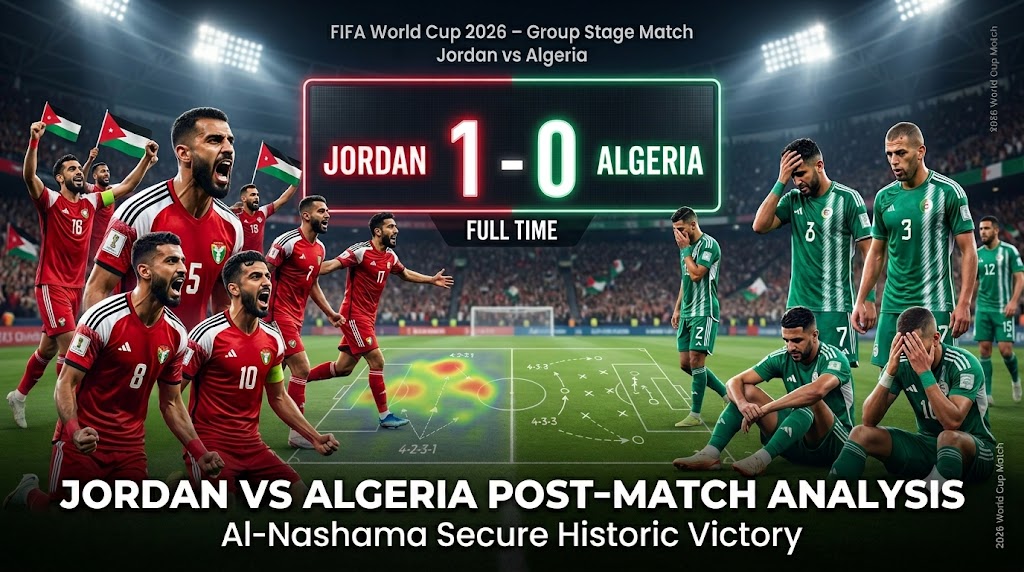
When the final whistle blew, it was Jordan who emerged victorious with a historic 1-0 win, sending shockwaves through Group J and igniting their debut World Cup campaign. For Jamal Sellami’s men, this wasn’t just a win; it was a structural and tactical masterclass in defensive resilience, strategic transitions, and execution under pressure. Conversely, for Vladimir Petković and Algeria, the defeat leaves their tournament hopes hanging by the thinnest of threads, raising serious questions about their clinical edge and midfield balance.
Match Summary
The encounter opened at a frantic pace, with a highly charged atmosphere reflecting the high stakes. Jordan chose a deeply compact approach, allowing Algeria to dictate the early tempo while looking to strike like a coiled spring on the counter-attack. The Fennec Foxes moved the ball well across the middle third but struggled to consistently crack the final line of Jordan’s defense.
The breakthrough came against the run of play in the 36th minute. After a prolonged spell of Algerian dominance, Jordan launched a rare, sweeping attack down the left flank. The ensuing cross caused pure chaos in the Algerian penalty area. The ball eventually squirted out to Jordan’s midfield engine, Nizar Al-Rashdan, at the edge of the box. Striking it cleanly with the outside of his boot from about 10 yards out, Al-Rashdan drilled a low shot into the bottom left corner, completely unsighting Algerian goalkeeper Luca Zidane.
Recognizing his midfield’s vulnerability, Algeria boss Vladimir Petković made a bold double substitution at halftime. He hauled off the cautioned Zerrouki and Hicham Boudaoui, introducing Nabil Bentaleb and Nadhir Benbouali to inject physical presence and vertical passing into the side. The second half became a grueling exercise in attack-versus-defense. While Algeria threw everything forward, Jordan’s low-block held firm, anchored by an inspired goalkeeping performance, ensuring a famous 1-0 victory for the Asian nation.
First Half Analysis
Formation and Tactics
Jamal Sellami deployed Jordan in a disciplined, fluid 3-4-3 formation that naturally transitioned into a rigid 5-4-1 out of possession. The three-man backline consisting of Abdallah Nasib, Husam Abu Dahab, and Yazan Al-Arab remained incredibly narrow, denying space to Amine Gouiri.
Algeria, on the other hand, set up in their traditional, expansive 4-3-3 under Petković. The plan was clear: utilize full-backs Rayan Aït-Nouri and Rafik Belghali to stretch Jordan’s defensive lines and create isolation opportunities for Riyad Mahrez and Farès Chaïbi on the wings.
Possession and Attacking Strategy
For the first 30 minutes, Algeria monopolized possession, hovering around 60%. They looked incredibly dangerous when unlocking Jordan’s lines with lofted through-balls over the top. However, Jordan’s defensive communication was flawless. When Jordan did win the ball back deep in their own territory, they targeted the spaces left vacated by Algeria’s marauding full-backs.
In the 11th minute, Jordan gave Algeria a stern warning. A rapid counter involving Ali Olwan saw him release Musa Al-Taamari down the right channel. Al-Taamari cut inside onto his favored left foot and let fly, forcing a sharp, diving save from Luca Zidane. Despite this, Algeria continued to dictate terms but lacked the clinical touch required in the decisive final meters.
Second Half Analysis
Tactical Changes
The introduction of Nabil Bentaleb and Nadhir Benbouali at the start of the second half significantly altered the physical profile of the Algerian midfield. Bentaleb immediately took control of the tempo, acting as a deep-lying playmaker, while Benbouali provided an extra body in the box to contest aerial duels. Algeria played with much higher intensity, compressing the pitch and forcing Jordan into a sustained period of deep defending.
Momentum Shifts
The momentum shifted entirely toward the North African side as they pinned Jordan inside their own defensive third. Jordan rarely managed to transition into the attacking half during the opening exchanges of the second period. However, Sellami’s tactical setup adapted beautifully. The wing-backs, Ihsan Haddad and Mohannad Abu Taha, ceased all forward ventures, cementing themselves alongside the back three.
Whenever Algeria managed to thread a pass through the compact block, they ran into a wall named Yazeed Abulaila. The Jordanian shot-stopper commanded his box with immense authority, neutralizing crosses and frustrating the Algerian frontline as the minutes ticked away.
Key Players
Jordan Standout Performers
- Yazeed Abulaila (Goalkeeper): Unquestionably the man of the match. Abulaila was a titan between the posts. His ability to read the game, close down angles, and execute high-stakes saves kept Jordan’s clean sheet intact when the defensive line was breached.
- Nizar Al-Rashdan (Midfielder): Beyond scoring the historic game-winner with a technically superb outside-of-the-boot strike, Al-Rashdan covers incredible ground. He broke up play, anchored the double-pivot alongside Al-Rawabdeh, and showed immense composure under structural duress.
- Musa Al-Taamari (Forward): Even when isolated, his blistering pace and dribbling ability remained a constant psychological threat to Algeria’s backline, preventing their defenders from overcommitting to the attack.
Algeria Standout Performers
- Rayan Aït-Nouri (Defender): The Wolves left-back was Algeria’s most consistent outlet. His driving runs down the flank and ability to break lines gave Jordan endless problems in the first half.
- Nabil Bentaleb (Midfielder): Coming on at halftime, Bentaleb provided the structural maturity and ball progression that Algeria desperately lacked in the opening 45 minutes.
Tactical Breakdown
Formation Analysis
Jordan’s 3-4-3 was built for defensive flexibility. By dropping the wing-backs deep, they created a five-man defensive chain that eliminated any numerical advantages Algeria tried to engineer in wide areas. Algeria’s 4-3-3 turned into an aggressive 2-3-5 when attacking, but this left them severely exposed to vertical transitions.
Pressing Style
Jordan applied a passive mid-to-low block. They intentionally declined to press Algeria’s center-backs, Aissa Mandi and Ramy Bensebaini, allowing them time on the ball. Pressing triggers were only pulled when the ball entered the half-spaces or went wide to Riyad Mahrez. Algeria utilized an aggressive counter-press, which worked well early on but fell apart as tiredness crept into their midfield during transitional moments.
Defensive Structure and Midfield Control
Jordan’s defensive structure was elite. By maintaining a tight distance between the defensive and midfield lines, they completely choked out Ibrahim Maza’s ability to operate in the pockets of space. Algeria’s midfield pivot of Boudaoui and Zerrouki struggled to dictate tempo in the first half, looking static when forced to break down a settled defense, which ultimately prompted Petković’s halftime adjustments.
Match Statistics
The verified metrics from the first half and early second-half exchanges highlight a classic tale of possession dominance versus transitional efficiency:
- Scoreline: Jordan 1 – 0 Algeria
- Goalscorers: Nizar Al-Rashdan (36′)
- Possession: Jordan 38% | Algeria 62%
- Yellow Cards: Ramiz Zerrouki (44′ – Algeria)
- Substitutions: Nabil Bentaleb for Ramiz Zerrouki (45′), Nadhir Benbouali for Hicham Boudaoui (45′)
Turning Point of the Match
The defining turning point of this encounter occurred in a frantic two-minute window just before the opening goal. In the 35th minute, Algeria carved out their best opportunity of the match. Riyad Mahrez slipped through on goal with an identical opportunity to an earlier chance. The Algerian captain took a crisp touch and tried to slide the ball past the onrushing Yazeed Abulaila.
In a moment of pure brilliance, Abulaila threw himself low to his right, making a spectacular reflex save to deny the veteran winger. Farès Chaïbi caught the rebound on the left wing, cutting inside and striking it cleanly, but Abulaila gathered it again.
Less than sixty seconds later, Jordan went down the other end and scored via Nizar Al-Rashdan. A potential 1-0 lead for Algeria instantly turned into a 1-0 deficit—a psychological blow from which the Fennec Foxes never truly recovered.
What This Result Means
This result completely opens up Group J. With Argentina sitting comfortably at the summit on 6 points after beating Austria 2-0, Jordan now moves to 3 points, level with Austria. For Jordan, a result against Argentina on the final matchday could mathematically seal an improbable spot in the Round of 32—or put them in a prime position to qualify as one of the best third-placed teams.
For Algeria, they remain pinned to the bottom of the group with 0 points and a -4 goal difference. Their final group fixture against Austria is now a mandatory win, and even then, they will require outside results to go their way to stand any chance of avoiding an embarrassing group-stage exit.
Expert Opinion
From a purely analytical perspective, Jamal Sellami completely out-thought Vladimir Petković in the first half. Sellami understood that Algeria’s attacking threat relies heavily on structural width and overloads. By instructing his wingers, Al-Mardi and Al-Taamari, to track back deeply, Jordan nullified the dangerous combinations between Aït-Nouri and Chaïbi.
Algeria’s biggest flaw was their lack of verticality in the final third during the first half. They played in front of Jordan’s defensive block rather than trying to drag them out of position. While Petković corrected this with his halftime substitutions, the damage had already been done. Jordan had something concrete to protect, and in tournament football, a disciplined low-block with a goal advantage is one of the hardest tactical structures to break down.
Conclusion
This match will go down as a landmark day in Jordanian football history. Entering the tournament as heavy underdogs, Al-Nashama proved that structural cohesion, tactical discipline, and clinical execution can overcome any deficit in individual star power. For Algeria, this post-match report serves as a harsh wake-up call. Talent alone does not win matches on the grandest stage of world football. If the Fennec Foxes are to salvage their World Cup campaign against Austria, Petković must find a way to inject clinical composure into his attacking line and restore balance to a midfield that looked completely exposed in transitional moments.