Japan vs Sweden 1-1: World Cup Thriller Sends Both Through
Introduction
There is a unique subgenre of tournament football where survival overrides spectacular aesthetics. When the stakes are a ticket to the knockout rounds of a global tournament, a match often transforms from a standard athletic contest into a hyper-calculated game of chess. That is exactly what unfolded at the FIFA World Cup 2026 as the final whistle blew on a tense, engrossing Group F clash between Japan and Sweden.
The 1-1 draw was a result that ultimately felt like a mutual victory. It sparked celebrations across both camps, albeit for different reasons. Japan, exhibiting the structural maturity and fluid positional chemistry that has defined their modern golden generation, safely booked their ticket as the Group F runner-up. Across the pitch, a resilient Swedish side breathed an immense sigh of relief. Having carried the heavy psychological baggage of a bruising earlier defeat against the Netherlands, Sweden scraped through to the Round of 32 as one of the tournament’s best third-placed teams.
Match Overview and Statistical Summary
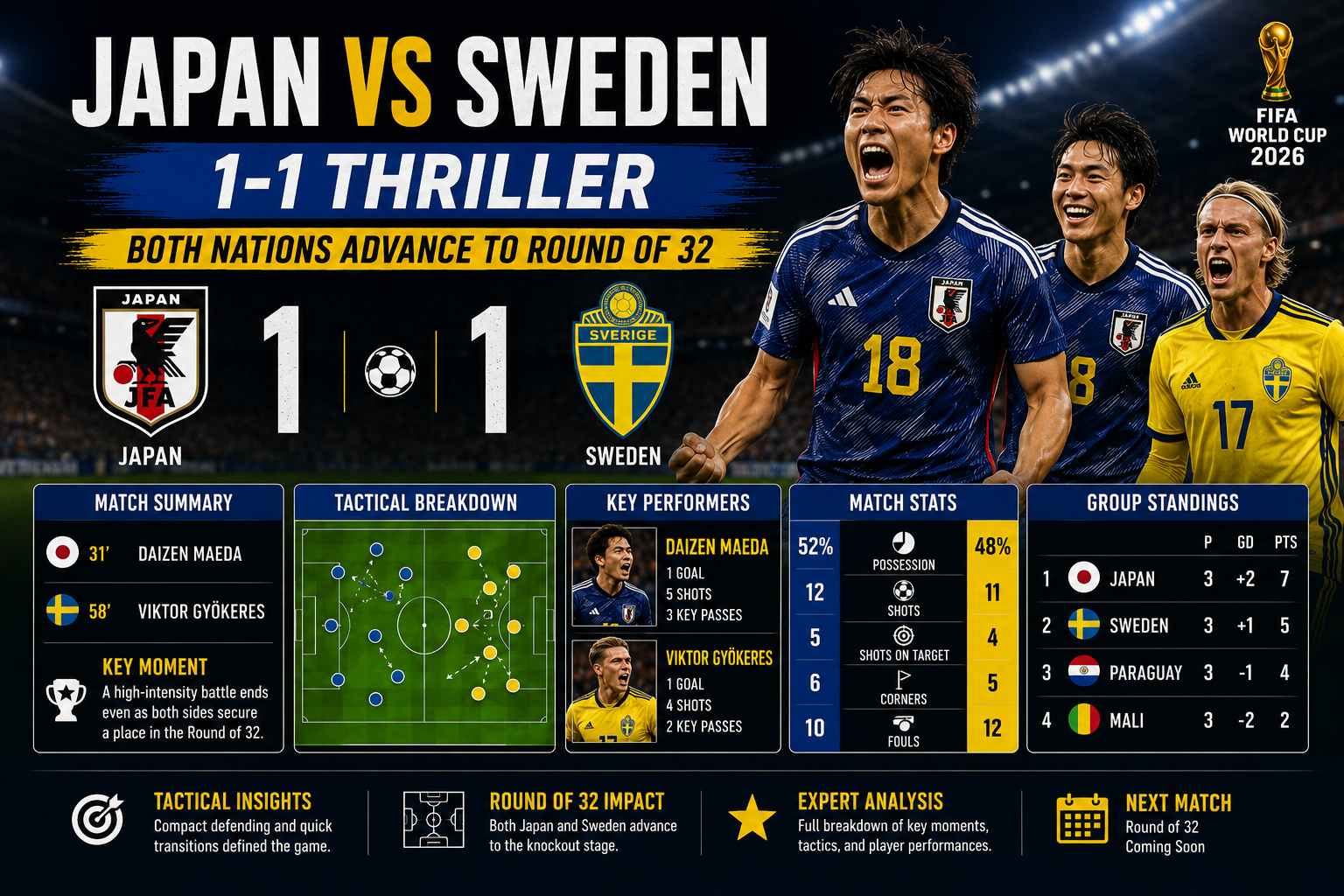
- Final Score: Japan 1-1 Sweden
- Tournament: FIFA World Cup 2026
- Stage: Group F Final Matchday
- Goalscorers: Daizen Maeda (Japan, 52′), Anthony Elanga (Sweden, 68′)
While the scoreline suggests a complete stalemate, the underlying metrics reveal a fascinating battle for spatial dominance. Japan manipulated territory with longer, highly structured sequences, while Sweden relied on vertical explosiveness.
| Match Statistics | Japan | Sweden |
| Score | 1 | 1 |
| Possession (%) | 54% | 46% |
| Total Shots | 11 | 14 |
| Shots on Target | 4 | 6 |
| Passing Accuracy | 87% | 81% |
| Corners | 5 | 7 |
| Saves | 5 | 3 |
First-Half Tactical Analysis
The opening 45 minutes was a masterclass in risk mitigation. Both managers approached the game with an acute awareness of the tournament qualification matrix. A catastrophic defeat would derail either team’s campaign, leading to a highly calculated, cautious affair.
Japan’s Disciplined 5-2-3 Defensive Shape
Hajime Moriyasu set up the Samurai Blue in an incredibly rigid, compact 5-2-3 out-of-possession structure. The objective was clear: systematically deny Sweden’s dangerous front-line spaces to run into.
The three-man central defensive wall of Ko Itakura, Takehiro Tomiyasu, and Shogo Taniguchi operated with flawless lateral communication. When Sweden attempted to circulate the ball through central areas, Japan’s front three—Daizen Maeda, Takefusa Kubo, and Kaoru Mitoma—dropped into an aggressive mid-block press. This tactical positioning cut off the supply lines to Sweden’s deep playmakers, forcing the Scandinavian side into slow, sideways passing sequences that failed to trouble Japan’s rest defense.
Sweden’s Passive Early Build-up
Graham Potter’s Sweden set up in a flexible 4-2-3-1 system but struggled significantly during the first half to progress the ball through Japan’s block. Hugo Larsson and Jens Cajuste found themselves crowded out in the center of the pitch by the industrious defensive work of Wataru Endo and Hidemasa Morita.
Because Sweden’s full-backs, Emil Holm and Ludwig Augustinsson, stayed deep to guard against the electric pace of Mitoma and Maeda, Sweden’s attacking movements looked isolated. Star striker Viktor Gyökeres spent the entire first half physically battling three center-backs, receiving virtually no service between the lines. It was half dominated by managers prioritizing structure over individual creativity.
Second-Half Breakdown
Whatever the managers said in the locker rooms completely altered the competitive nature of the game. The tactical conservatism of the first half vanished, replaced by an aggressive, high-tempo battle.
The Breakthrough: Japan’s Fluid Rotations
Japan struck first in the 52nd minute, showcasing their trademark fluid attacking rotations and quick passing combinations. Shifting smoothly from a 5-2-3 to an expansive 3-4-3 in possession, right-back Yukinari Sugawara pushed high up the pitch, dragging Augustinsson out of position.
Takefusa Kubo drops deep to collect, executing a brilliant one-touch triangle pass with Hidemasa Morita. Morita spotted Kaoru Mitoma making a diagonal underlapping run into the half-space. Mitoma drove to the byline and fired a low, fizzing cross across the six-yard box. Daizen Maeda anticipated the trajectory flawlessly, out-pacing Victor Lindelöf at the near post to poke home a deserved opener. The stadium erupted as the Daizen Maeda World Cup story added another clinical chapter.
Graham Potter’s Tactical Masterstroke
Conceding the goal acted as a massive wake-up call for Sweden. Facing potential tournament elimination, Graham Potter immediately made a bold tactical adjustment. He instructed his team to abandon their structured buildup and transition into a highly direct, vertical attacking style, pushing Dejan Kulusevski into a secondary striker role and giving his wingers absolute freedom to dribble.
Sweden became significantly more aggressive, utilizing a high counter-press that finally rattled Japan’s technical composure. They began using direct attacking transitions, bypassing Japan’s midfield pivot entirely by hitting long, diagonal balls into channels for their physical attackers to chase.
The Equalizer: Anthony Elanga’s Brilliance
The tactical shift paid off handsomely in the 68th minute through a moment of pure individual wizardry. Collecting a long transition pass out on the left wing, Anthony Elanga found himself isolated 1-v-1 against Sugawara.
Showcasing elite acceleration, the Nottingham Forest winger executed a sharp step-over, feinted to drive down the byline, and cut sharply inside onto his right foot. Before Tomiyasu could slide across to block, Elanga unleashed a stunning, curling strike that flew past a diving Zion Suzuki into the far top corner. The spectacular Anthony Elanga goal completely shifted the psychological momentum of the game, setting up a grandstand finish.
Player Performance Analysis
Japan Football Team Analysis
- Daizen Maeda: The Celtic forward was an absolute engine. Beyond his clinical, predatory goal, his relentless defensive pressing from the front forced Sweden into numerous unforced errors.
- Zion Suzuki: The young goalkeeper proved exactly why Moriyasu has total faith in him. When Sweden launched an all-out assault late in the game, Suzuki stood tall, making two world-class saves to deny Gyökeres and Emil Forsberg.
- Kaoru Mitoma: Provided the creative spark that unlocked Sweden’s defense. His elite spatial awareness and precise assist highlighted Japan’s technical superiority down the wings.
Sweden Football Team Performance
- Anthony Elanga: The undisputed savior for Sweden. When his team looked structurally stagnant, his direct dribbling and individual brilliance single-handedly drug them back into the tournament.
- Victor Lindelöf: Had a tough battle against Japan’s fluid front three. While he was caught slightly out of position for Maeda’s goal, his aerial dominance late in the game was vital during defensive set-pieces.
- Dejan Kulusevski: Completely grew into the game in the second half. His physical strength and ball retention in tight spaces allowed Sweden to sustain attacking pressure late on.
Fan Reactions and Match Atmosphere
The atmosphere inside the arena was an absolute festival of contrasts. The passionate, blue-clad Japanese supporters kept up a rhythmic, non-stop wall of sound, beating traditional drums and singing throughout the entire ninety minutes.
On the opposite end, the yellow wall of Swedish fans brought immense emotional intensity. They rode a complete rollercoaster of emotions—from the absolute despair of conceding Maeda’s opener to pure, unadulterated ecstasy when Elanga’s curling strike hit the back of the net. When the final whistle blew, the initial tension in the stadium dissolved into a beautiful display of mutual respect, with both fanbases applauding their teams’ hard-fought progression.
FAQ
1. What was the final score of the Japan vs Sweden World Cup 2026 match?
Japan and Sweden drew 1-1 in their final Group F match of the tournament.
2. Who scored the goals in the Japan vs Sweden match?
- Japan: Daizen Maeda (52′)
- Sweden: Anthony Elanga (68′)
3. Did both Japan and Sweden qualify for the Round of 32?
Yes. Japan qualified directly as the Group F runner-up with 5 points. Sweden advanced to the knockout rounds with 4 points as one of the best third-placed teams.
4. Who will Japan face in the next round of the World Cup?
Japan will take on South American powerhouse Brazil in a highly anticipated Round of 32 knockout match.
5. What was the key tactical feature of the match?
Japan utilized a highly disciplined 5-2-3 defensive structure paired with fluid attacking rotations. Sweden countered in the second half by adopting a highly vertical attacking style, relying heavily on direct transitions and individual dribbling from Anthony Elanga.
Conclusion
The Japan vs Sweden FIFA World Cup encounter was an exceptional advertisement for the intellectual depth of modern international football. It was a match where tactical structures clashed, individual brilliance shone, and both nations ultimately achieved their primary strategic objectives. As the competition moves into the high-stakes world of single-elimination football, both Japan and Sweden have proven they possess the identity, quality, and mental toughness required to compete on the biggest stage.