Iraq vs Norway FIFA World Cup 2026: Tactical Breakdown
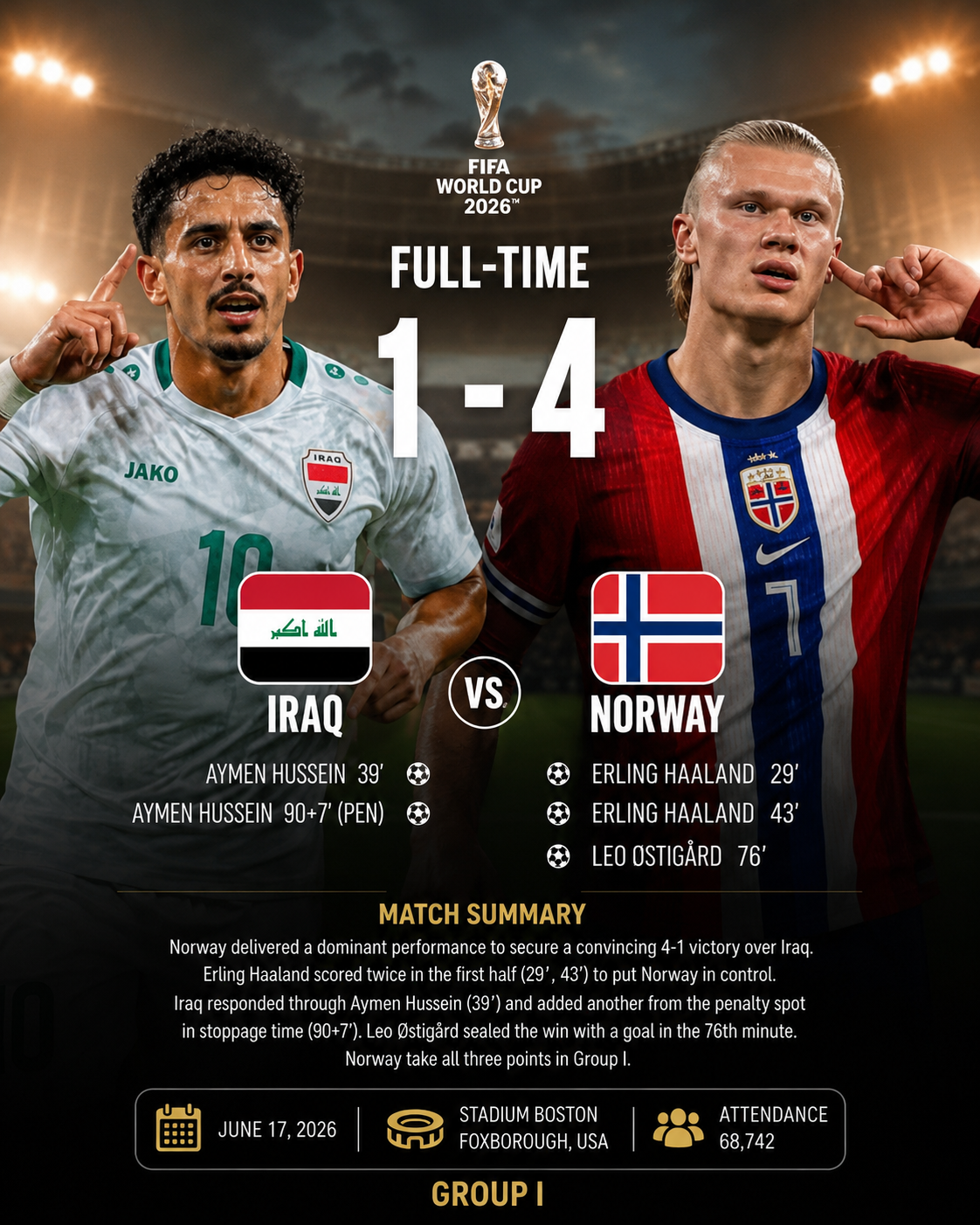
The FIFA World Cup 2026 delivered an enthralling Group I encounter as Norway dismantled Iraq with a convincing 4-1 victory. The fixture held immense significance for both nations, marking an emotional and historic return to football’s grandest stage after decades of absence. Norway had not played in a World Cup since France 1998, while Iraq’s last appearance dated back to Mexico 1986. Expectations before kick-off were sky-high, particularly regarding Norway’s attacking firepower, led by the prolific Erling Haaland, against an Iraqi side desperate to secure a historic point.
Match Overview
- Venue: Boston Stadium, Massachusetts
- Date: June 16, 2026 (Local) / June 17, 2026 (IST)
- Kick-off time: 18:00 Local / 3:30 AM IST
- Final score: Iraq 1 – 4 Norway
- Winning margin: 3 goals
- Player of the Match: Erling Haaland
How the Match Unfolded
First Half
Norway initiated the match with a recognizable 4-3-3 formation, while Iraq deployed a structured 4-4-2. The Scandinavians began somewhat shakily, displaying understandable nerves after their 28-year absence from the tournament. However, their pressure soon paid off. Erling Haaland opened the scoring in the 28th minute, stretching to turn home a back-post cross. Iraq responded aggressively and leveled the match 10 minutes later through a powerful header by Aymen Hussein in the 38th minute, assisted by Amir Al-Ammari. The parity was short-lived as Haaland’s relentless pressing forced an error just before halftime. He pounced on an under-hit back-pass and scored his second in the 42nd minute, restoring Norway’s lead.
Second Half
Norway established more control after the break. Both teams made crucial tactical adjustments, evidenced by a flurry of substitutions around the 58th and 72nd minutes. Iraq introduced Zidane Iqbal and Marko Farji to inject energy, while Norway brought on Leo Østigård, Oscar Bobb, and Kristian Thorstvedt to solidify their grip. The turning point arrived in the 75th minute when substitute Leo Østigård found the back of the net to extend Norway’s lead to 3-1.
Closing Stages
Despite their spirited efforts, Iraq could not overcome the widening deficit. Defensive resilience from Norway thwarted late Iraqi advances. The match was decisively sealed in the 90th minute when a tragic own goal by Aymen Hussein compounded Iraq’s misery, resulting in a comprehensive 4-1 final scoreline.
Iraq Performance Analysis
Attacking approach
Iraq approached the game adventurously, refusing to sit back in a low block. They created multiple meaningful chances, relying on overlapping crosses from Merchas Doski and incisive passes from Ali Jasim.
Midfield battle
Ibrahim Bayesh and Amir Al-Ammari worked tirelessly in the central zones, fighting to transition the ball swiftly. Al-Ammari’s delivery was a notable asset, providing the crucial assist for Iraq’s lone goal.
Possession play
While overall possession metrics were heavily contested, Iraq demonstrated an ability to retain the ball during key attacking phases, particularly late in the first half.
Build-up structure
Iraq favored building from the wings, utilizing their wide midfielders to stretch Norway’s disciplined defensive line.
Defensive organization
The defensive quartet of Hussein Ali, Zaid Tahseen, Akam Hashim, and Merchas Doski initially held firm but struggled immensely against the physicality and pressing of Norway’s elite attackers.
Standout players
Aymen Hussein was undeniably the focal point of the attack, showcasing excellent aerial ability. Amir Al-Ammari served as a creative hub from midfield.
Strengths and weaknesses
Iraq’s strength lay in their fearlessness and immediate response to falling behind. However, defensive lapses and individual errors, particularly the costly back-pass before Haaland’s second goal, exposed their vulnerabilities.
Areas requiring improvement
To progress in Group I, Iraq must tighten their defensive transitions and eliminate unforced errors when playing out from the back.
Norway Performance Analysis
Tactical discipline
Operating in a 4-3-3, Norway demonstrated structured European pressing and verticality. Captain Martin Ødegaard orchestrated the tempo, ensuring the shape remained intact.
Pressing system
Norway’s intense high press was their most effective weapon, directly resulting in Haaland’s second goal.
Counterattacking threat
With the pace of Antonio Nusa and the physical presence of Alexander Sørloth, Norway constantly threatened during offensive transitions.
Possession game
After a nervous start, the midfield trio of Ødegaard, Sander Berge, and Fredrik Aursnes commanded possession in the second half, suffocating Iraq’s build-up.
Defensive structure
Kristoffer Ajer and Torbjørn Heggem provided a solid foundation, while David Møller Wolfe’s crucial goal-saving block in the first half exemplified their defensive commitment.
Standout performers
Erling Haaland was the absolute protagonist, but significant contributions came from Møller Wolfe and second-half substitute Leo Østigård.
Lessons learned
Norway’s initial vulnerability to crosses highlighted a need for better aerial tracking inside their penalty area.
Positives moving forward
The depth of their squad was apparent, as substitutes immediately impacted the match and secured the three points.
Match-Winning Moments
The defining moment of the match occurred in the 42nd minute. With the score tied at 1-1 and Iraq gaining momentum, Haaland relentlessly pressured the Iraqi defense. An under-hit back-pass caught goalkeeper Jalal Hassan flat-footed, allowing Haaland to capitalize and score. Furthermore, Leo Østigård’s 75th-minute strike dismantled any remaining Iraqi hopes of a comeback, definitively killing the game.
Standout Players
- Player of the Match: Erling Haaland (9/10) – The Manchester City striker was lethal, scoring a brace on his World Cup debut and terrorizing the Iraqi backline with his pressing.
- Best attacker: Aymen Hussein (7/10) – Despite the late own goal, Hussein was a constant aerial threat and scored a brilliant header.
- Best midfielder: Amir Al-Ammari (7.5/10) – Dictated play for Iraq and provided a pinpoint assist.
- Best defender: David Møller Wolfe (8/10) – His crucial late first-half block preserved Norway’s lead.
- Surprise performer: Leo Østigård (7.5/10) – Came off the bench and quickly scored the third goal, completely shifting the momentum.
Player Ratings Table
| Player | Team | Rating | Explanation |
| Erling Haaland | Norway | 9/10 | Unstoppable on his debut, scored two crucial goals. |
| Aymen Hussein | Iraq | 7/10 | Scored a fantastic header but suffered a late own goal. |
| David Møller Wolfe | Norway | 8/10 | Solid defensively with a game-saving block. |
| Amir Al-Ammari | Iraq | 7.5/10 | Iraq’s best creative outlet, provided the assist. |
| Leo Østigård | Norway | 7.5/10 | Instant impact off the bench with a vital goal. |
Match Stats at a Glance
| Category | Detail |
| Final Score | Iraq 1 – 4 Norway |
| First Goal | Erling Haaland (28′) |
| Equalizer | Aymen Hussein (38′) |
| Match Winner | Erling Haaland (42′) |
| Cautions | Zaid Tahseen (86′) – Yellow |
Five Biggest Takeaways
- Haaland Arrives: Erling Haaland translates his club form to the international stage seamlessly.
- Norway’s Depth: Substitutes like Østigård can change the complexion of a match instantly.
- Iraqi Spirit: Iraq possesses the attacking talent to trouble top-tier European defenses.
- Costly Errors: Individual mistakes at this level are ruthlessly punished.
- Group of Death statement: Norway has set a high benchmark in Group I.
Winners and Losers from the Match
- Biggest winner: Norway’s attack, definitively proving they belong at the World Cup after 28 years.
- Surprise performer: Akam Hashim, who nearly scored a spectacular equalizer before halftime.
- Tactical success stories: Ståle Solbakken’s substitutions, particularly bringing on Østigård, sealed the victory.
- Disappointing performances: Iraq’s central defense struggled under pressure, specifically during the build-up to the second goal.
Impact on FIFA World Cup 2026 Group Standings
This 4-1 victory catapults Norway to the top of Group I ahead of France based on goal difference. For Iraq, the substantial negative goal difference presents a massive hurdle. Their upcoming fixtures against heavyweights France in Philadelphia and Senegal in Toronto have now become definitive must-win encounters if they harbor any hopes of progressing to the knockout stages. Norway, riding high on momentum, will look to solidify their position in their next match.
Biggest Talking Points
- The Tactical Battle: European high-pressing against resilient counter-attacking.
- Star Performers: Haaland’s immediate impact and Hussein’s aerial dominance.
- Key Moments: The catastrophic back-pass that handed Norway the lead right before halftime.
- Momentum: Norway moving top of the group, setting up a titanic clash with France.
Frequently Asked Questions
Q.1 Who won Iraq vs Norway?
Norway won the match 4-1.
Q.2 Who scored the goals?
Erling Haaland scored twice, Leo Østigård scored once, and Aymen Hussein scored an own goal for Norway. Aymen Hussein scored Iraq’s only goal.
Q.3 Who was Player of the Match?
Erling Haaland was the standout performer.
Q.4 Which players impressed the most?
Erling Haaland, David Møller Wolfe, and Aymen Hussein were highly impressive.
Q.5 What are the qualification implications?
Iraq must now secure points against France and Senegal to stay alive.
Conclusion
Norway’s 4-1 victory over Iraq served as a resounding declaration of intent at the FIFA World Cup 2026. Erling Haaland’s debut brace highlights a team capable of challenging the established global elite. Looking ahead, Norway will aim to carry this momentum into their remaining Group I fixtures, knowing they have the firepower to test anyone. Conversely, Iraq must quickly regroup, address their defensive frailties, and harness their undeniable attacking spirit as they prepare for massive upcoming clashes. The tournament has only just begun, but the stakes are already incredibly high.