Iran vs New Zealand 2-2 FIFA World Cup 2026 Tactical Drama
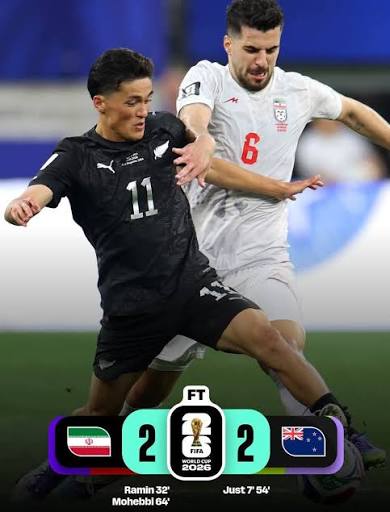
The Group G opening fixture between Iran and New Zealand at the 2026 FIFA World Cup carried massive significance well before the opening whistle blew. For Iran, the tournament arrived amidst extraordinary off-field turmoil and severe logistical challenges, putting their psychological fortitude to the ultimate test. Conversely, New Zealand entered the grandest stage looking to upset international hierarchical norms and secure an elusive first-ever World Cup victory.
Expectations before kick-off heavily favored Team Melli, given their superior squad depth and elite technical standing globally. However, tournament football routinely disregards historical records. This specific matchup mattered deeply within the framework of the expanded FIFA World Cup 2026 because it set the tone for a highly competitive group stage. With both sides desperate to lay a foundational claim for knockout qualification, the tactical chess match in California quickly exploded into an open, high-intensity four-goal thriller that will be analyzed for weeks to come.
Match Overview
- Venue: Los Angeles Stadium, Inglewood, California, USA
- Date: Monday, June 15, 2026 (Local Venue Time) / Tuesday, June 16, 2026 (IST)
- Kick-off Time: 6:00 PM Local / 6:30 AM IST
- Final Score: Iran 2–2 New Zealand
- Winning Margin: 0 (Draw)
- Player of the Match: Elijah Just (New Zealand)
How the Match Unfolded
First Half
The contest ignited instantly as New Zealand caught Iran completely cold in the opening exchanges. In the 7th minute, a massive tactical oversight during an Iranian goal kick allowed All Whites captain Chris Wood to intercept the ball and immediately look forward. Wood deftly directed the ball into the path of Elijah Just, who executed a brilliant, composed volley from inside the box to stun the stadium into silence.
Second Half
The second half saw immediate tactical moves from Iran manager Georgios Donis, who introduced Mehdi Ghayedi for Aria Yousefi at the interval to create more directness on the flanks. Despite Iran controlling the ball, New Zealand struck with lethal transition precision in the 54th minute. In a dazzling sequence, Elijah Just collected the ball at midfield, drove forward, and executed a flawless give-and-go with Chris Wood. Just calmly received the return pass and lifted a delicate finish over Alireza Beiranvand to secure his brace and hand the All Whites a 2–1 advantage.
Closing Stages
The final twenty minutes dissolved into a grueling battle of attrition, interrupted by crucial substitutions from both technical areas. New Zealand solidified their lines by bringing on Ryan Thomas, Ben Old, and later Callan Elliot to secure the defensive flanks. Iran’s veteran midfielder Ehsan Hajsafi came on to manage the game’s tempo but received a caution in the 88th minute for a tactical foul.
Iran Performance Analysis
Attacking Approach
Iran deployed a highly traditional, physically imposing strike partnership featuring Mehdi Taremi and Shahriyar Moghanlou. Their primary approach relied on establishing deep possession in the final third, working the ball out wide to create overloading cross opportunities, and capitalizing on standard knockdowns inside the box.
Midfield Control
Saman Ghoddos and Saeid Ezatolahi functioned as a central double-pivot, effectively recycling loose balls and controlling large stretches of the match tempo. Their distribution kept New Zealand pinned down for significant durations, though they struggled to prevent quick vertical passes on the counter.
Possession Play
Team Melli retained a substantial share of possession, building methodically from the back line through Ali Nemati and Shojae Khalilzadeh. While their spatial circulation was aesthetically pleasing, it occasionally lacked the blistering acceleration needed to cut open a compact low block cleanly.
Defensive Organization
The backline suffered severe lapses in concentration, particularly during transitional phases and early goal-kick build-ups. Allowing Chris Wood to dictate space in dangerous central areas exposed vertical gaps between the center-backs.
Build-up Play
Build-up sequences frequently focused on moving the ball toward full-backs Ramin Rezaeian and Milad Mohammadi. Rezaeian’s advanced positioning acted as a key attacking outlet, masking structural delays in central zones.
Key Players
Ramin Rezaeian was outstanding, directly contributing to both Iranian goals through his dynamic penalty-box arrival and elite crossing ability. Mehdi Taremi provided elite leadership up top, constantly threatening with his physical presence despite hitting the frame of the goal.
Strengths and Weaknesses
- Strengths: Elite mental resilience to fight back from two separate deficits; highly dominant aerial presence inside the opposition box.
- Weaknesses: Costly individual defensive errors and sluggish recovery pace during vertical transitions.
Areas Requiring Improvement
Iran must drastically tighten their concentration levels immediately following their own attacking cycles. Eliminating unforced errors during defensive-third passing sequences will be essential ahead of facing Belgium.
New Zealand Performance Analysis
Tactical Discipline
The All Whites displayed spectacular defensive cohesion, adhering perfectly to a rigid defensive layout under intense physical pressure from a team ranked 65 places higher globally.
Pressing Structure
New Zealand deployed an intelligent, highly effective mid-press. Instead of exhausting themselves chasing defenders across the pitch, they waited for specific structural triggers, such as the flat goal kick intercepted by Chris Wood for the opening goal.
Counterattacking Threat
Their transition threat was elite. The connection between Chris Wood’s hold-up play and Elijah Just’s explosive underlapping runs repeatedly carved open the Iranian defense.
Possession Game
With less time on the ball, New Zealand prioritized absolute directness. They avoided overcomplicating possession inside their own half, opting to launch long direct outlets to Wood or utilize quick linear passes down the touchlines.
Defensive Setup
Operating out of a compact 4-2-3-1, center-backs Finn Surman and Michael Boxall threw themselves into physical duels, effectively clearing secondary balls and protecting goalkeeper Max Crocombe from clean looks.
Standout Performers
Elijah Just wrote his name into national folklore with a world-class brace, showcasing cold-blooded composure in front of goal. Chris Wood provided a target-man masterclass, supplying two perfect assists.
Positives to Take Forward
Matching their historical World Cup goal tally in a single afternoon and taking a point from an elite Asian powerhouse represents an extraordinary psychological triumph.
Lessons Learned from the Match
The Kiwis learned that clinging to a single-goal advantage against a technically superior team without sustained possession is incredibly difficult, highlighting the need for better game management after taking the lead.
Match-Winning Moments
While the match ended in a draw, specific critical sequences dictated the outcome. The first was Elijah Just’s 7th-minute volley, which instantly dismantled Iran’s pre-match game plan and gave New Zealand immense belief. The second was Mehdi Taremi’s shot striking the post; a few inches over would have shifted the first-half momentum completely.
The defining moment of tactical adaptation occurred in the 63rd minute when Ramin Rezaeian found space out wide to deliver a precise cross for Mohammad Mohebi’s back-post header.
Standout Players
Elijah Just (New Zealand) – 9.5/10
The Motherwell winger was phenomenal. He became the first New Zealand player to score a World Cup brace, executing both his opening volley and his second-half give-and-go finish with world-class precision.
Ramin Rezaeian (Iran) – 9/10
A complete modern full-back performance. He stabilized Iran’s right side, scored the initial equalizer by reacting fastest to a loose ball, and provided the brilliant assist for Mohebi’s header.
Chris Wood (New Zealand) – 8.5/10
The veteran captain led from the front. His defensive work rate forced the error for the opening goal, and his hold-up play was essential in creating both of Just’s goals.
Mohammad Mohebi (Iran) – 8/10
A constant livewire down the flank, his physical dominance was rewarded with a brilliantly executed back-post header to rescue a draw.
Tim Payne (New Zealand) – 7.5/10
The tournament breakout sensation worked tirelessly at right-back for 80 minutes, restricting Iran’s dangerous wide players before coming off exhausted.
Match Statistics Table
| Match Statistic | Iran | New Zealand |
| Final Score | 2 | 2 |
| Goals First Half | 1 | 1 |
| Goals Second Half | 1 | 1 |
| Yellow Cards | 1 (Hajsafi 88′) | 0 |
| Red Cards | 0 | 0 |
| Total Substitutions Made | 4 | 4 |
| Woodwork Hits | 1 (Taremi 30′) | 0 |
Player Ratings Table
| Team | Player Name | Position | Rating | Key Match Contribution |
| Iran | Alireza Beiranvand | Goalkeeper | 6.0 | Had little chance with both clinical finishes from Just. |
| Iran | Ramin Rezaeian | Defender | 9.0 | Scored the first goal, assisted the second equalizer. |
| Iran | Shojae Khalilzadeh | Defender | 6.5 | Strong in air but struggled with New Zealand’s pace. |
| Iran | Saman Ghoddos | Midfielder | 7.0 | Controlled spatial distribution before being substituted. |
| Iran | Mohammad Mohebi | Midfielder | 8.0 | Scored the crucial equalizing header in the 63rd minute. |
| Iran | Mehdi Taremi | Forward | 7.5 | Hit the post; an influential leader up front throughout. |
| NZ | Max Crocombe | Goalkeeper | 6.5 | Made critical claims under heavy aerial pressure. |
| NZ | Finn Surman | Defender | 7.0 | Displayed great positional discipline against Taremi. |
| NZ | Liberato Cacace | Defender | 7.0 | Solid defensive work rate before tactical second-half sub. |
| NZ | Marko Stamenić | Midfielder | 7.5 | Anchored the engine room excellently to break up plays. |
| NZ | Elijah Just | Midfielder | 9.5 | Netted a historic brace with supreme composure. |
| NZ | Chris Wood | Forward | 8.5 | Provided both assists and marshaled the front line. |
Biggest Talking Points
- The Geopolitical Backdrop: Iran competing under extreme logistical pressure, flying in directly from Mexico right before the match due to major international upheavals.
- Elijah Just’s Historic Night: The winger’s clinical double established him as a national icon and a potential breakout star of the tournament.
- Ramin Rezaeian’s Clutch Display: The veteran full-back carried his team offensively when their central patterns were neutralized.
- Group G Paradox: An unprecedented opening matchday leaves all four teams completely equal on points and goal difference.
Five Biggest Takeaways
- Resilience Overcomes Chaos: Iran proved that structural and off-field adversity cannot easily break their core competitive spirit.
- A Star is Born: Elijah Just possesses the elite clinical quality necessary to punish top-tier international opponents.
- Full-Backs are Primary Weapons: When Taremi was marked closely, Rezaeian’s overlapping runs became Iran’s most effective route to goal.
- Transition Deficiencies Exposed: Elite teams will look to exploit Iran’s lack of central tracking pace during quick transitions.
- Absolute Parity: Group G is now a clean two-game sprint, where any single mistake could prove fatal to qualification hopes.
Winners and Losers from the Match
- Biggest Winner: Elijah Just. His historic brace showcased exceptional quality and elevated his status on the global stage.
- Surprise Performer: Tim Payne. The right-back delivered a highly disciplined defensive performance against elite opposition.
- Tactical Success Story: Chris Wood’s Target Play. His ability to win aerial duels and provide precise assists was central to New Zealand’s game plan.
- Disappointing Performance: Iran’s Defensive Transition. The lack of communication on the opening goal kick revealed a critical defensive vulnerability.
Frequently Asked Questions
Q.1 Who won Iran vs New Zealand?
The match ended in a 2–2 draw.
Q.2 Who scored the goals?
Elijah Just scored twice for New Zealand (6′, 54′); Ramin Rezaeian (31′) and Mohammad Mohebi (63′) scored for Iran.
Q.3 Who was Player of the Match?
Winger Elijah Just received the honor after netting his historic brace.
Q.4 What does the result mean for the standings?
All four teams in Group G are tied with one point each.
Q.5 Which players impressed the most?
Elijah Just, Ramin Rezaeian, and Chris Wood delivered standout performances.
Q.6 What are the qualification implications?
The group remains wide open, making the upcoming matches critical for all four teams.
Conclusion
The 2–2 draw between Iran and New Zealand will be remembered as a classic World Cup encounter where tactical discipline met pure emotional resilience. For New Zealand, the result proves their tactical framework can challenge elite international opposition. For Iran, securing a point amidst incredible off-field challenges keeps their qualification hopes fully intact. As Group G moves forward, both teams have demonstrated they possess the character and tactical quality to fight for a place in the knockout rounds of the 2026 FIFA World Cup.