Germany 7-1 Curaçao: FIFA World Cup 2026 Analysis
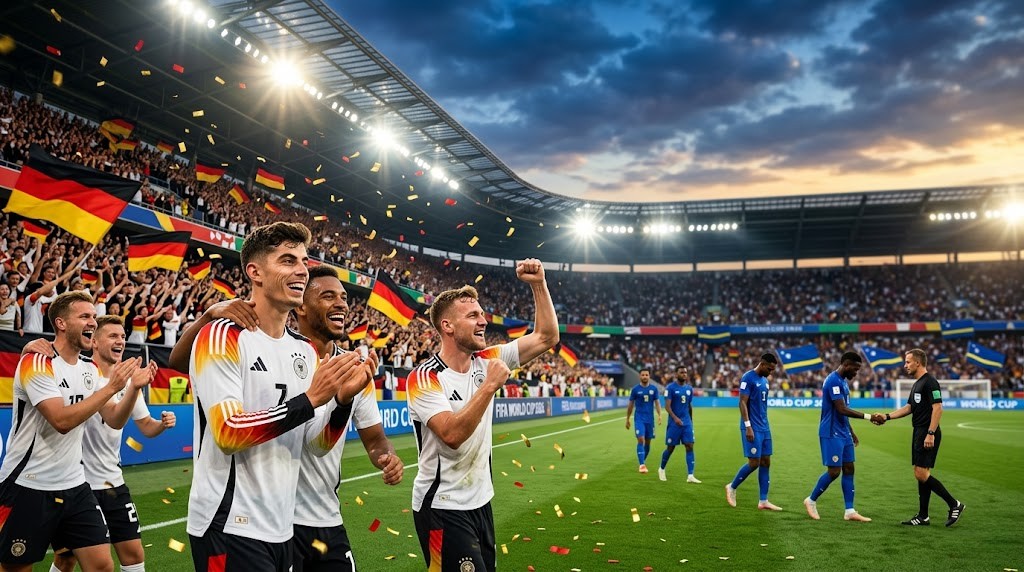
In the world of international football, few opening statements are as emphatic as the one delivered by Germany at the Houston Stadium on June 14, 2026. As Julian Nagelsmann’s side stepped onto the pitch to face World Cup debutants Curaçao in their Group E opener, the air in Texas was thick with expectation. Germany, a nation seeking redemption after consecutive group-stage exits in 2018 and 2022, arrived with a point to prove.
For Curaçao, the match represented a landmark moment—the Caribbean nation’s first-ever appearance at a FIFA World Cup finals. While the gulf in pedigree and experience was evident on paper, the occasion provided the ultimate stage for the underdog. The resulting 7-1 victory for Die Mannschaft was not merely a win; it was a ruthless display of intent. In this post-match analysis, we dissect the tactical maneuvers, the historical significance of the debutant’s goal, and why this result serves as a massive momentum-builder for Germany as they aim to reclaim their place at the summit of global football.
Match Overview
- Venue: Houston Stadium, Texas, United States
- Date: June 14, 2026
- Kick-off time: 12:00 PM (Venue Time) / 1:00 PM ET
- Final result: Germany 7 – 1 Curaçao
- Winning margin: 6 goals
How the Match Unfolded
First Half
Germany set the tone early, playing with a high-intensity press that forced Curaçao onto the back foot immediately. The breakthrough arrived in the 6th minute when Felix Nmecha curled an exquisite effort into the far corner after a sharp interchange with Florian Wirtz.
However, the “Blue Wave” of Curaçao provided one of the most memorable moments in the tournament’s early stages. In the 21st minute, Livano Comenencia capitalized on a rare moment of German defensive hesitation, firing a deflected strike past Manuel Neuer. It was Curaçao’s first-ever World Cup goal. Normal service resumed shortly after, with Nico Schlotterbeck restoring the lead via a powerful header in the 38th minute, followed by a Kai Havertz penalty in first-half stoppage time (45+4′).
Second Half
Germany emerged from the tunnel with renewed aggression. Jamal Musiala needed only 69 seconds of the restart to find the net, effectively ending any hopes of a Curaçao comeback. From that point, the match became a showcase of Germany’s attacking depth. Nathaniel Brown marked his debut with a volley in the 68th minute, while substitute Deniz Undav made an immediate impact, netting in the 77th minute.
Closing Stages
The intensity did not wane despite the lopsided scoreline. Germany continued to probe, with Deniz Undav proving to be a catalyst off the bench. Kai Havertz capped off his brace in the 88th minute with a delicate chip, mirroring the ruthlessness of Germany’s historic 2014 semi-final against Brazil.
Germany Performance Analysis
Attacking Approach
Germany utilized a fluid 4-2-3-1 that focused on quick transitions and overloading the half-spaces. The movement of Havertz, Wirtz, and Musiala proved too complex for Curaçao’s defensive block to track.
Midfield Control
Aleksandar Pavlović and Felix Nmecha maintained high pass volumes, ensuring that Germany kept the tempo of the game high. The midfield duo acted as a launchpad, consistently finding the attackers between the lines.
Defensive Organization
While the defensive unit was largely untroubled, the lapse leading to Comenencia’s goal will be the one point of concern for Nagelsmann. However, the recovery and composure shown by Schlotterbeck and Tah provided the necessary stability to prevent any further scares.
Strengths and Weaknesses
- Strengths: Clinical finishing, attacking depth, and tactical flexibility.
- Weaknesses: Occasional lapses in concentration during transition defensive phases.
Curaçao Performance Analysis
Tactical Structure
Dick Advocaat’s side began with a disciplined low block, aiming to congest the middle and limit the space for Wirtz and Musiala. While effective for the opening 20 minutes, the physical toll of chasing the ball eventually caused their structure to fracture.
Positives to Take
The undeniable highlight was the historic equalizer by Livano Comenencia. For a debutant nation, the ability to find the net against a four-time world champion is a testament to their spirit. Players like Leandro Bacuna and Tahith Chong provided moments of quality, showing that the squad has the individual talent to compete at this level.
Tactical Analysis
Germany operated in a dynamic 4-2-3-1, which often transitioned into a 2-3-5 in possession. By pushing Joshua Kimmich and Nathaniel Brown high as inverted wing-backs, they created a numerical superiority in the final third. This forced Curaçao to narrow their defense, leaving acres of space for Wirtz and Musiala to operate in the half-spaces. Curaçao’s pressing system was sporadic, which allowed Germany’s center-backs to step out of the defensive line with the ball, essentially acting as additional playmakers.
Match Stats at a Glance
| Statistic | Germany | Curaçao |
| Possession | 60% | 40% |
| Shots | 16 | 4 |
| Shots on Target | 5+ | 1 |
| Goals | 7 | 1 |
| Yellow Cards | 0 | 0 |
Standout Players
| Player | Rating (10) | Reasoning |
| Kai Havertz | 9.5 | Two clinical goals and constant movement. |
| Felix Nmecha | 9.0 | Opened the scoring and controlled the midfield tempo. |
| Deniz Undav | 9.0 | One goal and two assists after coming off the bench. |
| Jamal Musiala | 8.5 | Electrifying dribbling and a goal to kick off the second half. |
What This Result Means
For Germany, the three points are vital. With a daunting fixture against Ecuador looming, the massive goal difference serves as a crucial insurance policy for group progression. For Curaçao, the result is a harsh but valuable lesson in the realities of tournament football. Their goal is to take the confidence of having scored against a world heavyweight into their next match against Ecuador.
Expert Opinion
The tactical disparity was clear, but the professionalism Germany showed throughout the 90 minutes was impressive. Under Julian Nagelsmann, the squad looks refreshed. The most significant takeaway is the bench impact—Deniz Undav’s contribution highlights a squad depth that could prove decisive as the tournament progresses.
Key Takeaways
- Ruthless Intent: Germany has officially signaled a return to dominance.
- Historic Debut: Curaçao will forever cherish their first World Cup goal.
- Bench Depth: Germany’s substitutes are as dangerous as the starters.
- Midfield Synergy: Nmecha and Pavlović have found a rhythm that suits Nagelsmann’s system.
- Group Positioning: Germany takes control of Group E immediately.
Frequently Asked Questions
Q.1 Who won Germany vs Curaçao?
Germany won 7-1.
Q.2 Who scored the goals?
Nmecha, Schlotterbeck, Havertz (2), Musiala, Brown, and Undav scored for Germany; Comenencia scored for Curaçao.
Q.3 Who was Player of the Match?
Kai Havertz (as recognized by official tournament metrics).
Q.4 What does the result mean for the standings?
Germany tops Group E with three points and a +6 goal difference.
Q.5 Which players impressed the most?
Kai Havertz, Deniz Undav, and Felix Nmecha stood out.
Q.6 What are the qualification implications?
Germany is in a strong position to qualify for the knockout stages.
Conclusion
Germany’s 7-1 drubbing of Curaçao was a masterclass in attacking football. While Curaçao will look back on this as a “baptism of fire,” they leave with the historic memory of scoring against one of the game’s titans. For Germany, the challenge now is to maintain this momentum against stiffer opposition. With the 2026 campaign underway, Nagelsmann has successfully laid the groundwork for what promises to be a deep and compelling tournament run.