France vs Iraq 3-0 Post Match Analysis: Tactical Breakdown
Introduction
The Group Stage of a FIFA World Cup tests a team’s elite tactical structure just as much as its psychological resilience. For Didier Deschamps’ France national football team, their Matchday 2 fixture against Iraq at the Lincoln Financial Field (Philadelphia Stadium) in Pennsylvania provided an ultimate test of both. Coming off an authoritative 3-1 opening victory against Senegal, Les Bleus aimed to secure their ticket to the Round of 32 with a game to spare. Conversely, Iraq entered the pitch as massive underdogs, aiming to rebuild their defensive pride following a heavy 4-1 loss to Norway.
Pre-match expectations predicted a standard tactical attack vs. low-block containment battle. However, what played out was an unprecedented, four-hour-long international football spectacle. Severe local thunderstorms across Philadelphia forced an extraordinary 130-minute weather delay at halftime.
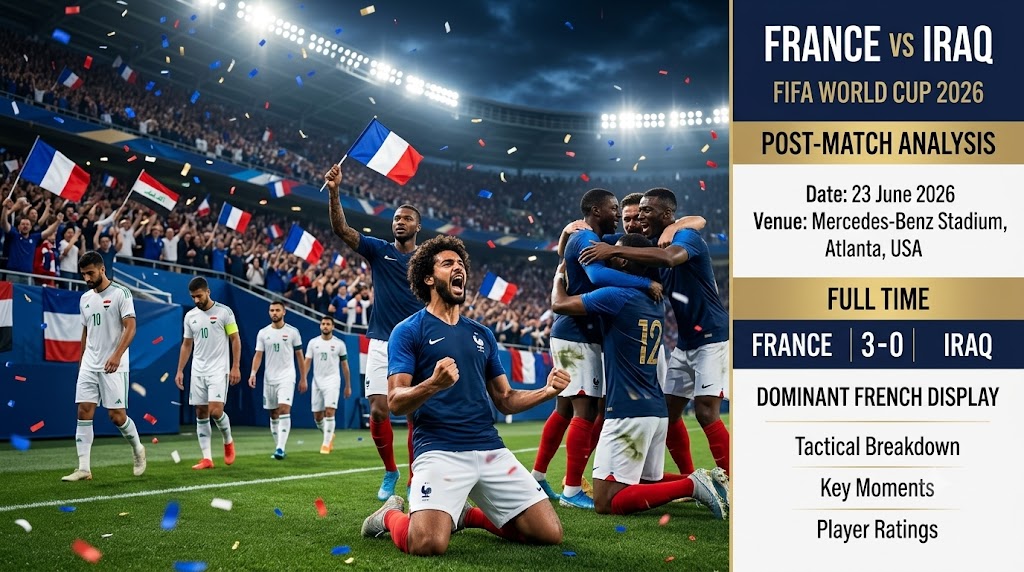
Despite the disruptive conditions, France showed complete maturity, securing a convincing 3-0 victory. This comprehensive France vs Iraq 3-0 post match analysis takes a deep dive into the tactical adjustments, positional overloads, and structural errors that defined this Group I encounter.
First Half Analysis: Positional Symmetrical Width Meets Mid-Block Resilience
Didier Deschamps deployed his side in a fluid, progressive 4-2-3-1 formation designed to exploit wide channels and manipulate the half-spaces. From the opening whistle, France’s attacking approach heavily utilized structural directness. They combined deep midfield orchestration from Adrien Rabiot and Manu Koné with isolated overloads on the flanks led by Oyarzabal-style wing play from Ousmane Dembélé and Bradley Barcola.
Iraq counteracted with a compact, ultra-defensive 4-5-1 mid-block under manager Jesus Casas. The Asian giants focused on vertical compaction, intending to clog the central channels and force France out wide into predictable, low-probability crossing positions. Early on, Iraq showed aggressive intent, with midfielder Amir Al-Ammari picking up a yellow card in just the 5th minute for trying to disrupt a rapid French transition.
The game’s tactical blueprint fractured in the 14th minute due to a moment of brilliant combination play. Michael Olise, operating intelligently as a roaming playmaker between the lines, collected possession in a pocket of space. He threaded an accurate pass to Kylian Mbappé on the edge of the box. Marking his historic 100th international cap for France, the captain cut inside his defender and unleashed a brilliant strike past Iraqi goalkeeper Ahmed Basil at the near post.
Following the opener, France dictated the rhythm with patient possession, achieving over 70% of the ball. Iraq struggled to transition effectively out of their own half. Their situation worsened in the 26th minute when star striker Aymen Hussein was forced off due to an apparent injury, replaced by Ali Al-Hamadi. As the half came to a close, heavy rainfall and nearby lightning strikes forced the officials to trigger severe weather protocols, leading to an unprecedented two-hour delay.
Second Half Analysis: Tactical Consolidation and Capitalizing on Backline Errors
When both teams finally returned to the pitch after a 130-minute delay, the primary question was how the extreme interruption would affect the tempo of the match. France answered immediately by strangling the game through continuous counter-pressing. Iraq tried to play with an adventurous build-up style out of the back, but this risk backfired against France’s elite pressing system.
In the 54th minute, France’s structural press forced a crucial error. Iraqi defender Rebin Sulaka played a short, risky backpass toward goalkeeper Ahmed Basil following a goal kick. Ousmane Dembélé aggressively closed down the space, forcing a heavy touch from the goalkeeper. Dembélé quickly collected the loose ball and squared it to Mbappé, who tapped it into an empty net to make it 2-0.
This second goal completely broke Iraq’s defensive game plan, forcing them to push higher up the pitch and leaving open spaces behind. France exposed these gaps in the 66th minute. The outstanding Michael Olise drove into the final third, drawing two defenders before supplying a perfectly weighted through-ball to Omane Dembélé. The Paris Saint-Germain winger fired a powerful, low right-footed shot into the bottom corner, scoring his first-ever major tournament goal for France.
With a 3-0 cushion, Deschamps efficiently managed his squad. He handed vital minutes to young talents, bringing on Rayan Cherki, Désiré Doué, and Maghnes Akliouche. Although Mbappé narrowly missed out on a hat-trick in the 89th minute, France coasted across the finish line with complete defensive composure.
Key Players Performance
France Football Team Analysis
- Kylian Mbappé: Celebrating his 100th senior appearance for Les Bleus, the captain put on a clinical performance. His brace took his tally to 16 career World Cup goals, pulling him level with Germany’s Miroslav Klose and just two behind Lionel Messi. His dangerous positioning off the shoulder of the last defender kept Iraq’s backline constantly retreating.
- Michael Olise: Operating in the central playmaker role, Olise was the main creative link for France. He claimed two assists, demonstrating excellent spatial awareness, line-breaking passes, and high-level decisions in tight spaces.
- Ousmane Dembélé: Beyond scoring his first major tournament goal on his 20th appearance, Dembélé’s defensive work rate was highly impressive. His aggressive press directly created the second goal, proving he is a balanced two-way winger in Deschamps’ tactical system.
Iraq Standout Performers
- Ahmed Basil: While he was involved in the mistake for the second goal, the Iraqi goalkeeper prevented a much larger scoreline. He registered important saves against Upamecano and Mbappé late on, showing good resilience under constant pressure.
- Zidane Iqbal: The former Manchester United midfielder showed brief flashes of high technical quality. He recorded a 85% pass completion rate under pressure and tried to spark attacking moves from deep positions.
Tactical Breakdown
An expert-level football tactical analysis reveals how France systematically dismantled Iraq’s defensive block through calculated positional rotations:
Formation Variations
Out of possession, France seamlessly transitioned from a 4-2-3-1 into a compact 4-4-2 mid-press, with Olise stepping up alongside Mbappé to cut off Iraq’s central passing angles. Iraq’s structural 4-5-1 shape failed because their wide midfielders didn’t drop back quickly enough to defend against France’s overlapping fullbacks, Jules Koundé and Lucas Digne.
Midfield Control and Counter-Pressing
The double-pivot of Manu Koné and Adrien Rabiot offered excellent structural balance. Koné operated as a traditional defensive anchor, registering 5 recoveries and clean short passes. This allowed Rabiot to advance forward into the half-spaces, overloading Iraq’s central midfielders and creating openings for the front three.
Defensive Structure Comparison
- France: Kept an aggressive, high defensive line. Center-backs William Saliba and Dayot Upamecano choked off long-ball outlets, restricting Iraq to only one shot on target over the 90 minutes.
- Iraq: Deployed a deep low-block but struggled to track secondary runs from deep areas. Their lack of horizontal quickness across the back four made them vulnerable to rapid ball switches.
Turning Point of the Match
While France controlled the first half, the true turning point of the match happened in the 54th minute with Mbappé’s second goal.
During the long two-hour weather delay, Iraq had reorganized into a tight defensive structure, hoping to catch France cold after the long break. However, the high-pressing sequence from Dembélé that forced Basil’s mistake completely ended any hopes of an Iraqi comeback. Conceding a second goal forced Iraq to abandon their defensive low-block, allowing France to comfortably control the rest of the match.
Match Statistics Overview
The data from the Philadelphia Stadium highlights France’s supreme dominance on Matchday 2:
| Match Metric | France | Iraq |
| Possession (%) | 71% | 29% |
| Total Shots | 19 | 3 |
| Shots on Target | 7 | 1 |
| Passing Accuracy (%) | 91% | 76% |
| Corners Conceded | 5 | 2 |
| Fouls Committed | 9 | 12 |
| Yellow Cards | 0 | 1 |
Conclusion
This Iraq vs France match report highlights a clear gap in technical execution and tournament experience. France handled the lengthy, storm-enforced delay with great professionalism. They delivered a balanced performance that secured their place in the Round of 32 with a game to spare.
For Iraq, the 3-0 defeat shows the tough lessons of competing at the highest level of international football. While their defensive effort was admirable in spells, their lack of attacking depth and mistakes at the back cost them dearly.
Looking ahead, France can rotate their squad in their final group match against Norway as they prepare for the knockout rounds. Meanwhile, Iraq faces a decisive match against Senegal, where only a victory will give them a chance of advancing as one of the best third-placed teams.