England 1-2 Argentina: Messi’s Two Assists Break English Hearts Again as Albiceleste Reach Back-to-Back World Cup Finals
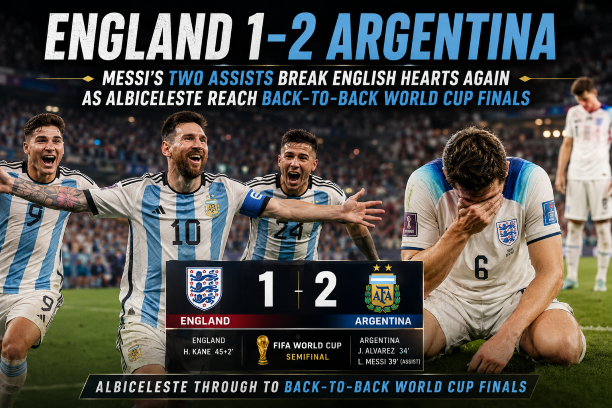
Atlanta — For 37 minutes, England could see the World Cup final. Anthony Gordon had given them the lead, the defence was holding, and a first final since 1966 was within touching distance. Then Lionel Messi decided otherwise. Two assists in the closing stages — one for Enzo Fernández, one for Lautaro Martínez deep in stoppage time — turned a night of English optimism into yet another chapter of heartbreak against Argentina. The reigning champions won 2-1 and booked a second successive World Cup final, where Spain await.
How the match unfolded
England were the better side for long stretches. Thomas Tuchel set his team up to be compact and to hit Argentina on the counter through Gordon and Morgan Rogers, and the plan worked almost to perfection. The breakthrough arrived in the 55th minute: Rogers swung a long, raking cross from the right and Gordon timed his run to volley home at the far post. It was a goal of real quality and, at that moment, England looked like a team that believed.
Argentina, though, are made of stubborn stuff — and they have Messi. The equaliser came in the 85th minute, and it was the captain who created it, slipping the ball to Enzo Fernández on the edge of the box for the Chelsea midfielder to arrow a low, long-range strike beyond Jordan Pickford. Suddenly the momentum flipped, and England — who had defended so well — began to sit deeper and deeper.
The killer blow landed in the 92nd minute. Alexis Mac Allister’s shot cannoned back off the right post, Messi gathered the loose ball, kept his composure as the play reset, and floated a cross to the back post where Lautaro Martínez rose to head Argentina into the final. The Argentine bench emptied; England’s players sank to the turf. It was the third time in World Cup history that Argentina had knocked England out of the tournament, and it followed the familiar, painful script.
Tactical analysis: England’s game plan and where it slipped
Tuchel’s approach deserves credit. England pressed selectively, protected the space in front of their back line, and gave Gordon and Rogers license to break at pace. For an hour it neutralised Argentina’s midfield control and kept Messi at arm’s length from the penalty area.
The problem was the response to going ahead. Rather than pushing for a second, England retreated — a natural instinct against a side of Argentina’s calibre, but a dangerous one. Deep blocks invite pressure, and pressure invites moments of magic. Once Argentina committed numbers forward and Messi drifted into the pockets between England’s midfield and defence, the equaliser felt like a matter of time. Harry Kane, starved of service as England dropped ever deeper, became a peripheral figure at exactly the moment his side needed a focal point to relieve the siege.
The Messi masterclass
At an age when most players have long retired, Messi produced the two decisive contributions of the biggest night of the tournament so far. He did not need to run the game end to end; he simply arrived in the right places at the right times, twice picking the pass that England could not legislate for. It was a reminder that Argentina do not merely rely on their captain — they are built to make his genius count, with runners like Fernández and Martínez timing their movement to his vision. For the neutral, it was a privilege. For England, it was agony.
The controversy and the VAR spotlight
No England-Argentina knockout tie passes without controversy, and this one carried its share of talking points. Both of Argentina’s late goals were subjected to VAR checks — for offside in the build-up and for the position of Argentine players in the box — and both were confirmed after review, decisions England’s players contested but which ultimately stood.
The refereeing operation was itself under a microscope even before kick-off. FIFA had moved its VAR officials into the stadium for the semifinals rather than running reviews from a remote hub, a change that put the video team’s calls under even greater scrutiny. Given the historical baggage between these two nations — from the “Hand of God” of 1986 to the flashpoints of 1998 — every marginal decision was always going to be dissected. In the cold light of the replays, however, the officials got the major calls right; England’s frustration was less about a single injustice than about the cruelty of conceding twice so late.
What it means
For Argentina, this is a stunning achievement: back-to-back World Cup finals and a chance to become the first nation since Brazil (1958 and 1962) to retain the trophy. For England, it is another semifinal near-miss, a fourth successive tournament in which Tuchel’s generation has come agonisingly close without lifting the prize. The performance was not the issue — the execution in the final ten minutes was.
What’s next: the schedule
- Third-place play-off: France vs England — Saturday, July 18, 2026, at Hard Rock Stadium, Miami.
- Final: Spain vs Argentina — Sunday, July 19, 2026, 3:00 p.m. ET, at MetLife Stadium, East Rutherford, New Jersey.
The final pits the world’s No. 1 ranked side, Spain — who beat France 2-0 in the first semifinal — against the defending champions. Argentina will lean on Messi one more time; Spain, coached to control games through possession, will fancy their chances of denying him a fairytale farewell. England, meanwhile, must dust themselves off for a third-place meeting with France that neither side truly wants but pride demands they win.
Stay with Prime Hunt Daily for full coverage of the World Cup 2026 final, team news and match analysis.