Brazil vs Morocco: Post Match Analysis FIFA World Cup 2026
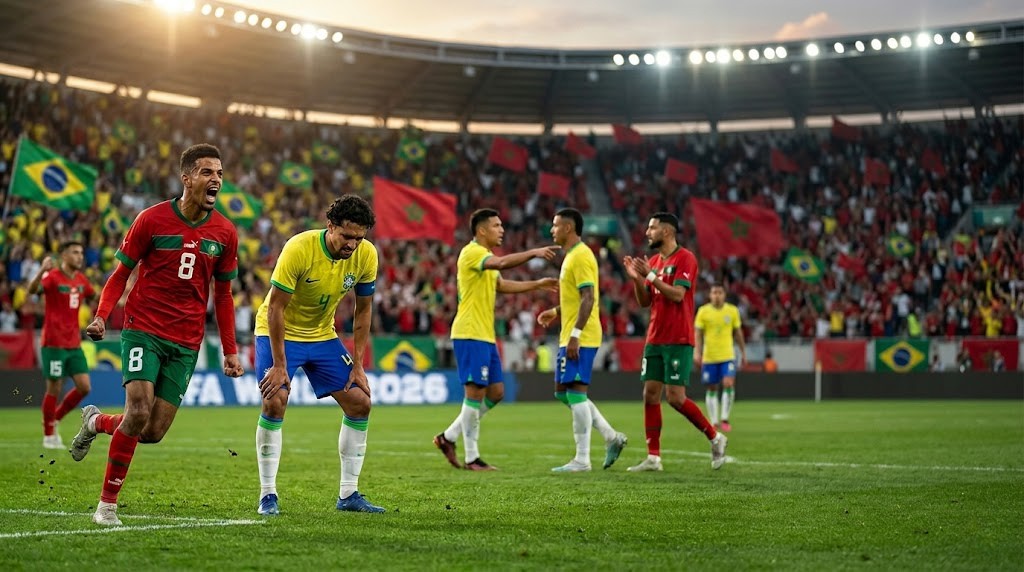
The FIFA World Cup 2026 has officially ignited with one of the most highly anticipated Group C fixtures. When five-time champions Brazil met an ambitious and tactically astute Morocco at the New York New Jersey Stadium, expectations were sky-high. Under the guidance of Carlo Ancelotti, Brazil arrived with a squad overflowing with individual brilliance and a hunger to end their 24-year quest for global supremacy. Conversely, Morocco stepped onto the pitch determined to prove that their historic run in the 2022 tournament was merely the beginning of a golden era for the Atlas Lions.
This match carried immense group-stage significance. As the two highest-ranked teams in Group C, both nations understood that securing three points would provide a massive leap toward the knockout stages, while a loss could invite immediate pressure. The resulting 1-1 draw proved to be a mesmerizing tactical clash, characterized by Morocco’s fearless early aggression and Brazil’s reliance on moments of isolated genius.
Match Overview
- Date: June 13, 2026
- Venue: New York New Jersey Stadium (East Rutherford, New Jersey)
- Kick-off time: 18:00 Local Time
- Final result: Brazil 1 – 1 Morocco
- Winning margin: Draw
How The Match Unfolded
First Half
The opening 45 minutes painted a picture very few analysts predicted. Morocco dictated the tempo, employing a blistering high press that completely disrupted Brazil’s midfield pivot of Casemiro and Bruno Guimarães. The Atlas Lions registered a staggering 12 shots in the first half alone. Their intense pressure paid off in the 20th minute when Brahim Díaz capitalized on a loose ball, executing a perfect pass that split Gabriel Magalhães and Marquinhos. Ismael Saibari latched onto the pass and elegantly lobbed the ball over Alisson to make it 1-0. Despite being outplayed systemically, Brazil’s individual quality shone through. Against the run of play in the 31st minute, Vinícius Júnior cut inside and bent a stunning effort into the top corner to level the score.
Second Half
Recognizing the structural issues, Carlo Ancelotti made sweeping changes at halftime, introducing Fabinho and Danilo to replace the struggling Casemiro and Ibañez. The substitutions brought necessary stability. The game state shifted dramatically; Morocco’s high-energy press began to fade, and they recorded zero touches in the opposition box by the 65th minute. Brazil started to dictate possession, probing the Moroccan low block. Lucas Paquetá tested Yassine Bounou with an acrobatic effort early in the half, while Igor Thiago fired a fierce strike that was also beaten away by the Moroccan keeper.
Final Stages
As the clock ticked down, the match opened up into a tense, end-to-end affair. In the 84th minute, Bounou showcased incredible sweeping skills, rushing off his line to deny Raphinha. Despite Brazil’s late possession dominance, it was Morocco who almost snatched a dramatic victory deep into stoppage time. In the 98th minute, Alisson was forced into a heroic double save, first parrying a long-range effort from Neil El Aynaoui and then instantly denying Ayoube Amaimouni’s follow-up, ensuring the points were shared.
Brazil Performance Analysis
Attacking approach
Brazil’s attacking setup relied heavily on the individual brilliance of their wide players rather than cohesive team buildup. Generating 1.27 expected goals (xG), the Seleção frequently looked to isolate Vinícius Júnior on the left flank. The lack of collective attacking fluidity meant that when their primary playmakers were stifled, the team struggled to create high-quality chances.
Midfield control
The midfield was undoubtedly Ancelotti’s biggest concern. The starting trio of Casemiro, Bruno Guimarães, and Lucas Paquetá found the distances between them too large in the first half. This disjointed shape allowed Morocco to easily bypass the midfield line with simple forward passes. It was only after Fabinho’s introduction at halftime that Brazil managed to establish a foothold in the center of the park.
Defensive organization
Brazil’s backline was frequently exposed during transitions. Roger Ibañez struggled under pressure, earning a yellow card before being hooked at halftime. Marquinhos and Gabriel Magalhães found themselves in uncomfortable one-on-one situations against Morocco’s rapid attackers. However, the team tightened up significantly in the second half, restricting Morocco’s box entries.
Al Jazeera
Key players
Vinícius Júnior was the undeniable spark, scoring a sensational goal that masked a largely disjointed team performance. In goal, Alisson Becker was an absolute wall; his 98th-minute double save single-handedly rescued a point for his country.
Strengths and weaknesses
Brazil’s primary strength remains their world-class individual talent, capable of scoring out of nothing. Their glaring weakness, however, was their vulnerability to a coordinated high press and poor midfield compactness, which left the defense drastically exposed.
Morocco Performance Analysis
Tactical discipline
Morocco executed their game plan to perfection in the opening 45 minutes. Their coordinated pressing traps rattled the Brazilian defense and forced turnovers in dangerous areas. Even as fatigue set in during the second half, their structural discipline in a deeper block demonstrated immense maturity.
Counterattacking threat
Transition play was Morocco’s greatest weapon. Brahim Díaz operated brilliantly in the half-spaces, punishing Brazil’s disconnected midfield. The Atlas Lions recorded 14 shots overall and consistently threatened on the break through the pace of Achraf Hakimi and Ismael Saibari.
Possession play
Remarkably, Morocco held 49% possession against one of the most dominant teams in world football. They did not simply sit back and absorb pressure; they utilized the ball intelligently, cycling possession to draw Brazil out before striking vertically.
Defensive setup
When the high press became physically unsustainable, Morocco retreated into a resilient low block. The defensive line, marshaled by Issa Diop and Chadi Riad, dealt incredibly well with Brazil’s crosses and sustained pressure. Yassine Bounou’s sweeping abilities provided the ultimate safety net.
Standout performers
Ismael Saibari was electric, capping off a fine team move with a delicate finish. Brahim Díaz pulled the strings effortlessly in the first half, while Neil El Aynaoui was a combative presence who almost won the game in stoppage time.
Match-Winning Moments
While the match ended in a draw, three pivotal moments defined the outcome. The first was Ismael Saibari’s 20th-minute goal; the composure required to lob a goalkeeper of Alisson’s caliber set the tone for Morocco’s fearless display. The second was Vinícius Júnior’s 31st-minute equalizer. Arriving entirely against the run of play, his curled effort into the top corner was a stark reminder of Brazil’s latent lethality. The ultimate match-defining moment, however, occurred in the 98th minute.
Standout Players
Vinícius Júnior (Brazil) – 8/10 [Player of the Match]
In a match where Brazil struggled collectively, Vinícius was the solitary bright spark. His individual magic produced the equalizer, and he constantly demanded the ball, looking to create something out of nothing.
Ismael Saibari (Morocco) – 8/10 [Best Attacker]
Saibari was a constant thorn in the side of the Brazilian defense. His movement off the ball was intelligent, and his finish over Alisson was breathtakingly composed.
Achraf Hakimi (Morocco) – 7.5/10 [Best Defender]
Operating high up the pitch, Hakimi’s average position was the third most advanced of any Moroccan player in the first half. He hammered a shot wide early on and fulfilled his defensive duties admirably against elite wingers.
Sky Sports
Neil El Aynaoui (Morocco) – 7.5/10 [Surprise Performer]
Tasked with battling the likes of Casemiro and Guimarães, El Aynaoui was fearless. He broke up play effectively and nearly etched his name into folklore with a thunderous late strike.
Key Match Statistics Table
| Statistic | Brazil | Morocco |
| Possession | 51% | 49% |
| Shots | 13 | 14 |
| Shots on Target | N/A (Official Data Unavailable) | N/A (Official Data Unavailable) |
| Pass Accuracy | N/A (Official Data Unavailable) | N/A (Official Data Unavailable) |
| Fouls | N/A (Official Data Unavailable) | N/A (Official Data Unavailable) |
| Corners | 6 | 2 |
| Yellow Cards | 2 | 0 |
| Saves | 2 | 4 |
Biggest Talking Points
- The Tactical Battle: Ancelotti’s failure to establish early midfield dominance versus Morocco’s masterful high press.
- Star Performers Rescuing the Favorites: Brazil required a moment of sheer brilliance from Vinícius Júnior and a miraculous stoppage-time double save from Alisson to survive the fixture.
- Momentum Gained: Morocco proving once again that they are not just participants, but genuine heavyweights on the global stage.
Frequently Asked Questions
Q.1 Who won Brazil vs Morocco?
The match ended in a 1-1 draw. Neither team secured a victory.
Q.2 Who scored the goals in the match?
Ismael Saibari opened the scoring for Morocco in the 20th minute, and Vinícius Júnior equalized for Brazil in the 31st minute.
Q.3 Who was the Player of the Match?
While official FIFA honors vary, Vinícius Júnior was the undeniable standout for rescuing Brazil with an incredible individual goal.
Q.4 What does the result mean for the FIFA World Cup standings?
Both teams earned one point, leaving Group C wide open as they look ahead to their next fixtures.
Q.5 Which players impressed the most?
For Brazil, Vinícius Júnior and Alisson Becker were critical. For Morocco, Ismael Saibari, Brahim Díaz, and Neil El Aynaoui delivered exceptional performances.
Q.6 What are the qualification implications?
With only one point secured by both favorites, neither team is guaranteed advancement yet. They will both push aggressively for victories in Matchday 2.
Q.7 Did anyone receive a red card?
No. Only two yellow cards were issued, both to Brazilian players (Casemiro and Roger Ibañez) in the first half.
Conclusion
The Brazil vs Morocco FIFA World Cup 2026 clash delivered exactly the type of tactical intrigue and high-stakes drama expected from the sport’s greatest tournament. Morocco’s fearless approach and calculated pressing exposed vulnerabilities in a Brazilian side that ultimately had to rely on elite individual talent to secure a point. As the dust settles at the New York New Jersey Stadium, both nations will take valuable lessons into their next Group C fixtures. For football tacticians and fans alike, this match serves as a thrilling reminder of why the World Cup remains the pinnacle of the beautiful game.