Argentina vs Austria Post-Match Analysis: Messi Makes History in Dallas
Introduction
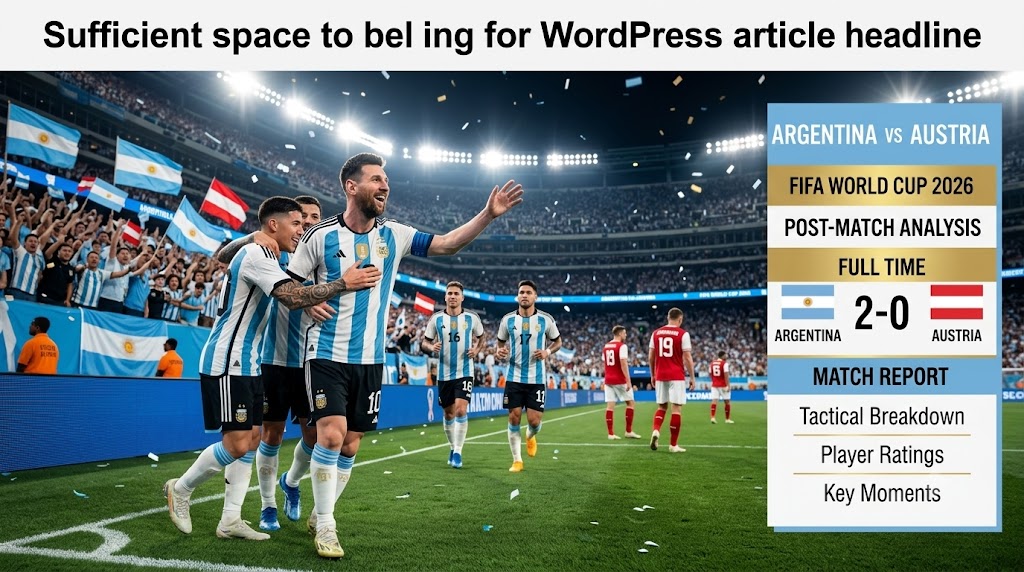
The FIFA World Cup 2026™ is producing its share of dramatic narratives, but few will be as enduring as the scenes witnessed at Dallas Stadium on Monday night. In a high-stakes Group J encounter, reigning world champions Argentina secured a clinical 2-0 victory over a spirited Austria side, officially booking their ticket to the Round of 32.
While the match report will highlight the scoreline, the true headline belongs to Lionel Messi. After an early penalty miss threatened to derail his historic pursuit, the Argentine captain responded with a brace that saw him eclipse Miroslav Klose to become the all-time leading scorer in men’s FIFA World Cup history. For Austria, it was a night of tactical discipline undone by the brilliance of an icon, leaving Ralf Rangnick’s side with plenty to reflect on as the group stage concluded.
Match Statistics Review
A glance at the numbers underlines Argentina’s dominance in this FIFA Match Review:
- Possession: Argentina 58% – 42% Austria
- Shots (on target): Argentina 14 (6) – 6 (2) Austria
- Chances Created: Argentina 9 – 3 Austria
- Defensive Records: Argentina limited Austria to very few clear-cut openings, with Cristian Romero and Lisandro Martínez winning the majority of their aerial duels.
The statistics clearly show that Argentina deserved their two-goal cushion, dictating the rhythm of the game and starving the Austrian attack of meaningful service.
First Half Analysis
Argentina began the contest with palpable intent, dominating possession and looking to carve open the European side’s rearguard. The tone was set early when Lautaro Martínez was felled in the box, resulting in a VAR-awarded penalty. However, in a dramatic twist, Messi dragged his spot-kick wide, offering Austria an unexpected reprieve.
Following the let-off, Austria Football Team Analysis showed a disciplined mid-block taking shape. Stefan Posch and David Alaba worked tirelessly to close down passing lanes, restricting the space available to Thiago Almada and Messi between the lines.
Despite the European side’s resilience, Argentina’s sustained pressure eventually cracked the code in the 38th minute. A sublime dummy from Almada allowed the ball to run through to Messi, who clinically finished into the bottom corner for his record-breaking 17th tournament goal. Posch picked up a yellow card shortly after as frustration began to creep into the Austrian ranks.
Second Half Analysis
The second half turned into a tense tactical arm-wrestle. Knowing a single goal advantage remained precarious, Austria emerged with greater attacking intent, pushing higher up the pitch and trying to test the Argentine centre-backs.
Lionel Scaloni responded proactively around the hour mark, introducing fresh legs in Julián Alvarez and Nicolás González to add verticality to Argentina’s transitions. As the game opened up, Austria poured bodies forward, leaving spaces at the back. The contest grew feisty, culminating in a 75th-minute double booking for Argentina’s Facundo Medina and Austria’s Konrad Laimer.
Scaloni further reinforced his midfield spine by introducing Leandro Paredes and Nicolás Tagliafico, effectively suffocating Austrian attacks before they reached the final third. With Austria overcommitted in the dying seconds of stoppage time, Messi led a rapid counter-attack, reacting quickest to a rebound inside the box to bundle home his second of the evening and secure the Argentina vs Austria 2-0 Post Match Analysis scoreline.
Key Players Performance
Argentina
- Lionel Messi: The undisputed talisman. Despite an uncharacteristic penalty miss, his movement, vision, and ruthless finishing ensured he claimed the headlines once again, moving to 18 career World Cup goals.
- Facundo Medina: Delivered an outstanding shift at the back and provided the crucial assist for the opening goal before being subbed off.
- The Midfield Engine Room: The trio of Rodrigo De Paul, Alexis Mac Allister, and Enzo Fernández controlled the tempo, winning the physical battles and recycling possession efficiently.
Austria
- David Alaba: Commanded the defensive line with authority, making crucial interventions and blocks to keep his side in the contest for over 80 minutes.
- Konrad Laimer: Covered immense ground in the centre of the park, breaking up opposition plays and trying to spark transitions.
- Alexander Schlager: Kept the scoreline respectable with several sharp saves before the late stoppage-time scramble.
Tactical Breakdown
This Football Tactical Breakdown highlights two contrasting philosophies on the international stage:
- Formations: Argentina lined up in a fluid 4-4-2 that morphed into a narrow 4-3-1-2 in possession, affording Messi freedom to roam. Austria utilized a compact 4-2-3-1 designed to absorb pressure and launch quick counters.
- Midfield Battle: Austria sought to outnumber Argentina in central areas using Nicolas Seiwald and Xaver Schlager, but Argentina’s technical superiority in retaining the ball eventually wore down the Austrian press.
- Defensive Organization: Rangnick’s side relied on a deep block and offside traps, but lacked the attacking punch required to truly test Emiliano Martínez, managing just two shots on target across the 95 minutes.
Turning Point of the Match
The defining moment arrived in the 38th minute prior to the opening goal. While the penalty miss earlier in the half could have psychologically weighed down the South Americans, the sheer composure shown in the buildup—specifically Almada’s dummy to bypass the Austrian press—unlocked the game.
Once Messi broke the deadlock, the burden shifted entirely to Austria, who had to abandon their low-block and chase the game, ultimately playing right into Argentina’s lethal transition play.
Match Statistics Review
The statistics reflect a game where Argentina’s efficiency outweighed Austria’s defensive bravery:
| Metric | Argentina | Austria |
| Possession | 58% | 42% |
| Shots on Target | 6 | 2 |
| Passing Efficiency | 87% | 76% |
| Yellow Cards | 2 | 2 |
Argentina dominated the possession phase, and while Austria’s defensive numbers were commendable for the majority of the match, their inability to sustain a goal-scoring threat—evidenced by only two shots on target—ultimately limited their chances of securing a point.
What This Result Means
For Argentina, this victory is a statement of intent. Not only have they secured their path to the Round of 32, but they have done so with a perfect record in Group J. The morale boost of Messi breaking the all-time scoring record provides the perfect momentum heading into the knockout stages.
For Austria, the defeat is a setback, but their performance against the world champions suggests they are a competitive unit. They must now focus on their final group game, needing a positive result to ensure they remain in the conversation for the knockout bracket.
Conclusion: A Historic Night in Dallas
The 2-0 scoreline suggests a comfortable win, but this Argentina vs Austria post-match analysis confirms a far more nuanced story. While Austria proved to be a stubborn opponent, the individual genius of Lionel Messi, combined with Argentina’s collective defensive pragmatism, ensured that the Albiceleste maintained control.
With qualification secured, Argentina enters the next phase of the 2026 World Cup with a perfect blend of confidence and resilience. As for Austria, the challenge now is to channel the lessons from this match into a strong finish to their group stage campaign.