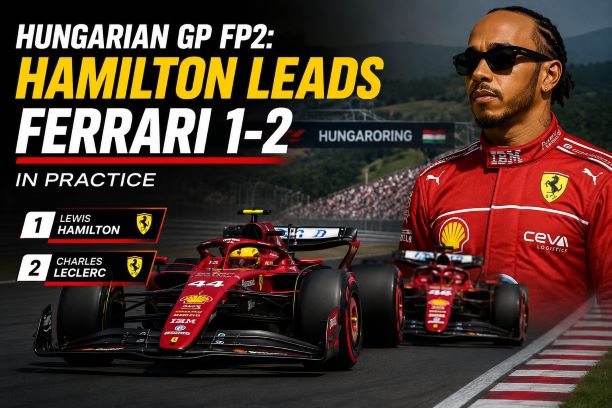
Hungarian GP FP2: Hamilton Leads Ferrari 1-2 in Practice
The twisty, undulating layout of the Hungaroring has historically served as a rigorous examination of aerodynamic efficiency, mechanical grip, and chassis agility. As the paddock settled into the opening day of the Hungarian Grand Prix, Scuderia Ferrari issued a resounding statement of intent.
Seven-time world champion Lewis Hamilton topped the timesheets in a dominant Free Practice Two, edging out teammate Charles Leclerc by 0.148 seconds to secure a commanding 1-2 finish for the Maranello-based squad.
With Ferrari displaying formidable one-lap speed and controlled balance across both sessions, the historic circuit on the outskirts of Mogyoród is buzzing with the prospect of a genuine red-colored resurgence. As the championship battles heat up, Friday’s running suggests the Scuderia could well dictate terms through the remainder of the Hungarian GP weekend.
Friday Practice Summary
The opening day of track action at the Hungaroring delivered contrasting fortunes across the pit lane, punctuated by fluctuating track temperatures and localized surface grip issues.
In Free Practice One, Charles Leclerc laid down an early marker by setting the fastest time of 1:19.075, outpacing Max Verstappen’s Red Bull by nearly half a second, with Lewis Hamilton slotting into third.
As ambient and track temperatures shifted into the afternoon for FP2, teams transitioned to qualifying simulations on the soft compound tyres. Hamilton responded with a blistering benchmark lap of 1:18.729, leading Leclerc as the only drivers to dip into the 1:18 bracket during the session.
The 60-minute afternoon running was briefly interrupted by a red flag when Alpine’s Franco Colapinto spun on entry to the final corner, tagging the barrier and causing rear suspension damage.
Once the circuit was cleared, a frantic period of qualifying and long-run simulations ensued, with Lando Norris dragging his McLaren to third overall, nearly half a second adrift of the pace.
FP2 Top 10 Classification
- Lewis Hamilton (Ferrari) — 1:18.729
- Charles Leclerc (Ferrari) +0.148s
- Lando Norris (McLaren) +0.499s
- Max Verstappen (Red Bull) +0.692s
- George Russell (Mercedes) +0.933s
- Isack Hadjar (Red Bull) +1.071s
- Liam Lawson (Racing Bulls) +1.312s
- Oscar Piastri (McLaren) +1.372s
- Nico Hülkenberg (Audi) +1.396s
- Arvid Lindblad (Racing Bulls) +1.524s
Ferrari’s Dominant Performance
Ferrari’s speed on Friday was neither a flash in the pan nor a product of low-fuel trickery; it was a comprehensive display of mechanical stability. The Scuderia arrived in Hungary with fine-tuned setup adjustments aimed at maximizing mid-corner rotation—a critical requirement for the sweeping, technical turns of the Hungaroring.
Throughout FP1 and FP2, the SF26 demonstrated exceptional compliance over the circuit’s notoriously bumpy curbing.
Drivers were able to attack apexes with supreme confidence, particularly in the notoriously tricky second sector. Furthermore, Ferrari’s race simulations revealed encouraging tyre degradation management on both the medium and soft compounds, alleviating historical concerns regarding rear-tyre thermal decay over longer stints.
Lewis Hamilton Analysis
Lewis Hamilton’s mastery of the Hungaroring—where he holds a legendary record of success—was evident from his very first installation lap. The British veteran looked entirely at one with his machinery during FP2, extracting maximum performance during the qualifying simulation runs.
Analysts noted a marked improvement in rear-end stability under braking compared to previous rounds, allowing Hamilton to rotate the car sharply into low-speed hairpins without suffering mid-corner understeer.
Setting the pace at 1:18.729, Hamilton’s ability to weave through the complex sequence of changes of direction highlights his growing synergy with the Ferrari technical group. Sitting second in the Drivers’ Championship standings, this performance serves as an ominous warning to his title rivals.
Charles Leclerc Analysis
While Hamilton grabbed the headlines with the fastest time, Charles Leclerc’s Friday execution underscored the collective strength of the team. Having topped FP1, Leclerc maintained blistering consistency across all stint lengths.
His feedback to the pit wall remained precise, focusing on fine-tuning differential settings to cope with shifting track evolution.
Leclerc’s long-run pace in FP2 matched Hamilton’s sector-for-sector, proving that Ferrari holds a distinct dual-car advantage heading into the weekend. His smooth driving style allowed him to preserve his rubber effectively, setting up an intra-team battle for pole position.
Rivals Analysis: McLaren, Red Bull, and Mercedes
McLaren
McLaren emerged as Ferrari’s closest challenger, though Lando Norris admitted the team is still chasing optimal balance. Norris salvaged third place with a tidy lap late in FP2, finishing 0.499s off Hamilton. However, teammate Oscar Piastri struggled more with balance, ending down in eighth as McLaren evaluates floor tweaks to combat high-speed bouncing.
Red Bull
Red Bull endured a frustrating Friday. Max Verstappen could manage only fourth fastest, finishing nearly seven-tenths down on the benchmark. The reigning world champion openly complained over team radio of a “super stiff” rear axle and a chronic lack of rear grip during his medium-tyre long runs. Teammate Isack Hadjar finished sixth, but Red Bull clearly faces an overnight engineering overhaul to unlock competitive pace.
Mercedes
Mercedes experienced a polarized day. While George Russell extracted respectable pace to round out the top five, championship leader Andrea Kimi Antonelli suffered a difficult session. Antonelli finished 13th, hampered by persistent rear lockups under braking and completing his fastest runs on the medium compound rather than softs. Nevertheless, Mercedes’ race simulation metrics suggest their traditional tyre-saving prowess cannot be discounted for Sunday.
Technical Breakdown
The technical narrative of the Hungaroring centers on maximum downforce configurations and thermal envelope management.
- Aerodynamic Setup: Teams ran maximum downforce wings, maximizing vertical load through the circuit’s prolonged lateral-loading corners. Ferrari’s efficient floor geometry allowed them to generate high downforce without excessive drag penalties on the short straight stretches.
- Tyre Strategy: Pirelli’s compound allocation faced stern tests from track temperatures exceeding 40°C. Ferrari excelled at keeping thermal degradation under control, whereas Red Bull struggled to switch on the front axle without inducing rear instability.
- Sector Analysis: Ferrari swept the charts by virtue of superior apex speeds in Sector 2, where mechanical grip dictates lap time.
Key Talking Points
- Ferrari’s Resurgence: The sheer margin of Ferrari’s dominance caught the paddock off guard, establishing them as the team to beat.
- Aston Martin’s Upgrades: Aston Martin arrived with a heavily revised B-spec aerodynamic package. However, technical gremlins ended Lance Stroll’s FP1 early with suspension failure, leaving the team scrambling to fly in spare parts for the remainder of the weekend.
- Track Surface Scrutiny: Several drivers expressed frustration over deteriorating asphalt patches and bumps around the circuit, prompting FIA monitoring ahead of qualifying.
What This Means for Qualifying and Beyond
Friday practice evidence firmly crowns Ferrari as the early favorites for pole position. Their ability to switch on the soft compound tyre instantaneously gives them a distinct advantage heading into Saturday’s knock-out sessions.
However, track evolution at the Hungaroring is notoriously rapid. If McLaren can refine its low-speed balance overnight, and if Red Bull resolves its rear-axle stiffness, the gap at the front will inevitably narrow.
Mercedes, too, remains a dark horse should ambient temperatures drop ahead of the Grand Prix.
Expert Verdict
Ferrari’s Friday masterclass at the Hungaroring was a clinical demonstration of engineering precision and driver confidence. Lewis Hamilton and Charles Leclerc look exceptionally comfortable in the SF26, giving the Scuderia a golden opportunity to convert practice pace into a landmark weekend victory.
While Formula 1’s competitive order can shift rapidly once fuel loads drop and engine modes turn up in qualifying, Ferrari has rightfully earned the mantle of the team to beat in Hungary.