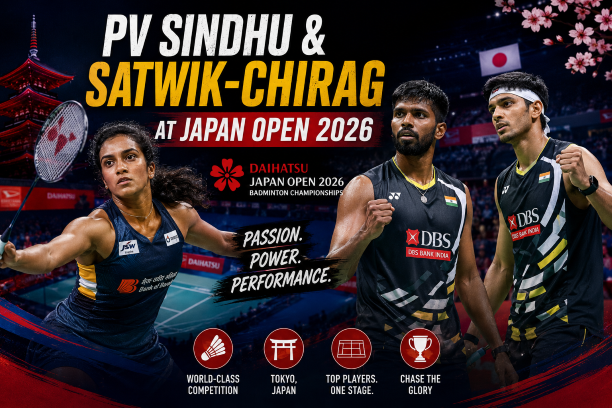
PV Sindhu & Satwik-Chirag at Japan Open 2026
Introduction
The opening day of a major BWF World Tour Super 750 event often serves as an unvarnished mirror, reflecting both the soaring ambitions and the fragile physical realities of elite sport. For the Indian contingent at the Japan Open 2026 in Tokyo, Tuesday delivered an afternoon of sharply contrasting fortunes. On one side of the emotional spectrum, two-time Olympic medallist PV Sindhu authored a crisp, authoritative masterclass to book her spot in the second round. On the other, the much-anticipated return of India’s premier men’s doubles duo, Satwiksairaj Rankireddy and Chirag Shetty, was cruelly cut short by a familiar physical demon.
These mixed results underline the unforgiving nature of the international circuit. While Sindhu navigated her opener with measured control and clinical tactical execution, the premature exit of Satwik and Chirag raises pressing questions about physical load management with major global championships looming just over the horizon. This analysis examines the technical masterclass delivered by Sindhu, the tactical architecture of her victory, and the sobering reality of the doubles setback in Tokyo.
Match Overview
- Tournament: Japan Open 2026 (BWF World Tour Super 750)
- Venue: Tokyo, Japan
- Date: Tuesday, July 14, 2026
- Women’s Singles Result: PV Sindhu def. Wong Ling Ching (Malaysia) 21-14, 21-11
- Men’s Doubles Result: Mads Vestergaard and Daniel Lundgaard (Denmark) def. Satwiksairaj Rankireddy and Chirag Shetty 21-19 (Retired)
- Key Headlines: Sindhu storms into the Round of 16 in 35 minutes; Satwik-Chirag forced to retire due to Satwik’s recurring shoulder injury.
PV Sindhu’s Dominant Performance
PV Sindhu stepped onto Court 2 with a clear objective: establish authority early and spend minimal energy doing so. Facing Malaysia’s Wong Ling Ching, the world No. 10 Indian star executed her game plan to near perfection, wrapping up a 21-14, 21-11 victory in just 35 minutes. From the very first rally, Sindhu looked entirely in control, dictating the tempo and imposing her physical reach across all four corners of the court.
Her shot selection was disciplined. Instead of forcing outright winners from disadvantageous positions, she constructed rallies patiently, using a sharp, penetrating drop-shot to pull Wong forward before capitalizing on loose lifts with steep, thunderous smashes. Her court coverage was effortless, and her net play exhibited a renewed sense of touch. There was no hesitation or tactical confusion; Sindhu looked confident, composed, and mentally locked in from the opening whistle to match point.
What This Means for India’s Doubles Campaign
The premature retirement of Satwik and Chirag sends immediate shockwaves through India’s elite doubles planning. With the BWF World Championships scheduled to take place in New Delhi next month, preserving the physical integrity of the country’s talismanic pair takes absolute priority over short-term tournament entries.
Losing valuable match practice at a Super 750 event disrupts their competitive rhythm, but smart fitness management remains the only viable path forward. The focus must now shift entirely toward comprehensive rehabilitation, ensuring that when they finally return to the competitive arena, they are operating at 100% capacity without the lingering shadow of joint instability.
Other Indian Performances
Tuesday also brought action for other members of the Indian delegation in Tokyo. In the mixed doubles draw, Olympian Tanisha Crasto and Dhruv Kapila delivered an assured, tactically disciplined performance to defeat Scotland’s Alexander Dunn and Julie Macpherson 21-16, 21-14, advancing comfortably to the second round.
However, it was a harsh welcome to the main draw for Rohan Kapoor and Ruthvika Shivani Gadde, who bowed out after a 21-11, 21-10 defeat against the world No. 1 Chinese top seeds, Feng Yanzhe and Huang Dongping. Meanwhile, in men’s doubles, Hariharan Amsakarunan and Arjun M.R. put up a brave fight against Chinese Taipei’s Yang Po-Hsuan and Lee Jhe-Huei before dropping a close three-game encounter 21-13, 17-21, 21-7.
Expert Analysis
PV Sindhu’s progression highlights the immense value of tactical maturity. Her ability to keep rallies uncomplicated and leverage her height advantage allowed her to conserve vital physical reserves—an essential trait for deep runs in grueling Super 750 draws. Her technical improvements in flat-racket exchanges at the forecourt were particularly striking.
On the flip side, the Satwik-Chirag situation illustrates the fine margin between peak athletic output and physical breakdown in modern men’s doubles. Badminton has evolved into an extraordinarily punishing sport where the sheer power required in modern smash-and-defend sequences places intolerable stress on rotator cuff units. Going forward, Indian badminton must institutionalize deeper sports science monitoring and more cautious return-to-play protocols to prevent recurring injury spikes ahead of major multi-sport games.
Key Talking Points
- Sindhu’s Assured Momentum: Cruising through an opening match in 35 minutes provides the ideal physical and psychological springboard heading into the deeper rounds.
- The Doubles Health Crisis: Satwik’s recurring shoulder issue underscores the urgent need for conservative rehabilitation rather than rushed tournament comebacks.
- Mixed Doubles Resiliency: Crasto and Kapila’s smooth progression offers a welcome bright spot in an otherwise testing day for India’s doubles contingent.
- Top-Tier Circuit Demands: Facing world No. 1 pairs like Feng and Huang serves as a stark technical benchmark for emerging Indian combinations.
Standout Performers
- Best Indian Player: PV Sindhu. Immaculate control, flawless court discipline, and lightning-fast execution in her straight-games win.
- Most Improved Performance: Tanisha Crasto and Dhruv Kapila. Showed great spatial coordination and composure to outmaneuver their Scottish opponents.
- Biggest Positive: Sindhu’s economic use of energy, leaving her fresh for the challenges of the Round of 16.
- Biggest Concern: The long-term recovery outlook for Satwiksairaj Rankireddy’s shoulder ahead of the World Championships.
- Player to Watch in Round Two: PV Sindhu, as she prepares to test her form against stiffer competition.
Final Thoughts
Tuesday at the Japan Open offered an unvarnished snapshot of competitive sport’s dual nature. India celebrates the clinical efficiency and enduring class of PV Sindhu as she marches into the second round with style. Yet, that joy is tempered by the sobering reality of Satwik and Chirag’s injury withdrawal.
As the tournament rolls into its second day, the broader landscape of Indian badminton remains full of promise, provided physical management takes center stage. With resilience in the singles draws and valuable lessons learned in the doubles, hope remains high for a strong campaign in the Japanese capital.