The 2027 ODI World Cup Format Explained: Super Series, Super Seven and Everything That’s Changing
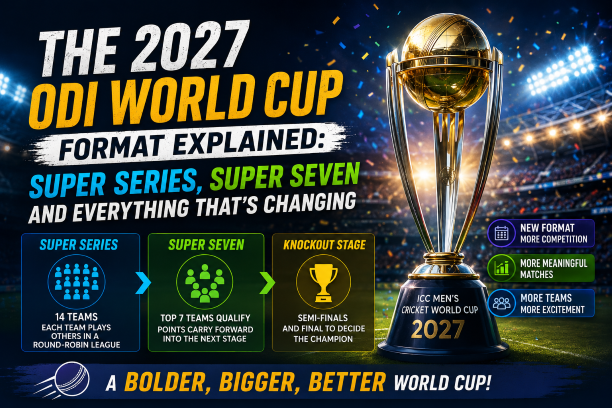
The ICC Men’s ODI Cricket World Cup is getting its biggest structural overhaul in years. When the tournament returns in 2027 — co-hosted by South Africa, Zimbabwe and Namibia from 4 October to 21 November 2027 — it will do so with a brand-new, multi-stage format built around two never-before-seen rounds: the Super Series and the Super Seven. If you found the 2023 edition’s simple round-robin easy to follow, brace yourself: the 2027 event is a very different beast. Here is everything you need to know, explained in depth.
The headline: 14 teams, but not all of them survive to the “main” event
The 2027 World Cup expands to 14 teams, up from the 10 that contested the 2023 edition in India. But the extra places come with a twist. Rather than throwing all 14 sides straight into the group stage, the ICC has introduced a qualifying-style knockout within the tournament itself. Two of the 14 teams will be eliminated before the group phase even begins. In other words, simply qualifying for the World Cup no longer guarantees you a place in the group stage.
Stage 1 — The Super Series
The tournament opens with the Super Series, a mini round-robin between the three lowest-ranked qualified teams. All three play each other once, and only the winner advances to the group stage. The other two are eliminated. It is, effectively, a play-in round that decides the twelfth and final group-stage berth.
This is where co-host Namibia’s status matters. Because Namibia is not a Full ICC Member, it has not been granted automatic qualification as a host. If Namibia does not rank high enough to qualify directly, it will have to fight through the Super Series to reach the group stage of its own home World Cup — a scenario that has already drawn plenty of debate.
Stage 2 — The Group Stage (two groups of six)
Once the Super Series winner is confirmed, the field is 12 teams. These are split into two groups of six. Each team plays the other five in its group once, producing 30 group-stage matches in total (15 per group). The top teams from each group carry forward into the next round.
Stage 3 — The Super Seven
This is the genuinely new idea. Seven teams qualify for the Super Seven stage: the top three from each group (six teams) plus the best fourth-placed side across both groups (one team). Those seven then play another full round-robin — everyone against everyone once — for a further 21 matches. The top four in the Super Seven table progress to the semifinals.
Whether points earned in the group stage carry over into the Super Seven (as they did in the old Super Six of the 1999 and 2003 World Cups) is the detail fans will want confirmed closest to the event, as it dramatically changes how teams approach the group phase.
Knockouts — Semifinals and Final
From the Super Seven, the top four advance to two semifinals, and the winners meet in the final on 21 November 2027. That part, at least, remains reassuringly familiar.
The format at a glance
| Stage | Teams | Format | Who advances |
|---|---|---|---|
| Super Series | 3 (lowest-ranked) | Round-robin | Winner only (2 eliminated) |
| Group Stage | 12 (two groups of 6) | Round-robin, 30 matches | Top 3 per group + best 4th |
| Super Seven | 7 | Round-robin, 21 matches | Top 4 |
| Semifinals | 4 | Knockout | 2 winners |
| Final | 2 | Knockout | Champions |
How teams qualify
Of the 14 places, 10 are automatic: the two Full Member co-hosts, South Africa and Zimbabwe, plus the eight highest-ranked teams on the ODI rankings, with the cut-off set for September 2026. The remaining four places go to the winners of a global qualifier — currently planned as a 10-team event featuring the next two highest-ranked sides, four teams from the ICC World Cup Cricket League 2, and four from a qualifier play-off.
The key nuance, again, is Namibia: co-hosting earns them a stage on the biggest platform, but not a guaranteed group-stage spot, because host qualification was extended only to the Full Member co-hosts.
How it compares to 2023
The 2023 World Cup used a clean, brutal single round-robin: 10 teams, everyone played everyone, top four to the semifinals. It was easy to follow and every game mattered, but it also meant 45 group games and a long, occasionally one-sided slog. The 2027 model trades that simplicity for more teams, more jeopardy early (the Super Series), and a second round-robin that keeps the strongest sides playing each other deep into the tournament.
The debate: more cricket, or too much?
Supporters argue the format rewards consistency — you cannot sneak through on one hot streak, because you must perform across a group phase and a Super Seven. It also gives Associate and lower-ranked nations a genuine, if narrow, pathway via the Super Series, and guarantees more marquee fixtures between top sides.
Critics counter that eliminating two teams before the “real” tournament starts feels harsh for sides that have already qualified for a World Cup, that the Super Series risks producing dead rubbers, and that the sheer volume of matches over seven weeks tests player workloads and fan attention alike. There is also the optics of a co-host, Namibia, potentially having to qualify for the group stage of its own event.
The bottom line
The 2027 ODI World Cup is bigger, longer and more layered than anything the 50-over game has attempted recently. Whether the Super Series and Super Seven come to be seen as an inspired way to add jeopardy — or an over-engineered detour to the semifinals — will depend on how the drama plays out on the field in South Africa, Zimbabwe and Namibia. One thing is certain: understanding the format before the first ball is bowled will be half the fun.
Prime Hunt Daily will bring you full qualification updates, group draws and match analysis as the 2027 World Cup takes shape.