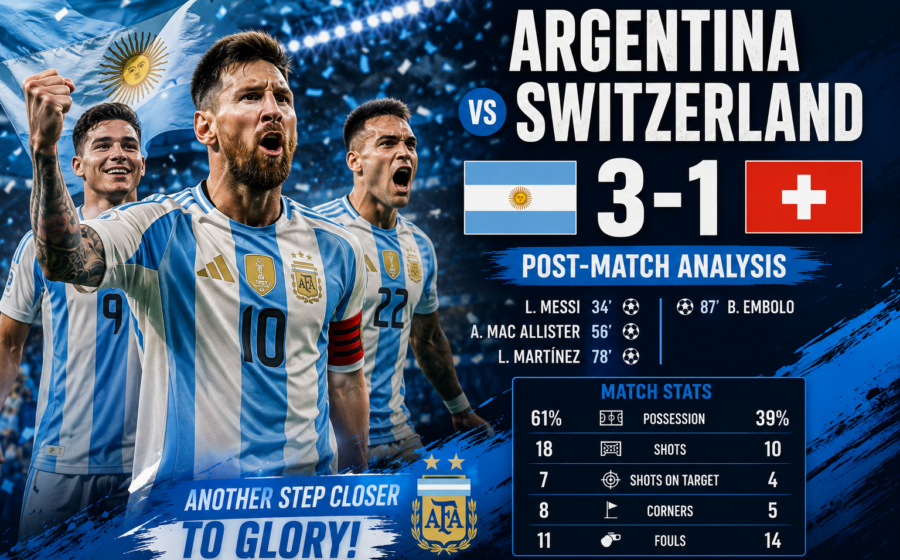
Argentina vs Switzerland 3-1: Post-Match Analysis
Introduction
The knockout drama of the global showpiece delivered yet another tactical masterclass and extra-time thriller at the Kansas City Stadium in Missouri. In this high-stakes quarter-final clash of the 2026 FIFA World Cup, the reigning world champions, the Argentina football team, squared off against a deeply disciplined and resilient Switzerland football team. With a coveted semi-final berth against England hanging in the balance, the match evolved into a magnificent test of nerves, stamina, and tactical acuity. Ultimately, the Argentina vs Switzerland result favored the South American giants as a pair of clinical extra-time strikes sealed a hard-fought Argentina 3-1 Switzerland victory, extending La Albiceleste’s historic scoring run and keeping their title defense firmly on track in this memorable FIFA football encounter.
Match Summary
- Competition: FIFA World Cup 2026™ (Quarter-Finals)
- Venue: Kansas City Stadium, Missouri, United States
- Date: July 11, 2026
- Final Score: Argentina 3-1 Switzerland (After Extra Time)
- Match Statistics Overview: Argentina dominated possession at 54% to Switzerland’s 37%, outshooting the Swiss 22 to 11 with 7 shots on target compared to 5 for Switzerland. Corners favored Argentina 8 to 2, while disciplinary counts stood at 3 yellow cards for Argentina and 2 yellow cards (plus 1 red) for Switzerland.
First-Half Analysis
Lionel Scaloni deployed a structured 4-1-3-2 tactical shape, utilizing Leandro Paredes as the defensive pivot behind an industrious midfield diamond of Rodrigo De Paul, Alexis Mac Allister, and Enzo Fernández, with Lionel Messi roaming freely alongside Julián Álvarez in attack. Murat Yakin countered with a sturdy, compact 4-2-3-1 setup, tasking Granit Xhaka and Remo Freuler with shielding the central defenders and cutting off supply lines to Messi.
Despite Switzerland controlling significant portions of the early territorial battle, it took just ten minutes for La Albiceleste to draw first blood. Earning a corner on the right, Lionel Messi delivered an exquisite, teasing cross into the danger zone, where Mac Allister rose above taller markers to direct an emphatic header past Gregor Kobel.
Rather than pressing for a second, Argentina shifted into a pragmatic low-block, inviting Switzerland forward and absorbing pressure with central defenders Cristian Romero and Lisandro Martínez standing resolute. Switzerland probed patiently through the flanks with Dan Ndoye and Fabian Rieder, but Argentina’s disciplined defensive organization restricted them to speculative efforts, keeping the score at 1-0 heading into the interval.
Second-Half Analysis
The second half resumed with Switzerland increasing their tempo and verticality in search of an equalizer. Ndoye became increasingly influential down the right channel, testing Emiliano Martínez with a sharp header in the 65th minute. The pressure finally yielded results two minutes later when Ndoye launched a swift counter-attack, exchanged a neat one-two with Ricardo Rodriguez down the left flank, and clinically converted Rodriguez’s pinpoint cross to make it 1-1.
Just as the momentum swung decisively toward the Swiss, a flashpoint changed the complexion of the match. Breel Embolo went down inside the penalty area looking for a penalty; however, a VAR review determined simulation, resulting in a second yellow card and a red for the striker in the 72nd minute.
Forced to play with 10 men, Switzerland retreated into a defensive shell. Scaloni reacted by introducing fresh legs, bringing on Nicolás González, Lautaro Martínez, and Gonzalo Montiel in regulation time, but the Swiss rearguard held firm to force the contest into extra time.
Tactical Breakdown
Argentina Tactical Analysis
Scaloni’s 4-1-3-2 formation prioritized control of the central corridor while granting Messi the freedom to orchestrate transitions. In possession, Argentina utilized short passing combinations and line-breaking passes via Mac Allister and Fernández. When pegged back, their high press in the first half successfully disrupted Swiss build-up play, forcing 39 turnovers. Once numerical superiority was secured in extra time, Argentina stretched the pitch wide through their full-backs, allowing substitutes like Thiago Almada and José Manuel López to create the numerical overloads that unlocked the exhausted Swiss defense.
Switzerland Analysis
Yakin’s 4-2-3-1 was a tactical triumph for over an hour. The double-pivot of Xhaka and Freuler effectively stifled Argentina’s central progression, while the defensive line—anchored by Manuel Akanji—effectively marshaled the box. Switzerland’s build-up play via short vertical passes caught Argentina off guard during the equalizer phase. However, their structural vulnerability lay in transitional defense when pushing numbers forward, which ultimately left gaps that Álvarez and Martínez exploited in extra time.
Key Turning Points
- Mac Allister’s 10th-Minute Header: Gave Argentina an early psychological cushion, allowing them to dictate the tempo and adopt a reactive defensive posture.
- Ndoye’s 67th-Minute Equalizer: Rewarded Switzerland’s sustained second-half pressure and shifted all momentum to the European side.
- Embolo’s Red Card (72′): A major turning point that halted Swiss momentum and forced them into a defensive rearguard for the remainder of the evening.
- Álvarez’s 112th-Minute Wonder Strike: The decisive breakthrough in extra time, breaking Swiss resistance with a curling effort from the edge of the box.
- Martínez’s Insurance Goal (120’+1′): Put the result beyond doubt on a rapid counter-attack at the death.
Player Performance Analysis
Argentina
- Emiliano Martínez: Crucial when called upon, denying Ndoye with an instinctive save in the second half and commanding his area under crosses.
- Alexis Mac Allister: Outstanding in both phases, scoring the opener and covering a staggering 14.24 kilometers of distance while orchestrating line breaks.
- Lionel Messi: Dictated play in pockets of space, providing the crucial assist for the first goal and drawing constant defensive attention.
- Julián Álvarez: Worked tirelessly with 56 sprints and delivered the sensational game-winning goal in extra time.
Switzerland
- Dan Ndoye: A constant livewire who scored a brilliant equalizer and troubled the Argentine backline all night.
- Granit Xhaka: Provided immense leadership and discipline in midfield, registering 29 completed line breaks before fatigue set in.
- Manuel Akanji: Defended heroically in central defense, keeping Argentina’s frontline at bay for the majority of regulation time.
Statistical Breakdown
The statistical data from this quarter-final underlines Argentina’s overall territorial dominance. Holding 54% possession and completing 629 of 716 passes, Argentina dictated the rhythm of the game. They generated 22 total attempts at goal compared to Switzerland’s 11, reflecting their sustained pressure during extended phases. Crucially, Argentina’s 8 corners to Switzerland’s 2 demonstrated their ability to pin the opposition back. Despite playing with 10 men for nearly an hour of action including extra time, Switzerland matched Argentina in line breaks (112 completed), highlighting their immense structural discipline before the late goals broke their resistance.
Five Biggest Talking Points
- Argentina’s Historic Scoring Streak: Continuing their remarkable record of scoring two or more goals across consecutive tournament matches.
- Swiss Resilience: Demonstrating tactical mastery and pushing the defending champions to the absolute brink.
- The Embolo Dismissal: The critical flashpoint that turned a balanced tactical battle into an uphill defensive struggle for ten men.
- Clutch Substitutions: How Scaloni’s introduction of Álvarez and Martínez proved decisive in extra time.
- The Semi-Final Setup: Setting up a blockbuster last-four clash against England.
What This Result Means
Argentina
The defending champions take massive momentum and psychological fortitude from this encounter. Overcoming an organized opponent and fatigue proves their championship pedigree. However, defensive lapses on transitional counters require tightening before facing a rampant English side.
Switzerland
The Swiss exit the tournament with immense pride. Their tactical framework under Yakin proved they belong among the elite, though emotional discipline and composure in high-pressure refereeing moments remain areas for future growth.
Conclusion
This Kansas City quarter-final will be remembered as a classic chapter of the 2026 World Cup. From Mac Allister’s early header to Álvarez’s extra-time thunderbolt, the match showcased the best of international football. As Argentina marches on toward a semi-final date with destiny against England, the bar for tournament endurance and attacking firepower has been emphatically raised.