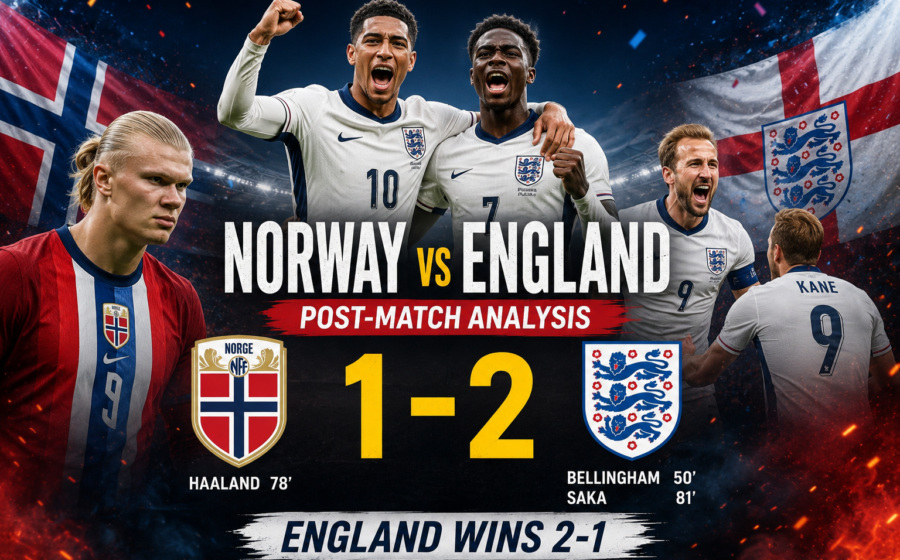
Norway vs England Post-Match Analysis: England Wins 2-1
Introduction
The high-stakes drama of knockout football reached a fever pitch at the Miami Stadium in Florida, where the Norway vs England quarter-final clash delivered an unforgettable extra-time thriller. Contested under the searing summer heat of the 2026 FIFA World Cup, this high-profile encounter carried immense tournament significance, with a coveted semi-final berth against either Argentina or Switzerland on the line. Thomas Tuchel’s England football team entered the match brimming with confidence following their round-of-16 triumph over Mexico, while Ståle Solbakken’s formidable Norway football team boasted a star-studded spine featuring Erling Haaland and Martin Ødegaard. In a match defined by fierce tactical chess, resilience, and individual brilliance, it was a Jude Bellingham masterclass that sealed a dramatic England 2-1 Norway victory after extra time, propelling the Three Lions into the last four of the FIFA football match spectacle.
Match Summary
- Competition: FIFA World Cup 2026™ (Quarter-Finals)
- Venue: Miami Stadium, Florida
- Date & Time: July 11, 2026
- Final Score: Norway 1-2 England (After Extra Time)
- Goalscorers:
- Norway: Andreas Schjelderup (36′)
- England: Jude Bellingham (45’+2′, 93′)
- Player of the Match: Jude Bellingham
- Match Statistics Overview: The contest showcased intense physical battles, with Norway exploiting set-piece danger and England utilizing tactical flexibility and high-intensity midfield control.
First-Half Analysis
The tactical setup from both managers set the tone early in the scorching Florida humidity. Thomas Tuchel deployed a fluid 4-2-1-3 / 4-2-3-1 hybrid structure, bringing John Stones back into central defence while shifting Ezri Konsa to right-back and handing Noni Madueke a starting berth on the flank. Solbakken countered with an aggressive and compact 4-1-2-3 system, designed to choke central spaces and launch swift transitions utilizing Erling Haaland’s gravitational pull up front.
The opening half-hour was characterized by a ferocious midfield battle where Declan Rice and Elliot Anderson worked tirelessly to match the industry of Sander Berge and Martin Ødegaard. However, the momentum tilted in the 36th minute. A lapse in concentration deep in the England half allowed Norway to pick Harry Kane’s pocket, and Andreas Schjelderup unleashed a speculative, dipping delivery from the left flank that caught Jordan Pickford off guard, looping directly off the far post and over the line.
Stung by the setback, the Three Lions increased their pressing intensity and re-established a foothold. Just as the half seemed destined to close with Norway ahead, Anthony Gordon slid a clever pass inside to Bellingham in stoppage time. The Real Madrid talisman exhibited elite spatial awareness, gliding past two defenders, shifting the ball onto his left foot, and arrowing a precise low drive into the bottom corner. Kane thought he had grabbed a second just moments later with a delicate dink over Orjan Nyland, only for the offside flag to intervene.
Second-Half Analysis
Recognizing the need for fresh tactical impetus, Tuchel made decisive double-changes at the interval, introducing Bukayo Saka and Eberechi Eze in place of Madueke and Rice. The tempo shifted visibly as England sought to monopolize possession, yet Norway’s defensive block remained remarkably stubborn.
Pickford was forced into crucial interventions early in the second stanza, brilliantly tipping Alexander Sørloth’s effort over the bar and parrying a fierce Haaland header away from danger. Norway continued to press their advantage from set-pieces. In the 56th minute, the Scandinavian side thought they had reclaimed the lead when Torbjørn Heggem bundled in a rebound, but VAR intervened to correctly penalize Haaland for a foul on Anderson during the build-up.
As regulation time wound down, Norway struck the woodwork from another dangerous corner routine with 15 minutes remaining, Kristoffer Ajer steering a header against the crossbar. Both sides turned to their benches to manage fatigue in the stifling heat, and despite seven minutes of stoppage time, the deadlock remained unbroken as the match ticked into extra time.
Tactical Breakdown
England Tactical Analysis
Tuchel’s tactical flexibility proved to be the decisive element. Operating primarily in a 4-2-3-1 shape during the initial phase, England transitioned into a more dynamic, high-pressing machine in the second half. The utilization of inverted wingers and overlapping full-backs stretched Norway’s narrow midfield four. Defensively, the backline maintained exceptional vertical compactness, while the introduction of physical anchors like Dan Burn late in extra time neutralized Norway’s aerial barrage from set-pieces.
Norway Tactical Analysis
Solbakken’s 4-1-2-3 setup executed a brilliant containment strategy for large stretches of the match. Patrick Berg anchored the midfield effectively, cutting off passing lanes into Kane, while Ødegaard and Berge provided energetic box-to-box transitions. Norway’s primary threat materialized from wide deliveries and dead-ball situations, where they consistently exploited the height of Ajer and Haaland. Their undoing lay in maintaining concentration during defensive transition phases, which allowed Bellingham the fraction of space required to equalize and win the game.
Key Turning Points
- Schjelderup’s 36th-Minute Breakthrough: A sudden turnover allowed Norway to draw first blood and force England out of their comfort zone.
- Bellingham’s Stoppage-Time Equalizer: Changing the psychological landscape right before the whistle, giving England renewed belief heading into the break.
- Disallowed Norway Goal (56′): A vital VAR intervention that prevented Norway from taking a two-goal psychological advantage.
- Bellingham’s Extra-Time Winner (93′): The decisive moment where the midfielder anticipated Nyland’s handling error from a substitute’s shot.
- Overturned Penalty (101′): A potential game-killing penalty awarded to Djed Spence correctly rescinded upon review, keeping the contest alive.
Player Performance Analysis
England
- Jude Bellingham: A monumental performance, crowned with two ice-cold goals and indefatigable leadership in the engine room.
- Jordan Pickford: Immense under high balls, making critical stops against Sørloth and Haaland to keep England afloat.
- Elliot Anderson: Displayed exceptional maturity and defensive grit in the midfield battle against elite opposition.
Norway
- Andreas Schjelderup: Constantly dangerous down the left, capping a lively display with the opening goal.
- Orjan Nyland: Produced several vital saves throughout the night before an unfortunate spill handed England their winner.
- Erling Haaland: Worked tirelessly as a focal point, though tightly marshaled by Stones and Guéhi.
Statistical Breakdown
The statistical narrative of this quarter-final underlined how close the contest was. While possession remained closely contested in the high-intensity humidity, England’s pass accuracy in the final third improved significantly after the introduction of Saka and Eze. Norway matched England shot-for-shot in open play and dominated aerial duels within the penalty area, registering multiple dangerous corner opportunities that rattled the English framework. Ultimately, England’s clinical edge in converting high-value transitional phases and second balls separated the two finalists.
Five Biggest Talking Points
- Bellingham’s World-Class Clutch Factor: Cementing his status as the premier generational talent for the national team.
- Tuchel’s Pragmatic Substitutions: Turning the match around through decisive half-time changes.
- Norway’s Set-Piece Menace: Demonstrating that physical height and delivery precision remain the ultimate equalizer against technical powerhouses.
- The Physical Toll of Extra Time: Navigating brutal weather conditions while maintaining tactical discipline.
- Semi-Final Aspirations: Positioning the Three Lions just one step away from the ultimate tournament showdown.
What This Result Means
England
The victory serves as a monumental psychological and tactical milestone for the England football team. Validating Tuchel’s developmental template, the squad showcased resilience under extreme pressure and fatigue. The team enters the semi-finals with profound depth and belief, though defensive attentiveness on opposition crosses and set-pieces requires careful refinement.
Norway
Despite the heart-breaking elimination, the Norway football team exits the tournament with their heads held high. They proved they can go toe-to-toe with global giants. Ståle Solbakken’s side will take invaluable tournament experience home, focusing on closing out matches and sustaining defensive focus deep into stoppage time.
Expert Verdict
England deserved this victory through sheer willpower, tactical adaptability, and the transcendent quality of Jude Bellingham. While Norway executed a phenomenal game plan and exposed vulnerabilities through aerial and set-piece power, the inability to shut down central transitional runners proved fatal. This match will be remembered as a classic testament to tournament football management under physical duress.
Conclusion
This quarter-final showdown at the Miami Stadium encapsulated the pure magic and cruelty of international football. From Schjelderup’s opener to Bellingham’s extra-time heroics, both sides laid bare their tactical identity and fighting spirit. As England marches forward toward the semi-finals, the bar for white-ball and tournament resilience has been emphatically set.