Max Verstappen: The Ultimate Fighter of Formula 1 Career & Style
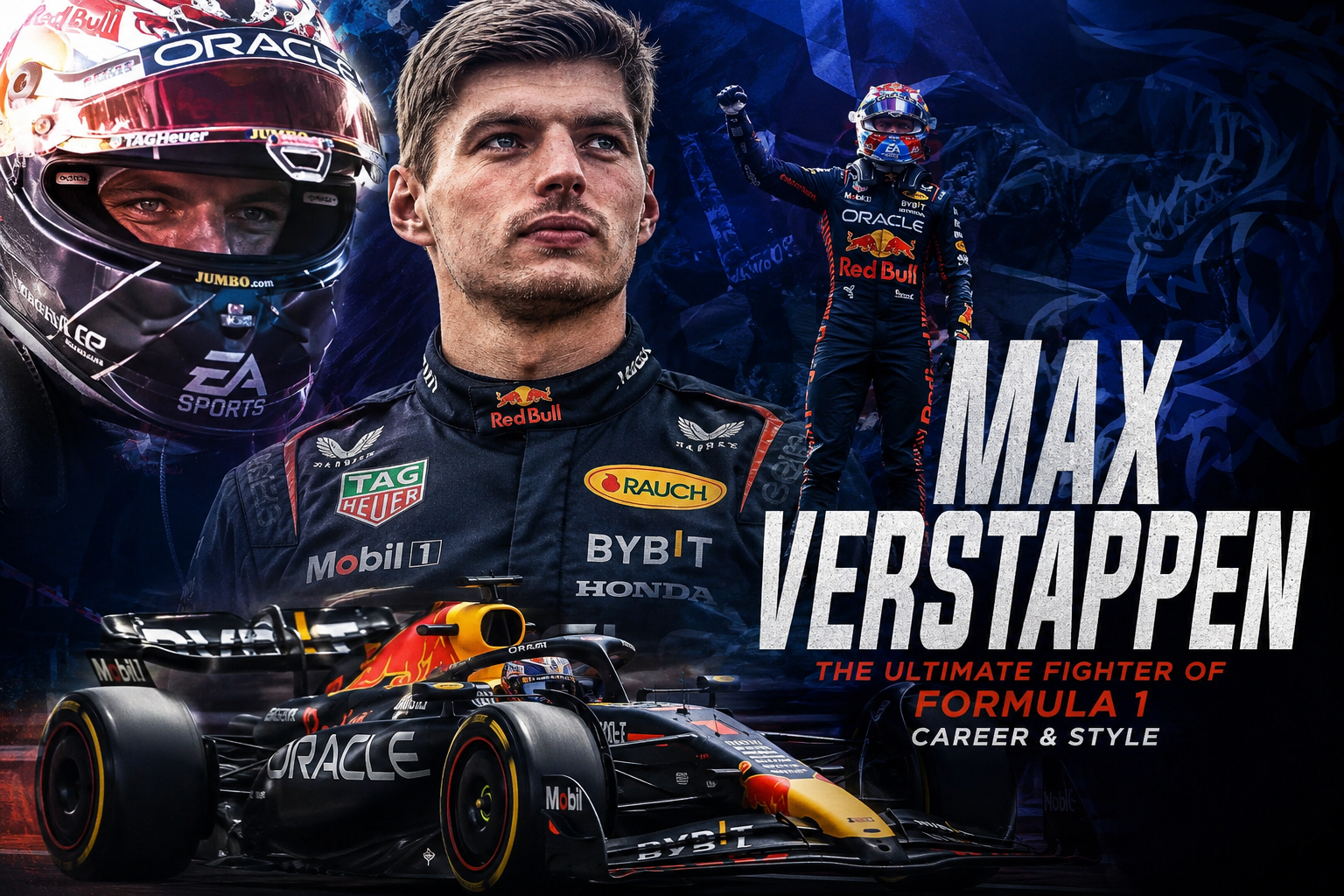
In the modern landscape of grand prix racing, few figures polarize, captivate, and dominate the narrative quite like Max Verstappen. From the moment he breached the Formula 1 grid as a raw, razor-sharp teenager, the Dutchman re-engineered our collective understanding of what is possible behind the wheel of a racing car.
Often hailed as the ultimate fighter of the paddock, Verstappen’s reputation is forged in wheel-to-wheel combat, unwavering mental fortitude, and an uncompromising approach to racing. Driving for Red Bull Racing, his trajectory from a hyper-aggressive prodigy to a clinical, four-time Formula 1 champion reflects one of the most fascinating evolutions in sporting history.
Who Is Max Verstappen?
Born on September 30, 1997, in Hasselt, Belgium, Max Emilian Verstappen was biologically engineered for speed. Motorsport was not a career choice; it was the family business. His father, Jos Verstappen, was a fierce, journeyman F1 driver known for his gritty style, while his mother, Sophie Kumpen, was an elite karting driver who regularly defeated future grand prix winners in her youth.
Under the exacting, notoriously strict tutelage of his father, Max was introduced to karting at the age of four. The junior categories did not know what hit them. Verstappen’s karting career was a relentless march of silverware, culminating in the 2013 World KZ Championship title.
His transition to single-seaters in 2014 via the FIA European Formula 3 Championship was so explosive—scoring 10 wins in a single debut season—that it triggered an immediate bidding war between the sport’s top driver academies. Red Bull’s Helmut Marko won the signature, famously offering a direct pass straight to the F1 grid.
The Youngest Driver in Formula 1
When Verstappen walked into the Scuderia Toro Rosso garage at the 2015 Australian Grand Prix, he was just 17 years and 166 days old. He lacked a road driver’s license, yet he was tasked with wrangling a complex, V6 hybrid Formula 1 machine. The decision drew immense criticism from traditionalists, prompting the FIA to alter its licensing laws to prevent anyone under 18 from entering the sport again.
Verstappen spent his rookie campaign silencing the skeptics. His wheel-to-wheel audacity was instantly visible, highlighted by a breathtaking, high-speed overtake around the outside of Felipe Nasr at Spa-Francorchamps’ legendary Blanchimont corner. Despite early mechanical retirements and structural challenges with the Renault power unit, his rapid development and ironclad resilience proved he belonged at the absolute pinnacle.
Rise to Red Bull Racing
Just four races into the 2016 season, Red Bull Racing management pulled off one of the most ruthless driver swaps in history. Daniil Kvyat was demoted, and the 18-year-old Verstappen was instantly promoted to the senior team ahead of the Spanish Grand Prix.
What followed is etched into motorsport folklore. After the dominant Mercedes duo of Lewis Hamilton and Nico Rosberg famously collided on the opening lap, Verstappen inherited the front lines. He withstood immense, race-long pressure from Ferrari’s Kimi Räikkönen—a driver who had raced against Max’s father—to take the checkered flag.
By winning on his Red Bull debut at 18 years and 228 days, he shattered the record for the youngest grand prix winner in history, establishing an unshakeable foundation as a future title contender.
Why Max Verstappen Is Called the Ultimate Fighter
The moniker of the “ultimate fighter” is not merely marketing fluff; it is a clinical assessment of Verstappen’s psychological and tactical approach to racing.
- Aggressive Driving Style: Max treats every session like a street fight. His signature move involves placing his car in areas where his opponent must either yield or trigger a collision. This “all-or-nothing” posture forces rivals into submissive defensive choices.
- Wheel-to-Wheel Mastery: Whether slicing through the field in treacherous downpours or defending a position on degrading rubber, his spatial awareness is sublime. He exploits track limits and micro-gaps with terrifying precision.
- Unrivaled Mental Toughness: Verstappen possesses a rare, ice-cold psychological disposition. External criticism, political paddock drama, or intense media scrutiny roll off him without leaving a mark.
- Consistency and Recovery: When technical issues or bad luck strike, Max doesn’t look back. His ability to instantly reset and extract 100% from a wounded package or recover from the back of the grid stands as a core pillar of his greatness.
Championship-Winning Seasons
Verstappen’s legacy is formally enshrined in his four consecutive World Drivers’ Championships ($2021, 2022, 2023, 2024$). Each campaign highlighted a distinct dimension of his racecraft.
2021: The Heavyweight Title Fight
The 2021 season was a cinematic, bitter, multi-episode war against seven-time champion Lewis Hamilton. It was a clash of generations. From the wheel-banging encounters at Silverstone and Monza to the controversial, heart-stopping final lap showdown in Abu Dhabi, Max claimed his maiden title through pure, unyielding defiance.
2022–2023: Historical Autocracy
In 2022, Verstappen paired his aggressive edge with clinical maturity, crushing the challenge of Ferrari’s Charles Leclerc to take 15 victories.
The 2023 season, however, was a masterclass in statistical demolition. Behind the wheel of the legendary Adrian Newey-designed RB19, Verstappen won an unprecedented 19 out of 23 grands prix, including a record-shattering 10 consecutive victories, leaving the rest of the grid fighting for scraps.
2024: The Thinking Man’s Crown
If 2023 was easy, 2024 was a true test of a champion. As the Red Bull RB20 lost its developmental edge to a surging McLaren outfit, Verstappen was forced to defend his crown through raw racecraft, maximizing points on weekends where his machinery had no right to win, ultimately securing his fourth consecutive world title.
Greatest Races of Max Verstappen’s Career
1. 2016 Brazilian Grand Prix: The Rain Masterclass
In a treacherous, waterlogged Interlagos, Verstappen produced a performance drawing direct comparisons to Ayrton Senna at Donington Park in 1993. After a late pit stop dropped him to 14th with just 16 laps remaining, Max searched for unconventional wet lines, carving through the field with physics-defying car control to claim an astonishing 3rd place.
2. 2021 United States Grand Prix: The Strategic Standoff
Locked in an intense tactical chess match with Lewis Hamilton at Austin, Verstappen took an aggressive, early pit stop strategy. On completely exhausted rear tires, he managed his micro-gaps flawlessly over the final stints, holding off a charging Mercedes to win by a mere 1.3 seconds.
3. 2023 Miami Grand Prix: Hunting From P9
Starting a distant ninth on a hard-tire strategy, Verstappen put on a clinical display of tire preservation and raw pace. He cut through the midfield without breaking a sweat, ultimately hunting down and overtaking his teammate Sergio Pérez on track to seal a statement victory.
Max Verstappen’s Driving Style Explained
To understand Verstappen’s superiority, one must look at the telemetry. His style is built around an incredibly sensitive sensory feedback loop.
V-Shaped Cornering Strategy
Unlike drivers who prefer a traditional, geometric sweeping arc through corners, Verstappen excels at “V-shaping” the turn. He drives deep into the braking zone, rotates the car rapidly at a sharp, decisive apex, and straightens the wheel early. This allows him to get back on the throttle faster than almost anyone else, exploiting maximum traction.
Tire Management & Braking
Max has an uncanny ability to feel the exact threshold of locking a tire. He manipulates his brake bias dynamically throughout a single lap, preserving the front tires while maintaining staggering entry speeds. In mixed or wet conditions, his sensory feel for grip transitions is unmatched, allowing him to discover traction where others slide off.
Why He Dominates Modern Formula 1
Verstappen’s dominance is a perfect trifecta of driver, team, and machine. Under the leadership of Christian Horner, Red Bull Racing built an operational fortress completely centered around Max’s unique driving preferences.
Furthermore, Verstappen possesses an intricate technical understanding of the car. He works in perfect harmony with his race engineer, Gianpiero Lambiase, using an elite vocabulary of car balance to tweak setups on the fly. Combined with an almost error-free baseline of execution on Sundays, he leaves his competitors with zero margin for error.
Current Season Performance and Championship Situation
The 2026 Formula 1 season has thrown a massive curveball at the grid. With the introduction of the highly anticipated 2026 technical regulations—featuring drastically overhauled power units and active aerodynamics—the traditional pecking order has been completely turned on its head.
Red Bull Racing’s new challenger, the RB22, has endured a complex, highly disruptive start to the new era, leaving Verstappen facing an uphill battle against a newly dominant, resurgent Mercedes squad led by teenage phenom Andrea Kimi Antonelli.
Following a highly frustrating retirement due to a painful start-line clutch failure at the recent Monaco Grand Prix, Verstappen currently finds himself in an unfamiliar chase position:
| Driver | Team | Points | Wins |
| Andrea Kimi Antonelli | Mercedes | 156 | 5 |
| Lewis Hamilton | Ferrari | 90 | 0 |
| George Russell | Mercedes | 88 | 1 |
| Charles Leclerc | Ferrari | 75 | 0 |
| Max Verstappen | Red Bull Racing | 43 | 0 |
Despite a lone podium finish and zero wins across the opening six rounds, the paddock knows better than to count Max out. True to his reputation as the grid’s ultimate fighter, Verstappen is driving with relentless fury, dragging every ounce of performance out of his machinery as Red Bull scrambles to bring crucial upgrade packages to the upcoming European rounds.
Career Statistics Table
Here is a comprehensive breakdown of Max Verstappen’s historic career achievements up to the current 2026 campaign:
| Statistical Metric | Career Total |
| World Championships | 4 ($2021, 2022, 2023, 2024$) |
| Grand Prix Starts | 239 |
| Race Wins | 71 |
| Podiums | 128 |
| Pole Positions | 48 |
| Career Points | 3,487.5 |
Interesting Facts About Max Verstappen
- Dual Nationality: Born in Belgium to a Belgian mother and Dutch father, Max chose to race under the Dutch flag due to spending more time with his father’s racing network.
- Sim Racing Addict: Max is an elite sim racer for Team Redline, frequently jumping into high-level virtual 24-hour endurance races the night before driving a real Formula 1 car.
- The No-Lifting Legend: In his junior days, his father Jos would refuse to talk to him for days if he felt Max wasn’t pushing a car to its absolute limit or showing enough aggression in battles.
Frequently Asked Questions
Q.1 Who is Max Verstappen?
Max Verstappen is an elite Dutch racing driver currently competing for Oracle Red Bull Racing. He is a four-time Formula 1 World Drivers’ Champion and holds the record for being the youngest driver to ever start and win an F1 grand prix.
Q.2 Why is Max Verstappen called the Ultimate Fighter?
He is called the ultimate fighter due to his unyielding, ultra-aggressive wheel-to-wheel racing style, immense mental toughness, and a refusal to back down in any on-track confrontation.
Q.3 How many world championships has he won?
Verstappen has won four World Drivers’ Championships, taking consecutive titles from 2021 through to 2024.
Q.4 Which team does he drive for?
He drives for Red Bull Racing, having joined their senior program early in the 2016 season after moving up from Toro Rosso.
Q.5 What records has he broken?
Verstappen is F1’s youngest starter (17 years, 166 days) and youngest race winner (18 years, 228 days). He also holds the record for the most wins in a single season (19 wins in 2023) and the most consecutive wins in F1 history (10).
Conclusion
Max Verstappen remains the absolute distillation of raw speed. He entered Formula 1 as a disruptive, highly controversial lightning bolt and transformed into an era-defining maestro. Whether he is dominating from pole position or fighting with every fiber of his being to drag an underdeveloped car through a challenging regulatory transition, his identity never wavers. He is, and will always remain, the ultimate fighter of the Formula 1 grid.