F1 2026 Regulations Explained: Power Units, Active Aero and What’s New
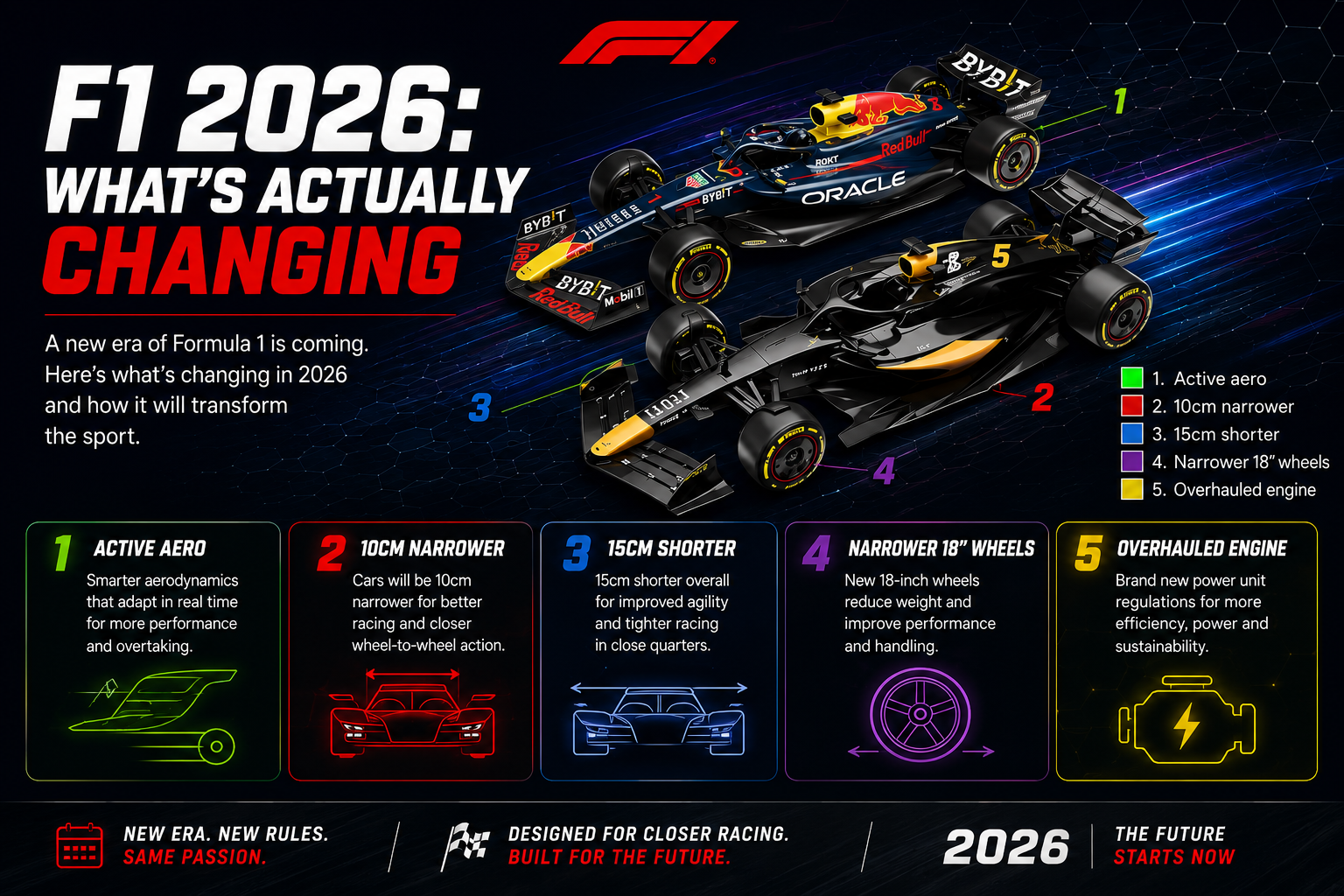
F1 2026 Explained | Technical Regulations Guide | Updated July 2026
Introduction
The 2026 Formula 1 season introduced the biggest technical shake-up the sport has seen in years, with an entirely new power unit configuration and active aerodynamics rewriting the competitive order almost overnight. Mercedes’ dominance, Red Bull’s early struggles, and the arrival of two new manufacturers can all be traced back to this single regulation reset. Here’s a complete breakdown of what actually changed, and why it matters.
Regulation Changes at a Glance
| Area | What Changed for 2026 |
| Power Unit | Revised configuration with a significantly higher proportion of electrical power |
| Aerodynamics | New active aerodynamics system introduced across the grid |
| Calendar | 22 confirmed Grands Prix (reduced from a planned 24 after Bahrain and Saudi Arabia were cancelled) |
| Sprint Format | Six sprint weekends: China, Miami, Canada, Great Britain, Netherlands, Singapore |
| New Manufacturers | Audi (works team) and Cadillac (11th team on the grid) both debut |
The New Power Unit Era
The headline change for 2026 is a revised power unit configuration, shifting the balance of performance more heavily toward the electrical side of the hybrid system than in previous seasons. The shake-up has rewarded manufacturers who got their electrical deployment strategy right from the outset — most obviously Mercedes, who have won seven of the first eight races of the season, a level of dominance that stands in stark contrast to their form in the years immediately prior to the regulation change.
Active Aerodynamics: What It Actually Does
Alongside the new power units, 2026 introduced active aerodynamics as a core part of every car’s design. Unlike the fixed-wing philosophy of previous regulation cycles, teams can now actively adjust aerodynamic surfaces to manage the trade-off between straight-line speed and cornering downforce in real time. It’s a fundamental shift in how cars are designed and driven, and it has been a significant factor in the adjustment period several teams — Red Bull and Ferrari among them — have visibly gone through in the opening rounds of the season.
New Manufacturers, New Power Suppliers
The regulation reset coincided with a wave of new manufacturer interest. Audi entered the sport for the first time as a full works team, having acquired the former Sauber squad in 2024 and competed under the Kick Sauber banner through 2025 before the rebrand. Cadillac became the eleventh team on the grid — the first new team since Haas joined in 2016 — initially using Ferrari power units and gearboxes as a customer team, with its own in-house General Motors power unit not scheduled to arrive until 2029.
On the engine supply side, Ford returned to Formula 1 for the first time since 2004, this time in partnership with Red Bull Powertrains, supplying both Red Bull Racing and Racing Bulls. Honda also returned as a fully independent engine supplier for the first time since 2021, now partnering Aston Martin after splitting from its previous Red Bull-linked programme. Renault, by contrast, exited the sport as an engine supplier after years of underwhelming results in the hybrid era, with Alpine transitioning to become a Mercedes customer team from 2026 onward.
A Reshaped Calendar
The 2026 calendar was originally planned at 24 Grands Prix, matching the previous two seasons, but the Bahrain and Saudi Arabian races were ultimately cancelled following the outbreak of conflict in the Middle East earlier in the year. Both events were contracted and scheduled for April, but with safety concerns mounting as the situation unfolded, the FIA opted to cancel rather than attempt a late replacement, leaving the season at 22 confirmed rounds. There remains ongoing discussion about whether one of the two races could be reinstated later in the year, though nothing has been confirmed.
Frequently Asked Questions
Why has Mercedes been so dominant in 2026?
Mercedes appears to have made the strongest early adaptation to the new power unit’s higher electrical demands, translating into seven wins from the first eight races of the season — a level of early-season dominance rarely seen in the hybrid era.
How many races are in the 2026 F1 season?
The season currently comprises 22 confirmed Grands Prix, down from a planned 24 after the Bahrain and Saudi Arabian races were cancelled.
Which teams are new to F1 in 2026?
Cadillac joined as the grid’s eleventh team, the first new entrant since Haas in 2016. Audi also debuted as a full works team, having previously competed as Kick Sauber using Ferrari power units.
Conclusion
The scale of change for 2026 explains much of what’s unfolded so far this season: a new competitive order led by Mercedes, a Red Bull team still finding its footing, and two new manufacturers adding fresh storylines to the grid. With 14 rounds still to run, teams that continue refining their understanding of the new power units and active aero rules have every chance to reshape the picture further before the season concludes in December.