Colombia vs Portugal Post-Match Analysis: Tactical 0-0 Draw
Introduction
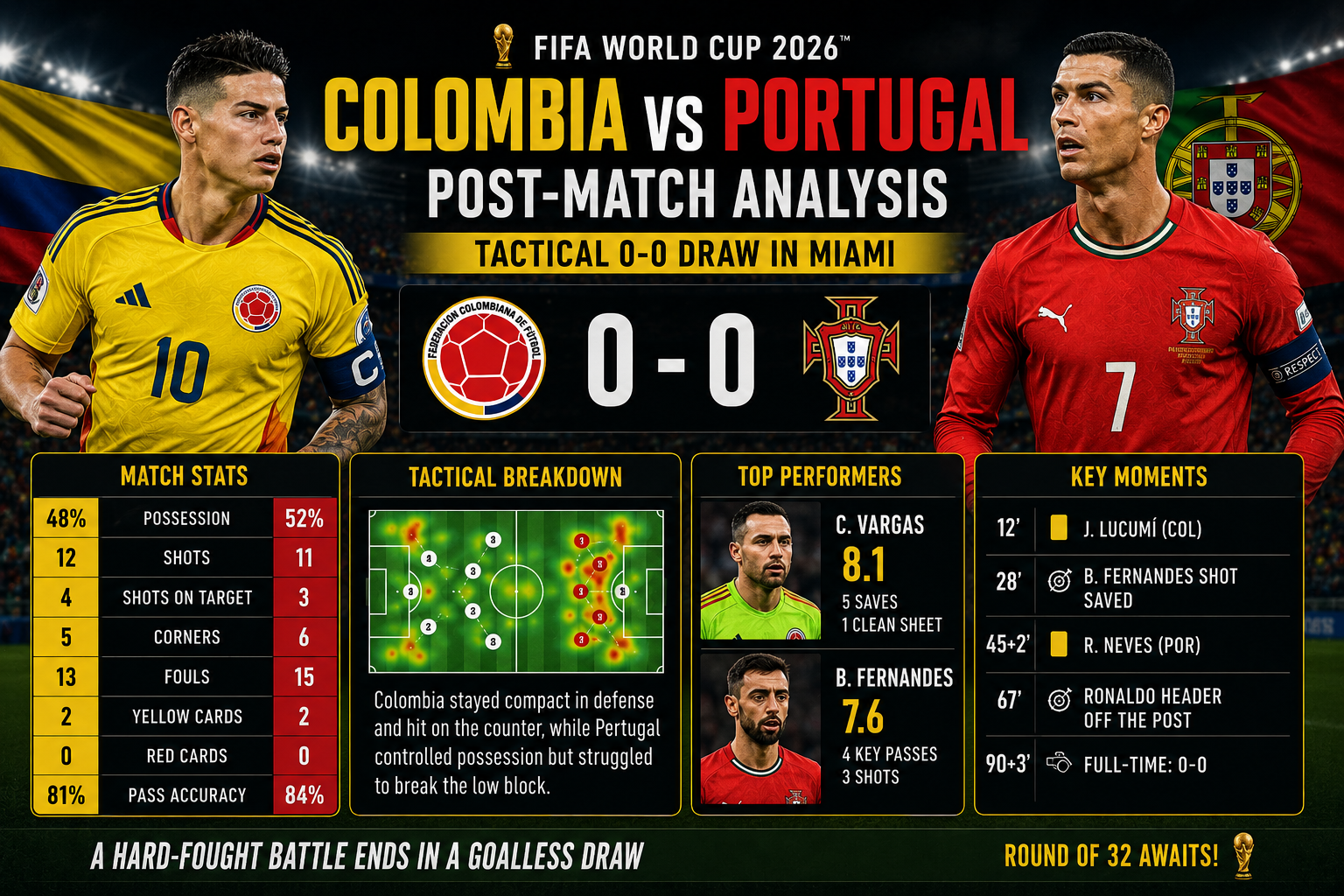
In a tournament that has already delivered plenty of high-scoring spectacles, the Group K finale between Colombia and Portugal at the FIFA World Cup 2026 offered a completely different kind of masterpiece. The highly anticipated clash at a sweltering Hard Rock Stadium in Miami ended in a breathless 0-0 draw, but the scoreline tells only a fraction of the story. This was an elite, end-to-end tactical chessboard match featuring 36 total shots, magnificent goalkeeping displays, goal-line clearances, and a heart-stopping stoppage-time video assistant referee (VAR) decision that left fans completely captivated.
For Portugal, managed by Roberto Martínez, the draw meant finishing as group runners-up with five points. While the Seleção went into the match knowing their place in the Round of 32 was mathematically secure, they pressed aggressively for the victory that would have allowed them to leapfrog the South Americans. The tactical stalemate maps out distinct trajectories for both powerhouses: Colombia heads to Kansas City for a highly anticipated Round of 32 tie against Ghana, while Portugal will travel to Toronto to square off against Croatia in a heavyweight European knockout clash.
Match Overview
- Final Score: Colombia 0-0 Portugal
- Tournament: FIFA World Cup 2026
- Group: Group K (Matchday 3)
- Match Date: June 27, 2026
- Venue: Hard Rock Stadium, Miami, Florida, USA
- Attendance: 64,752 (Officially Capacity-Packed)
- Player of the Match: Diogo Costa (Portugal)
The atmosphere inside Miami’s iconic venue was electric, with a heavily pro-Colombian crowd creating a raucous, cauldron-like environment. The match unfolded at an astonishing tempo despite the humid Florida heat, as both teams eschewed conservative mid-blocks in favor of vertical, expansive attacking transitions. Ultimately, world-class goalkeeping and marginal refereeing calls kept the match entirely goalless, writing a unique chapter in Colombian football history—this marked the nation’s first-ever 0-0 draw in a FIFA World Cup match across their 25 tournament appearances.
First-Half Analysis
The opening exchanges established a tactical pattern that persisted throughout the match: Colombia looked to exploit wide areas through direct transitions, while Portugal sought dominance through central overloads and patient, positional build-up. Néstor Lorenzo lined up his team in a flexible 4-1-2-3 configuration, relying heavily on Jefferson Lerma to sit in front of the central defenders, allowing James Rodríguez and Jhon Arias the freedom to orchestrate attacks. On the other side, Roberto Martínez deployed a structured 4-2-3-1 system, bringing Rúben Neves into the double-pivot alongside Vitinha to shield the backline against Colombia’s dangerous central runs.
Colombia nearly stunned the European giants within the opening 60 seconds. That structural scare served as a massive wake-up call for Portugal. Following a much-needed hydration break midway through the first half, Roberto Martínez’s tactical adjustments bore fruit. Portugal began bypassing Colombia’s aggressive counter-press by utilizing full-backs João Cancelo and Nuno Mendes as inverted outlets. In the 34th minute, Portugal created their best chance of the half. Cancelo drifted into the half-space and cut a precise ball back for Bruno Fernandes, who took a sharp touch 12 yards out and rifled a shot toward the roof of the net. Colombia’s Camilo Vargas produced a magnificent, acrobatic reflex save to fingertip the ball over the bar.
Shortly after, João Félix managed to peel away from Davinson Sánchez to meet a lofted pass from Vitinha, but his first-time volley flew harmlessly over. The teams entered the tunnel at halftime tied at 0-0, with both managers aware that minor structural details would decide the match.
Second-Half Analysis
The tactical adjustments made at the intermission underscored the high stakes of the contest. Roberto Martínez made an immediate double substitution for Portugal, replacing João Cancelo with Diogo Dalot and hooking Rúben Neves in favor of the youthful energy of João Neves. The objective was clear: inject press-resistance into the midfield and establish absolute control over the second balls.
The partnership between Jhon Arias and Santiago Arias continued to cause significant structural problems for Portugal’s left flank. A few minutes later, Jhon Arias linked up with Santiago, who immediately returned the ball via a sharp one-two. Jhon Arias unleashed a heavily deflected effort that looked bound for the corner, requiring an elite piece of goalkeeping from Diogo Costa, who adjusted mid-air to tip the ball wide. Colombia maintained their intense pressure from the resulting corner, as Gustavo Puerta latched onto a loose ball and unleashed a venomous long-range rocket that shaved the outside of the post.
In the 82nd minute, Cristiano Ronaldo—who had been largely kept quiet by the impeccable center-back pairing of Davinson Sánchez and Jhon Lucumí—combined beautifully with Bruno Fernandes.
The closing stages produced standard-setting tournament drama. In the 88th minute, Colombia looked certain to score when Daniel Muñoz, fresh off the bench, whipped a dangerous, deflected cross into the six-yard box. With Luis Suárez lurking for a tap-in, Portuguese center-back Rúben Dias retreated heroically to the goal-line, leaping backwards to head the ball away from the Colombian forward. Suárez could only volley the loose second ball over the crossbar.
Tactical Breakdown
Colombia’s Tactical Performance
Néstor Lorenzo set up Colombia to maximize their physical superiority and vertical transition speed. Playing out of a defensive 4-1-2-3, which shifted into a compact 4-5-1 out of possession, Los Cafeteros suffocated Portugal’s ability to build cleanly through the middle.
- The Midfield Smother: Jefferson Lerma functioned as a defensive anchor, aggressively shadowing Bruno Fernandes. This restricted the playmaker’s time on the ball and forced Portugal to look wide. When Richard Ríos entered the pitch, his physical dynamism allowed Colombia to win the vast majority of second-ball duels.
- Exploiting the Flanks: Colombia deliberately targeted the space behind Nuno Mendes. By overloading the right channel with Santiago Arias and Jhon Arias, they forced Portugal’s back three configurations into uncomfortable shifting movements.
- Transitions: The speed with which Colombia shifted from deep defensive shapes to attacking sequences was elite. Luis Díaz operated as a constant outlet, using his press-resistance to carry the ball 40–50 yards up the pitch, relieving pressure on the backline.
Portugal’s Tactical Performance
Roberto Martínez’s 4-2-3-1 template aimed to monopolize possession and utilize positional rotations to disorganize Colombia’s low block. While they controlled significant phases of the ball, they struggled against Colombia’s physical profile.
- Inverted Structural Changes: Realizing that Colombia’s wingers were tracking his full-backs, Martínez instructed João Cancelo and later Diogo Dalot to tuck inside as extra midfielders. This gave Vitinha and João Neves safe passing lanes but occasionally left Cristiano Ronaldo isolated against two physical center-backs.
- Central Progression Blocks: Portugal excelled at playing through Colombia’s first line of pressure, heavily aided by the ball-distribution skills of Rúben Dias and Renato Veiga. However, they lacked the necessary incisiveness in the final third to break down Colombia’s low defensive block.
- Defensive Resilience Under Pressure: When Colombia completely dominated the middle of the second half, Portugal showed incredible tactical discipline. Rúben Dias organized the defensive line perfectly, ensuring that the distance between the midfield and defensive structures remained incredibly tight.
Key Turning Points
- 2nd Minute (The Initial Statement): Diogo Costa’s crucial near-post stop against Jhon Córdoba prevented Colombia from taking a psychological stranglehold on the match right out of the gate.
- 15th Minute (The Goal-line Intervention): Rúben Neves tracking back to clear Jhon Arias’s low shot from underneath the crossbar was a masterpiece of defensive awareness.
- 34th Minute (Vargas’s Reflexes): Camilo Vargas fingertipping Bruno Fernandes’s 12-yard rocket over the bar stopped Portugal from capitalizing on their strongest possession phase of the match.
- 88th Minute (Dias’s Heroics): Rúben Dias’s retreating header to deny Luis Suárez a simple tap-in preserved the clean sheet when Portugal’s structural shape had completely broken down.
- 91st Minute (The VAR Margins): Davinson Sánchez’s header being disallowed for a marginal, millimeter offside following a Juan Fernando Quintero cross completely preserved the group dynamics.
Standout Performers
Colombia
- Davinson Sánchez (8.5/10): An absolutely towering performance at the heart of the defense. He won 100% of his aerial duels, completely neutralized Cristiano Ronaldo, made a vital block to deny Leão, and was a millimeter away from scoring a World Cup winner.
- James Rodríguez (8.0/10): Despite the sweltering heat, the veteran playmaker displayed timeless quality. His reverse pass in the first half was world-class, and his ability to draw fouls and slow down the tempo was essential for Colombia’s game management.
- Luis Díaz (7.5/10): A tireless worker on the left flank. Even when his final ball lacked perfection, his carrying ability kept Portugal’s right-backs from pushing too high up the pitch.
Portugal
- Diogo Costa (9.0/10 – Player of the Match): Fully deserved his Player of the Match honors. He made six saves in total, including two world-class interventions to deny Córdoba early on and Jhon Arias in the second half. His commanding presence on crosses brought safety to a stressed defensive line.
- Rúben Dias (8.5/10): The defensive anchor for Portugal. His goal-line intervention in the 88th minute was standard-setting, and his positional leadership prevented Colombia’s direct counter-attacks from turning into high-value opportunities.
- João Neves (7.5/10): His introduction at halftime drastically improved Portugal’s ball-retention. He brought physical energy and positional discipline, single-handedly balancing a midfield that had been overrun in the opening 45 minutes.
Match Statistics Analysis
| Match Statistic | Colombia | Portugal |
| Possession | 44% | 56% |
| Total Shots | 21 | 15 |
| Shots on Target | 8 | 4 |
| Expected Goals (xG) | 1.84 | 1.12 |
| Passing Accuracy | 81% | 88% |
| Corners | 8 | 5 |
| Fouls Committed | 15 | 11 |
| Yellow Cards | 1 (Gustavo Puerta 85′) | 0 |
| Red Cards | 0 | 0 |
The data reveals the fascinating story of this tactical battle. While Portugal dominated the ball with 56% possession and registered an impressive 88% passing accuracy, it was Colombia who generated the far more dangerous opportunities. Out-shooting Portugal 21 to 15, Los Cafeteros tested Diogo Costa with eight shots on target compared to Portugal’s four.
The Expected Goals (xG) battle highlights Colombia’s attacking efficiency, outperforming Portugal 1.84 to 1.12. This margin indicates that while Portugal had longer periods of possession, Colombia’s direct transition architecture created higher-value scoring opportunities. The physical nature of the contest is clear from the 26 combined fouls, yet referee Felix Zwayer managed the game exceptionally well, issuing only a single yellow card to Colombia’s Gustavo Puerta in the 85th minute.
Key Lessons from the Match
- Elite Goalkeeping Wins Tournaments: Both Camilo Vargas and Diogo Costa proved that having world-class shot-stoppers is non-negotiable for success in the knockout rounds.
- Width Over Central Infiltration: Trying to break down compact blocks through central channels was largely ineffective. The best opportunities for both sides came from overloads in wide spaces.
- The Impact of Fresh Legs: The second-half introductions of Richard Ríos and João Neves demonstrated how vital modern five-substitution rules are for shifting tactical momentum.
FAQ SECTION
1. What was the final score of Colombia vs Portugal?
The FIFA World Cup 2026 Group K match between Colombia and Portugal ended in a 0-0 draw at the Hard Rock Stadium in Miami.
2. Who was named Player of the Match?
Portugal goalkeeper Diogo Costa was named the Player of the Match after making six crucial saves to keep a clean sheet.
3. Why did the match finish 0-0 despite so many chances?
The match ended goalless due to spectacular reflex saves from goalkeepers Diogo Costa and Camilo Vargas, goal-line clearances from Rúben Neves and Rúben Dias, and a marginal stoppage-time VAR offside call against Colombia’s Davinson Sánchez.
4. How does this result affect the group standings?
Colombia won Group K with 7 points, while Portugal advanced to the Round of 32 as runners-up with 5 points. DR Congo also qualified as one of the best third-placed teams with 4 points.
5. What are the next matches for Colombia and Portugal?
Colombia will play Ghana in the Round of 32 on July 4 in Kansas City, while Portugal will take on Croatia in the Round of 32 on July 3 in Toronto.
Final Thoughts
This 0-0 draw at Hard Rock Stadium will be remembered as a classic tournament tactical battle. Colombia proved they have the physical and tactical identity to match any elite European side, while Portugal demonstrated they can weather a storm and manage high-pressure situations. As the competition transitions into the high-stakes environment of single-elimination football, both nations have laid down a marker showing they are structurally equipped for the challenges ahead.