Egypt vs Iran Post-Match Analysis: Thrilling 1-1 Draw
Introduction
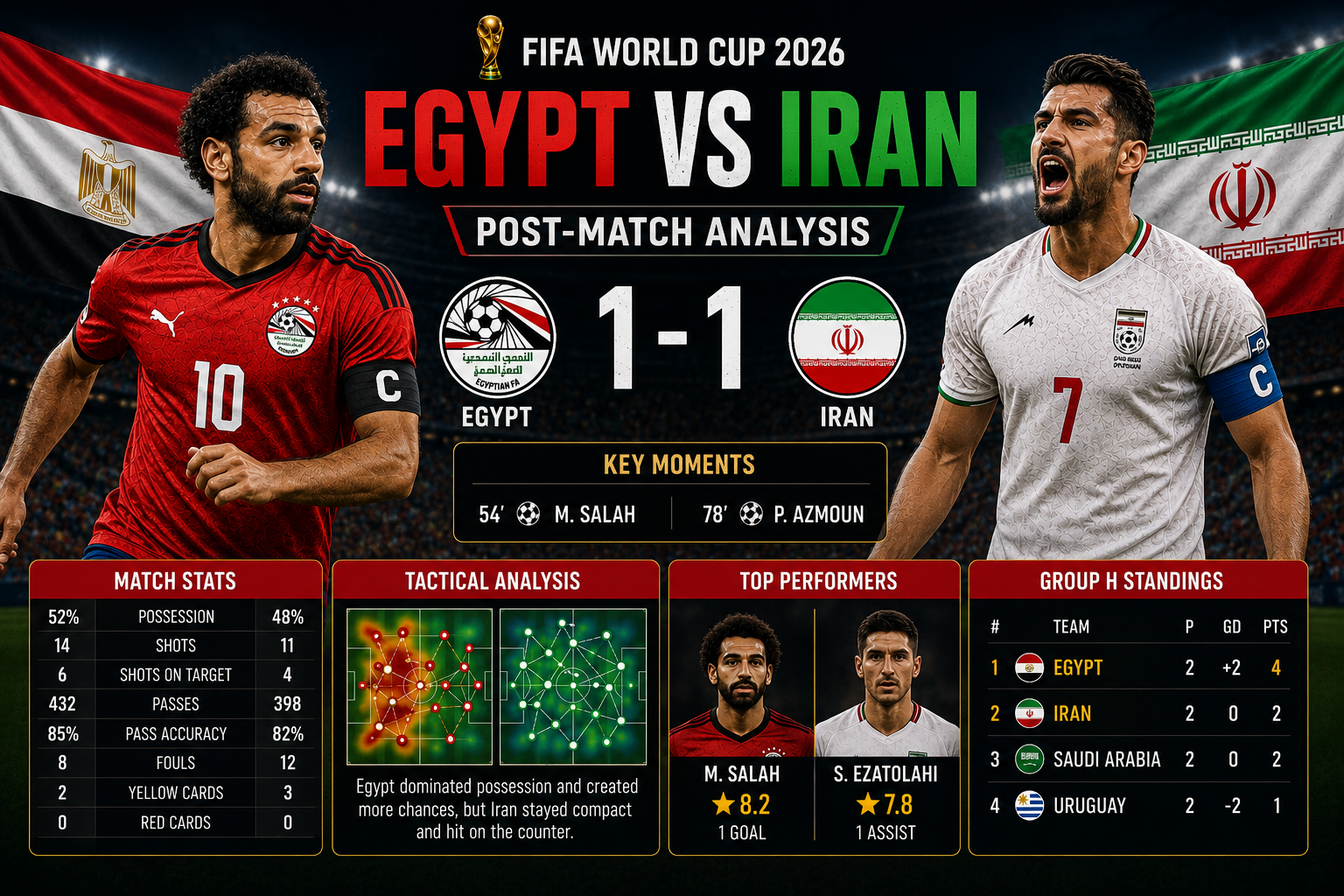
The final matchday of the group stage presented one of the most structurally chaotic, emotionally exhausting, and tactically polarizing matches of the FIFA World Cup 2026. Meeting at a packed, atmospheric Seattle Stadium, Egypt and Iran fought out a breathless 1-1 draw that possessed enough narrative arcs to define an entire tournament. For the Pharaohs, this hard-earned point secured a historic milestone—their first-ever progression past the World Cup group stage. For Team Melli, the result leaves them trapped in agonizing suspense, awaiting cross-group mathematics to see if their wild-card ranking will grant them passage to the Round of 32.
Match Overview
- Final Score: Egypt 1-1 Iran
- Tournament: FIFA World Cup 2026
- Group: Group H
- Match Date: June 26, 2026
- Venue: Seattle Stadium (Lumen Field), Seattle, Washington, USA
- Referee: Manuel de Sousa (Portugal)
The game exploded into life inside the opening quarter of an hour, delivering two goals, a penalty, and an injury before some fans had even taken their seats. Egypt opened the scoring via Mahmoud Saber in the fifth minute, only for Iran to launch an immediate counter-offensive. Despite seeing a penalty saved by Mostafa Shobeir minutes later, Iran successfully equalized through wing-back Ramin Rezaeian. The second half shifted from an open technical exchange into a gritty defensive blockade by Egypt, culminating in an extraordinary injury-time sequence where Iran hit the woodwork and saw a 93rd-minute winner overturned by a microscopic VAR offside review.
First-Half Analysis
Egypt manager Hossam Hassan deployed his side in an expansive 4-2-3-1 structure, aiming to isolate Mohamed Salah against Iran’s left-sided center-backs. The blueprint bore immediate fruit. In the 5th minute, Salah picked up the ball on the right channel, skipped past Ali Nemati, and unleashed a low, swerving drive. Iranian goalkeeper Alireza Beiranvand parried the deflected effort directly into the danger zone, where the arriving Mahmoud Saber reacted fastest to slide the ball between the keeper’s legs, giving Egypt a 1-0 lead.
The goal shook Iran into a state of furious verticality. Transitioning rapidly into an attacking 3-4-3 shape out of their nominal 5-3-2 baseline, Team Melli swarmed the Egyptian box. In the 10th minute, a clever lofted pass found Mehdi Taremi, who was clipped from behind by Mohamed Abdelmonem. The referee pointed directly to the penalty spot, but Egypt’s young keeper Mostafa Shobeir guessed correctly, diving low to his right to deny the Iranian captain.
The penalty save offered only brief respite. In the 14th minute, Milad Mohammadi forced another top-tier save from Shobeir, but the rebound fell perfectly to Ramin Rezaeian. From a razor-thin angle on the right, the experienced wing-back slammed a first-time rocket into the roof of the net to equalize.
Second-Half Analysis
Both managers looked to their benches at the interval to regain tactical structural balance. Iran replaced the cautioned Kanaanizadegan with Saleh Hardani, while Egypt completed a double switch, introducing Marwan Attia and Omar Marmoush to establish security in central areas. Egypt initially monopolized the ball, racking up a high sequence of short passes to exhaust Iran’s midfield press.
However, the dynamic shifted drastically in the 57th minute when Mohamed Salah was substituted after showing discomfort in his left hamstring. With the talismanic winger on the bench receiving ice treatment, Egypt lost their structural outlet on the right flank.
In the 89th minute, Taremi rose above the defense to loop a header against the crossbar. Then, in the 92nd minute, chaos erupted: a blocked shot fell to Shojae Khalilzadeh, who smashed it into the net, sparking wild celebrations on the Iranian bench. However, the automated VAR system flagged a microscopic offside against the defender during the build-up phase, scrubbing the goal. Iran pushed one final time in the 97th minute, but Saeid Ezatolahi’s towering header rattled off the crossbar, leaving the full-time score deadlocked at 1-1.
Tactical Breakdown
Egypt’s Performance
- Formation: 4-2-3-1 (In-possession) / 5-4-1 (Late low-block)
- Defensive Organization: The forced introduction of Yasser Ibrahim disrupted Egypt’s vertical defensive line early on. However, the secondary line protection offered by Mohanad Lasheen prevented Iran from penetrating through central zones.
- Midfield Control and Wing Play: In the opening period, Emam Ashour and Saber expertly manipulated the half-spaces, overloading the flanks to allow Trézéguet and Salah to operate in isolation drills against the Iranian full-backs.
- Transition Mitigation: Once Salah departed, the attacking transition ceased entirely. Egypt focused strictly on lateral compression, limiting spaces between full-backs Mohamed Hany and Ahmed Fatouh to handle Iran’s crossing threat.
Iran’s Performance
- Formation: 5-3-2 (Nominal) / 3-4-3 (Attacking transitions)
- Defensive Shape: Amir Ghalenoei’s back five looked structurally unstable during the opening ten minutes, frequently caught out by Egypt’s lateral ball-circulation speed.
- Attacking Movements and Counter-Attacks: Team Melli focused heavily on utilizing Mohammad Mohebi and Ramin Rezaeian to create numerical superiorities out wide, bombarding the Egyptian box with high, curling deliveries to find Taremi’s aerial presence.
- Tactical Weaknesses: Iran displayed a distinct lack of spatial awareness when defending rebounds inside their own penalty box, an inefficiency that Mahmoud Saber exploited for the opening goal.
Key Turning Points
- Saber’s 5th-Minute Opener: Capitalizing on a rare Alireza Beiranvand positioning error, the goal forced Iran to instantly abandon their passive low-block.
- Shobeir’s 12th-Minute Penalty Save: Stopping Taremi’s penalty prevented Egypt from suffering a complete psychological collapse following their early tactical setback.
- Salah’s 57th-Minute Injury: The removal of Egypt’s captain completely stripped the Pharaohs of their vertical counter-attacking threat, turning the final half-hour into an exercise in pure survival.
- The 93rd-Minute VAR Offside Intervention: A decision decided by mere millimeters, preventing Iran from claiming an automatic knockout berth and keeping Group H entirely fluid.
Standout Performers
Egypt
- Mostafa Shobeir (8.5/10): An absolutely elite goalkeeping display. Beyond the legendary penalty save, his commanding handling of crosses under immense pressure in stoppage time stabilized a fractured defense.
- Mahmoud Saber (7.5/10): Showed superb tactical anticipation to register the opening goal and worked tirelessly out of possession before his half-time substitution.
Iran
- Ramin Rezaeian (8.5/10): Awarded the official Player of the Match honors. His thunderous finish from a near-impossible angle showcased elite technical execution, complemented by an indefatigable engine down the right flank.
- Milad Mohammadi (7.5/10): A constant outlet on the opposite flank, his initial low drive directly engineered the chaos that led to Iran’s equalizer.
Match Statistics Analysis
| Match Statistic | Egypt | Iran |
| Possession | 44% | 56% |
| Total Shots | 8 | 17 |
| Shots on Target | 3 | 7 |
| Expected Goals (xG) | 1.12 | 2.38 |
| Passing Accuracy | 79% | 84% |
| Corners | 2 | 6 |
| Fouls Committed | 15 | 13 |
| Yellow / Red Cards | 3 / 0 | 4 / 0 |
The data points to a match where tactical control gave way to territorial dominance. Iran’s $56\%$ possession and superior 17 total shots indicate that they dictated the geographical terms of the second half. This is reinforced by an xG value of $2.38$ compared to Egypt’s $1.12$. The low shot-on-target efficiency for Iran ($7$ out of $17$) highlights Egypt’s structural capacity to force their opponents into lower-probability aerial efforts under heavy physical duress.
FAQ
1. What was the final score of Egypt vs Iran?
The match concluded in a dramatic 1-1 draw at the Seattle Stadium.
2. Who scored the goals in the match?
Egypt opened the scoring through Mahmoud Saber in the 5th minute, while Iran equalized via a Ramin Rezaeian strike in the 14th minute.
3. Who was named Player of the Match?
Iranian wing-back Ramin Rezaeian was awarded the official honor for his exceptional tactical coverage and stunning tight-angle goal.
4. How does this draw affect Group H?
Egypt finishes second in Group H with 5 points and automatically advances to the Round of 32. Iran finishes third with 3 points and must wait to see if they qualify as one of the best third-placed teams.
5. What are the next matches for Egypt and Iran?
Egypt will face Australia in the Round of 32 in Dallas on July 3, 2026. Iran’s next steps are entirely dependent on the final cross-group third-place wild-card rankings.
Final Thoughts
The final whistle in Seattle brought scenes of contrasting emotional extremes—Egyptian players collapsing in historic ecstasy while Iranian shirts slumped in complete physical and mental exhaustion. This 1-1 draw was an exhibition of why the World Cup remains the absolute peak of sporting drama. Egypt moves forward into uncharted historical waters, while Iran has shown they possess the structural heart to compete with anyone, provided the mathematical gods smile upon them.