Bosnia vs Qatar: Bosnia Secure Crucial 3-1 Victory
Introduction
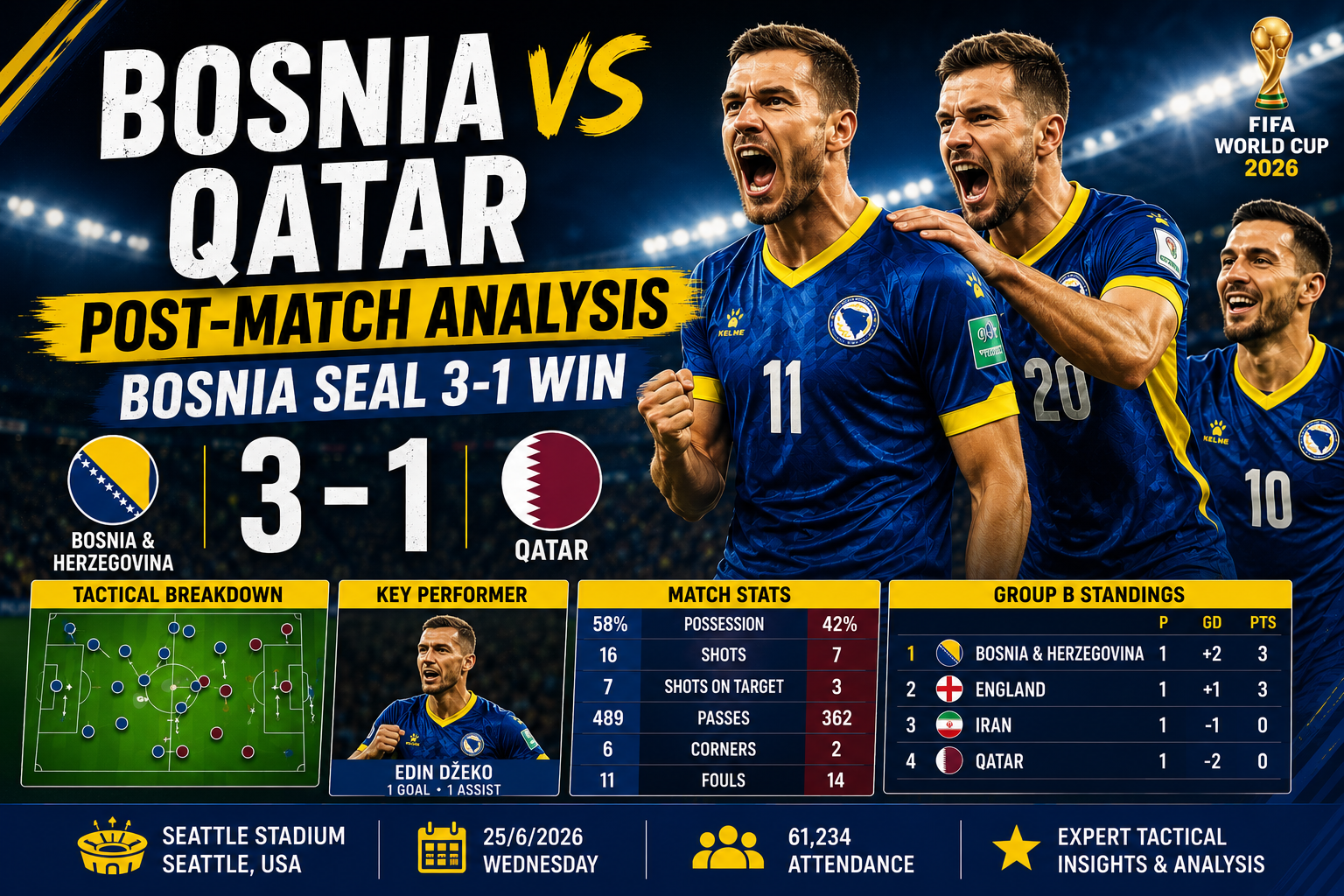
The high stakes of the expanded FIFA World Cup 2026 were on full display at a packed Seattle Stadium, where Bosnia and Herzegovina kept their tournament dreams alive with an emphatic 3-1 victory over Qatar in their final Group B fixture. Entering the match under immense pressure following a heavy 4-1 loss to Switzerland, the Dragons needed nothing short of a definitive victory to secure third place in the group and keep themselves in the mix for a historic Round of 32 berth.
The match provided a fascinating blend of generational narratives. It featured an outstanding performance from 18-year-old sensation Kerim Alajbegović and a landmark 150th international cap for the legendary Edin Džeko. This post-match analysis breaks down the tactical decisions, key turning points, and statistical metrics that defined this high-stakes encounter in Washington.
Match Summary
- Final Score: Bosnia and Herzegovina 3-1 Qatar
- Tournament: FIFA World Cup 2026
- Group: B
- Match Date: June 24, 2026
- Venue: Seattle Stadium, Seattle, Washington, USA
The match unfolded as an open, end-to-end spectacle. Bosnia and Herzegovina dominated the opening half-hour before surviving a spirited late first-half resurgence from Qatar. While a tense second half saw both managers shuffle their tactical decks, the Dragons ultimately sealed the three points late in the game, ending Qatar’s World Cup campaign and securing a crucial four-point total in Group B.
First-Half Analysis
Bosnia and Herzegovina flew out of the blocks with an aggressive, high-pressing intent that immediately pinned Qatar into their own defensive third. Within the opening four minutes, Qatar’s goalkeeper Mahmud Abunada was called into action twice. First, he denied a fierce drive from Ermedin Demirović, before quickly adjusting to tip away a goal-bound effort from midfielder Ivan Šunjić.
The breakthrough arrived in the 29th minute through a moment of individual brilliance. Picking up the ball 20 yards out on the left wing, 18-year-old Kerim Alajbegović slalomed past two Qatari defenders before unleashing a spectacular right-footed strike into the top corner. The goal made Alajbegović the eighth-youngest goalscorer in World Cup history, a landmark moment celebrated with a finger-to-the-lips gesture toward the crowd.
As the intense afternoon heat began to take a toll on Bosnia’s physical press, Qatar grew into the game. In the 42nd minute, 35-year-old veteran Hassan Al-Haydos capitalised on a lapse in the Bosnian defensive shape, ghosting into the box to calmly slot home and make it 2-1.
Second-Half Analysis
The second half began with both managers making immediate adjustments to combat fatigue. Bosnia’s head coach Sergej Barbarez introduced Benjamin Tahirović and Amar Memić to inject fresh energy into the midfield and stabilize the right flank. Lopetegui countered by bringing on the experienced Abdulaziz Hatem to wrestle back control of central areas.
Qatar’s momentum suffered a major psychological and tactical blow in the 54th minute when goalscorer Hassan Al-Haydos was forced off with an injury, replaced by Ahmed Al-Ganehi. Without Al-Haydos’s positioning between the lines, Qatar struggled to bridge the gap between midfield and star forward Akram Afif.
Bosnia re-established control by dropping into a compact mid-block, looking to exploit transitions. Esmir Bajraktarević cut inside from the right wing and forced a fine low save from Abunada in the 78th minute.
Mahmić’s secondary strike of the tournament sparked ecstatic celebrations, sealing the 3-1 victory and ending any hopes of a Qatari comeback.
Tactical Breakdown
Bosnia and Herzegovina’s Winning Formula
Barbarez deployed a classic, physically imposing 4-4-2 formation designed to overwhelm Qatar in wide areas and utilize structural overloads.
- Midfield Control & Pressing: In the first 30 minutes, Ivan Šunjić and Ivan Bašić operated as an aggressive double-pivot, effectively cutting off central passing lanes to Akram Afif. Their high press forced hurried clearances from Qatar’s backline.
- Attacking Movements: The Dragons focused their attack down the flanks. Sead Kolašinac’s overlapping runs created a 2-v-1 isolation against Pedro Miguel, which directly led to the second goal. Up front, Demirović played as a functional foil, dragging center-backs away to leave space for Džeko’s aerial targets.
- Defensive Organization: When out of possession in the second half, Bosnia shifted into a rigid 4-5-1 block. This defensive adjustment limited Qatar’s ability to operate in the half-spaces and forced them into low-probability crosses.
Qatar’s Performance Assessment
Julen Lopetegui set his side up in a fluid 4-1-2-3 system, hoping to use Karim Boudiaf as a single anchor while relying on the creative speed of Afif and Edmilson Junior out wide.
- Tactical Shortcomings: Qatar struggled significantly against Bosnia’s physical asymmetry. The single-pivot midfield was easily bypassed during the opening half-hour, leaving central defenders Boualem Khoukhi and Issa Laye exposed to direct balls.
- Defensive Weaknesses: Qatar showed vulnerability when defending transitional crosses. The structural communication between goalkeeper Abunada and his full-backs faltered during the second goal, highlighting a recurring defensive frailty under high-pressure scenarios.
- Attacking Spark: On the positive side, Qatar showed excellent verticality when playing through transition late in the first half, demonstrating that their technical baseline remains highly competitive at this level.
Key Turning Points
- Alajbegović’s Screamer (29th Minute): Before the opening goal, Bosnia had controlled possession but lacked clinical execution. The teenager’s spectacular strike broke the deadlock and completely altered Qatar’s defensive game plan.
- Pedro Miguel Hitting the Woodwork (45+2 Minute): Had Miguel’s shot gone in instead of striking the post right before halftime, Qatar would have entered the locker room with massive psychological momentum.
- The Injury to Hassan Al-Haydos (54th Minute): The forced substitution of their veteran captain stripped Qatar of their main creative catalyst, severely disrupting their attacking fluidity for the remainder of the match.
Standout Performers
Bosnia and Herzegovina
- Kerim Alajbegović: The 18-year-old winger proved to be a constant thorn in Qatar’s side. His technical intelligence, confidence on the ball, and clinical finish set the standard for the Dragons.
- Edin Džeko: Marking his 150th international appearance, the veteran forward put on a masterclass in hold-up play. He won aerial duels, hit the post, and forced the critical own goal that broke Qatar’s resistance.
- Ermin Mahmić: Coming off the bench in the 63rd minute, the 21-year-old midfielder showed great positional awareness to score the decisive third goal, maintaining his excellent tournament form.
Qatar
- Hassan Al-Haydos: The 35-year-old gave everything for the shirt, showcasing elite movement and composure to score his team’s solitary goal before injury cut his afternoon short.
- Mahmud Abunada: Despite conceding three goals, the Qatari goalkeeper made several high-quality saves early in the first half and late in the second to keep the scoreline respectable.
Match Statistics Analysis
While official tracking metrics vary, an objective analysis of the match events reveals the underlying story of the encounter:
| Metric | Bosnia and Herzegovina | Qatar |
| Scoreline | 3 | 1 |
| Total Shots | 16 | 11 |
| Shots on Target | 7 | 4 |
| Hit Woodwork | 1 | 1 |
| Corners | 5 | 4 |
| Yellow Cards | 1 | 1 |
The statistics highlight Bosnia’s early efficiency and offensive volume. Forcing seven shots on target compared to Qatar’s four shows their superiority in creating high-value scoring chances. Qatar’s 11 total shots demonstrate they were highly competitive during their dominant spells, but they lacked the final ball to consistently trouble Nikola Vasilj.
What the Result Means for Group B
This result had immediate, definitive implications for the final structural standings of Group B:
Final Group B Standings
| Pos | Team | Pld | W | D | L | GF | GA | GD | Pts | Status |
| 1 | Switzerland | 3 | 2 | 1 | 0 | 7 | 3 | +4 | 7 | Advanced to Round of 32 |
| 2 | Canada | 3 | 1 | 1 | 1 | 8 | 3 | +5 | 4 | Advanced to Round of 32 |
| 3 | Bosnia & Herzegovina | 3 | 1 | 1 | 1 | 5 | 6 | -1 | 4 | Advanced via 3rd-Place Pool |
| 4 | Qatar | 3 | 0 | 1 | 2 | 2 | 10 | -8 | 1 | Eliminated |
With Switzerland and co-hosts Canada advancing in the top two spots, Bosnia and Herzegovina finished third with 4 points. Thanks to the expanded 48-team format, their 4-point total and -1 goal difference successfully placed them among the eight best third-placed teams across the 12 groups. This marks the first time in national history that Bosnia has reached the knockout rounds of a FIFA World Cup. Qatar exits the tournament at the group stage with a solitary point, mirroring their structural exit from 2022.
FAQ Section
1. What was the final score of Bosnia and Herzegovina vs Qatar?
Bosnia and Herzegovina defeated Qatar 3-1 at Seattle Stadium during their final Group B match of the FIFA World Cup 2026.
2. Who scored the goals in the match?
- Bosnia and Herzegovina: Kerim Alajbegović (29′), Sultan Al-Brake (34′ Own Goal), and Ermin Mahmić (80′).
- Qatar: Hassan Al-Haydos (42′).
3. How does this result affect Group B?
Switzerland (7 points) and Canada (4 points) finished as the top two. Bosnia and Herzegovina finished third with 4 points and advanced to the Round of 32 as one of the best third-placed teams. Qatar finished fourth with 1 point and was eliminated.
4. Who was the Player of the Match?
Bosnia’s 18-year-old winger Kerim Alajbegović earned the honor thanks to his stunning opening goal and excellent creative performance on the left flank.
5. What happens next for Bosnia and Herzegovina and Qatar?
Bosnia and Herzegovina advance to the Round of 32 for the first time in their history, where they will play a group winner. Qatar has been eliminated from the tournament and will turn their focus to future Asian continental competitions.
Final Thoughts
This memorable afternoon in Seattle belonged entirely to Bosnia and Herzegovina. By balancing the veteran leadership of Edin Džeko with the explosive energy of Kerim Alajbegović, the Dragons executed a comprehensive game plan to secure an impressive 3-1 victory. They fully deserved the three points, writing a historic new chapter in Bosnian football history.