Uruguay vs Cabo Verde: 2-2 World Cup Thriller Analysis
Introduction
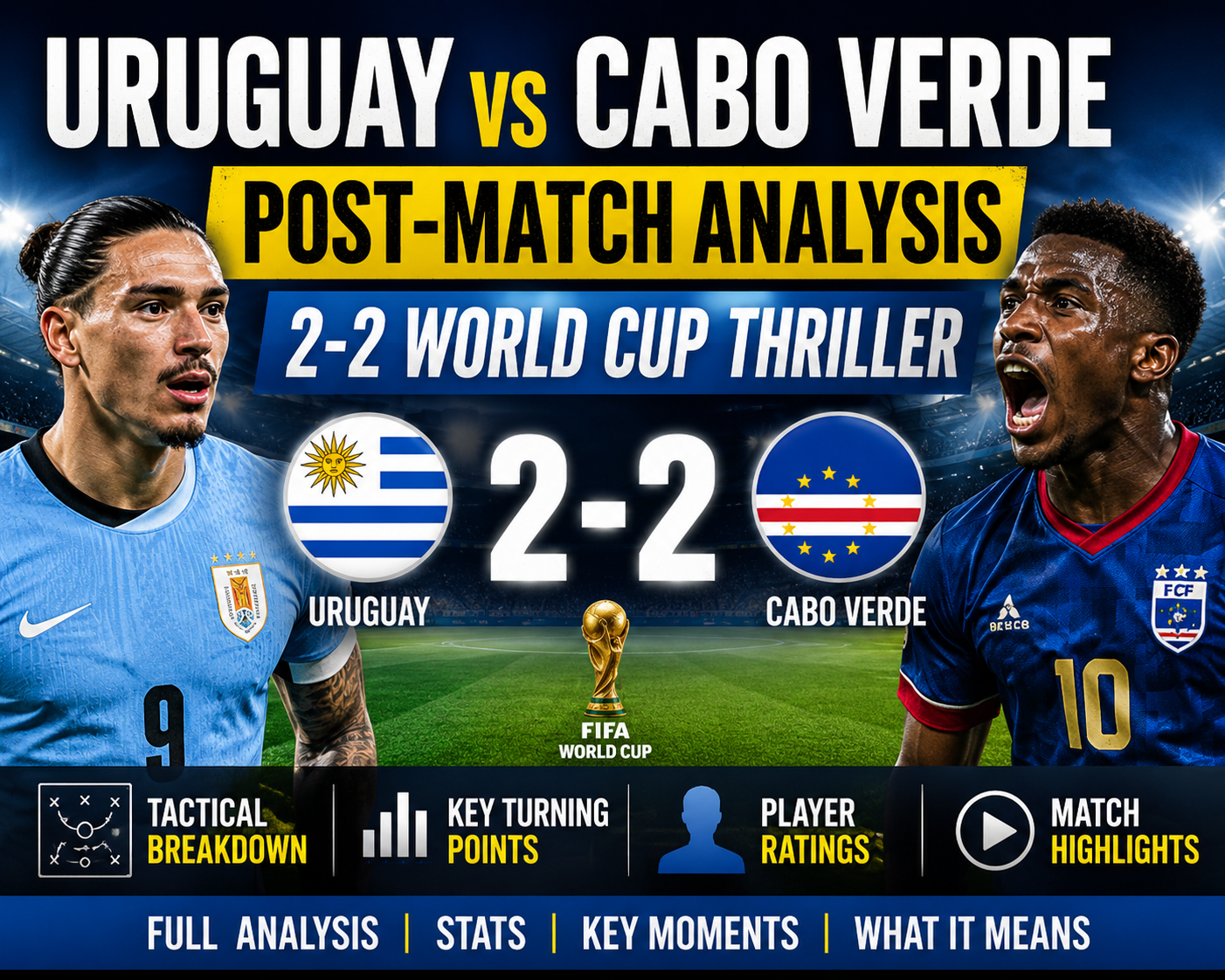
The 2026 FIFA World Cup has already delivered its fair share of dramatic storylines, but few groups present as much tension and intrigue as Group H. On Monday, June 21, 2026, football fans witnessed a captivating chapter unfold at the Miami Stadium in Florida. The highly anticipated face-off between the Uruguay football team and the Cabo Verde football team concluded in a pulse-raising 2-2 draw, leaving group qualification hanging in the balance.
Coming off an opening goalless draw against tournament heavyweights Spain, Cabo Verde proved that their defensive resilience was no fluke. This time, they paired structural discipline with attacking bravery. They shocked the two-time world champions by taking an early lead, absorbing a quick-fire Uruguayan comeback right before halftime, and then fighting back in the second half to secure a historic point. This Uruguay vs Cabo Verde post-match analysis breaks down the tactical chess match, the defining individual errors, and what this monumental Uruguay vs Cabo Verde result means for both nations moving forward.
Match Summary
- Venue: Miami Stadium, Florida, USA
- Date: June 21, 2026 (Local Time)
- Competition: FIFA World Cup 2026™ (Group Stage — Group H)
- Final Score: Uruguay 2 – 2 Cabo Verde
- Goalscorers: * Uruguay: Maximiliano Araújo (44’), Agustín Canobbio (45+6’)
- Cabo Verde: Kevin Pina (21’), Hélio Varela (61’)
First Half Analysis
Uruguayan head coach Marcelo Bielsa shook things up ahead of kickoff. He moved away from his conventional 4-4-2 setup to deploy a fluid 4-2-3-1 formation. Notably, star striker Darwin Núñez started on the bench, allowing Agustín Canobbio to enter the starting lineup on the wing. Bielsa aimed to stretch the compact block that Cabo Verde utilized so effectively against Spain. Uruguay began the game with their trademark high-intensity pressing, pinning the Blue Sharks deep inside their own half for the opening fifteen minutes. Canobbio, playing with intense energy, dictated the early tempo, forcing the Cabo Verde backline into several hurried clearances.
However, Cabo Verde, under the guidance of manager Bubista, refused to panic. Operating in a defensively disciplined 4-1-4-1 system, they absorbed the initial wave of sky-blue pressure. The match turned completely on its head in the 21st minute. Telmo Arcanjo drew a foul roughly 35 yards away from the Uruguayan goal, offering Cabo Verde a rare set-piece opportunity.
In the 44th minute, Federico Valverde swung a cross toward Rodrigo Bentancur, whose header struck the post. Responding quickest to the rebound, Maximiliano Araújo stooped low to nod the ball past the 40-year-old Cabo Verdean goalkeeper Vozinha, evening the score at 1-1.
Uruguay did not stop there. Deep into first-half stoppage time (45+6′), Araújo turned provider. He rose well to knock down a lofted pass inside the penalty area, cushioning it perfectly into the path of Canobbio. The winger kept his composure, slotting the ball past Vozinha to give Uruguay a 2-1 lead at the whistle.
Second Half Analysis
The second half began with tactical adjustments from both benches. Bubista immediately introduced Deroy Duarte for Telmo Arcanjo to solidify the midfield. Down but not out, Cabo Verde abandoned their low block, stepping higher up the pitch to disrupt Uruguay’s buildup play. The physical intensity increased, leading to a yellow card for Uruguayan defender Mathías Olivera in the 57th minute.
Recognizing the need for dynamic attacking outlets, Bubista made a double substitution in the 58th minute, sending on Nuno da Costa and winger Hélio Varela. The managerial gamble paid dividends almost instantly. In the 61st minute, a severe breakdown in communication between Muslera and his central defenders left a loose ball bouncing dangerously in the penalty box. Showing incredible awareness, Varela read the flight of the ball, capitalised on the defensive mix-up, and calmly slotted the ball into the open net to make it 2-2.
Cabo Verde even threatened on the counter-attack during stoppage time, when Laros Duarte forced a sharp save out of Muslera from the edge of the area. Despite a late VAR check and agonizing pressure from Celeste, the match ended 2-2.
Key Players Who Made the Difference
Best Player of the Match: Maximiliano Araújo (Uruguay)
Araújo carried the Uruguayan attack on his back during their most difficult moments. His quick reflexes allowed him to score the crucial equalizer when the team looked completely devoid of ideas. Minutes later, his excellent vision and selfless assist created Canobbio’s go-ahead goal. He remained a constant threat down the left flank before being substituted for Brian Rodríguez in the 81st minute.
Uruguay’s Top Performers
- Agustín Canobbio: Justified his surprise inclusion in the starting lineup with an energetic, high-pressing display. His clinical finish right before halftime epitomized his sharp technical skill.
- Federico Valverde: Operated as the primary creative engine in midfield. His cross initiated the sequence for Uruguay’s first goal, and he consistently tried to unlock the stubborn Cabo Verdean defense.
Cabo Verde’s Standout Players
- Kevin Pina: Inscribed his name into World Cup history with his audacious 34-yard free kick. Beyond the goal, he anchored the midfield brilliantly before making way for Laros Duarte in the 70th minute.
- Hélio Varela: The ultimate super-sub. His opportunistic reading of the game allowed him to punish Uruguay’s defensive hesitation, earning his country a crucial point.
- Roberto “Pico” Lopes: The defensive rock. He made numerous clearances and blocks in the final fifteen minutes when Uruguay poured numbers forward into the box.
Turning Point of the Match
While the quick-fire double from Uruguay completely altered the first half, the definitive turning point of this FIFA World Cup match report occurred in the 58th minute. Bubista’s decision to introduce Hélio Varela completely re-energized a Cabo Verde side that was beginning to tire under Uruguayan pressure.
Varela’s introduction shifted the momentum, and his opportunistic equalizer just three minutes later completely disrupted Uruguay’s tactical rhythm, forcing Marcelo Bielsa into reactive substitutions.
Statistical Comparison
The match statistics paint a clear picture of a contest where one team dominated territory and possession, while the other relied on supreme efficiency and defensive organization.
| Match Statistics | Uruguay | Cabo Verde |
| Possession | 61% | 39% |
| Shots (Total) | 18 | 7 |
| Shots on Target | 6 | 3 |
| Corners | 8 | 2 |
| Fouls Committed | 12 | 15 |
| Yellow Cards | 2 (Bentancur, Olivera) | 2 (Cabral, Diney) |
| Pass Accuracy | 86% | 74% |
What This Result Means for Uruguay
This Uruguay vs Cabo Verde score comes as a severe disappointment for the South American giants. Following their opening 1-1 draw against Saudi Arabia, Uruguay have collected just two points from their first two group fixtures.
While they remain unbeaten, their inability to secure a victory leaves them in a precarious position in Group H. They currently sit behind group leaders Spain, who dismantled Saudi Arabia 4-0 to climb to four points.
Uruguay now faces a high-stakes, must-win showdown against Spain in their final group fixture. Bielsa must quickly resolve his team’s defensive communication issues, as anything less than a victory could result in a shocking, premature exit from the competition.
What This Result Means for Cabo Verde
For the Cabo Verde football team, this 2-2 draw is nothing short of a victory. Standing toe-to-toe with Spain and Uruguay—two titans of international football—and remaining unbeaten is an incredible achievement for the tournament debutants.
With two points from two matches, their hopes of qualifying for the knockout stages remain fully alive. They face Saudi Arabia on the final matchday of the group stage. If Bubista’s men can maintain this high level of tactical discipline and secure a victory against the Green Falcons, they will put themselves in a fantastic position to achieve a historic qualification for the Round of 32.
Three Major Takeaways From Uruguay vs Cabo Verde
1. Tactical Flexibility Requires Defensive Stability
Bielsa’s structural shift to a 4-2-3-1 unlocked creative avenues in the wide areas, but it clearly left the central defense exposed to simple long-ball transitions. Tactical evolution cannot come at the expense of defensive communication.
2. The Rise of the Underdog Sub
Hélio Varela’s immediate impact proved that games at this elite tournament are increasingly decided by the depth of a squad. Bubista’s in-game management was absolutely flawless.
3. Group H is the Ultimate Group of Death
With Spain leading on four points, Uruguay and Cabo Verde tied on two, and Saudi Arabia on one, Group H guarantees a dramatic final matchday where any of the four teams can still qualify or exit.
Frequently Asked Questions (FAQs)
1. What was the final score of the Uruguay vs Cabo Verde match?
The match ended in a thrilling 2-2 draw at the Miami Stadium in Florida.
2. Who scored the goals in this FIFA World Cup fixture?
For Uruguay, Maximiliano Araújo (44’) and Agustín Canobbio (45+6’) found the back of the net. Cabo Verde’s goals came from Kevin Pina (21’) and Hélio Varela (61’).
3. What historic milestones were achieved during this match?
Kevin Pina scored Cabo Verde’s first-ever goal in a FIFA World Cup. Additionally, it was the first time in World Cup history that two starting goalkeepers in their 40s (Fernando Muslera and Vozinha) faced each other.
4. What are the current Group H standings after this result?
Spain leads Group H with 4 points, followed by Uruguay and Cabo Verde both tied on 2 points. Saudi Arabia sits at the bottom with 1 point.
5. Who do Uruguay and Cabo Verde play in their final group stage matches?
Uruguay will face group leaders Spain in a high-stakes encounter, while Cabo Verde will take on Saudi Arabia with knockout stage qualification on the line.
Conclusion
The thrilling Uruguay vs Cabo Verde recap highlights exactly why the World Cup remains the pinnacle of international sport. Cabo Verde’s incredible fairytale continues to capture the hearts of neutral fans worldwide, showing that tactical discipline, unity, and clinical efficiency can bridge any gap in historical prestige. For Uruguay, the wake-up call has sounded. The two-time champions possess the technical quality to defeat any team in the world, but they must eliminate basic errors if they hope to lift the trophy on July 20.