England & India Fine-Tune T20 World Cup Plans
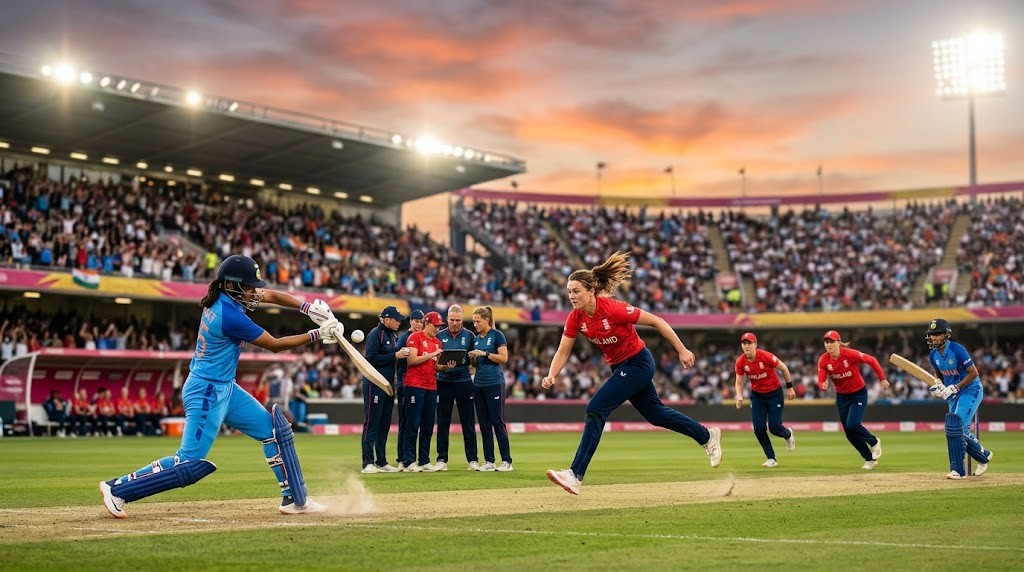
Warm-up fixtures before a major global tournament are often dismissed as mere practice, but they serve as critical, high-stakes laboratories for title contenders. As the global elite descend upon England for the Women’s T20 World Cup 2026, the preparatory phase concluded with standard-setting drama. These practice outings provided teams with their final opportunity to adapt to local English conditions, fine-tune batting orders, settle bowling combinations, and assess bench strength before the official matches begin.
Among the frontrunners to lift the trophy, the England women’s cricket team and the India women’s cricket team stand out as formidable powerhouses. Both squads possess a deep blend of experienced world-beaters and electrifying young talent. With England enjoying the distinct advantage of playing on home soil and India desperate to cross the final hurdle to secure their maiden ICC senior trophy, their final preparatory matches carried immense weight. The closing warm-up game between these two giants in Cardiff highlighted exactly why they are heavily favored, offering a thrilling preview of the tactical warfare expected over the coming weeks.
How England Prepared During the Warm-Up Matches
The home side entered their final block of Women’s T20 World Cup preparations with a clear mandate: solidify their top-order aggression and test their bowling depth under pressure. Playing at Sophia Gardens, Cardiff, England’s management used the opportunity to give their core batters extended time in the middle while testing variations in their bowling attack.
England’s batting engine showed impressive resilience. Despite losing opener Danni Wyatt-Hodge early in the innings for just 27 runs on the board, the hosts did not panic. Instead, wicketkeeper-batter Amy Jones partnered with star all-rounder and captain Nat Sciver-Brunt to construct a masterful rebuilding phase. Jones looked in sublime touch, striking eight boundaries on her way to a commanding 64 off 45 deliveries. Her ability to rotate strike and clear the infield minimized the impact of India’s spinners through the middle overs.
Sciver-Brunt anchored the spine of the innings with an unbeaten 57 from 45 balls. Her knock was a tactical clinic in managing a mid-innings rain interruption without losing momentum. What really stood out for England was their late-innings explosive power. Danielle Gibson provided a sensational cameo at the death, plundering an unbeaten 30 runs off a mere 12 deliveries. Gibson’s final-over onslaught fetched England 19 runs, catapulting them to a highly competitive total of 171 for 6.
Defensively, England experimented heavily with their bowling resources. Left-arm orthodox spinner Linsey Smith led the attack beautifully, taking 3 for 42 and striking early to dismiss the dangerous Smriti Mandhana. Head coach Jon Lewis also gave extended spells to rising stars like teenager Tilly Corteen-Coleman, who showed remarkable composure under extreme pressure. Corteen-Coleman’s execution, alongside Charlie Dean and Gibson, helped England navigate a ferocious late-innings counterattack to successfully seal a narrow five-run victory.
India’s Warm-Up Campaign
The India women’s cricket team enjoyed a highly productive stint in the Women’s T20 World Cup warm-up matches, registering a comprehensive win before pushing England to the absolute limit. India began their warm-up schedule on a high note by defeating the West Indies by 26 runs. In that opening fixture, India put up a solid total of 179 for 8 before their bowlers restricted the Caribbean side to 153 for 8, courtesy of a spectacular four-wicket haul from young off-spinner Shreyanka Patil.
However, their final encounter against England exposed both their elite-level strengths and a few glaring areas that require immediate improvement before the group stage. Opting to field first after winning the toss, India’s bowling unit struggled initially to contain England’s middle-order partnerships. While Shreyanka Patil remained the pick of the bowlers with impressive figures of 2 for 29, the rest of the attack found it challenging to stem the flow of runs in the final three overs, where England plundered 43 runs.
India’s primary concern coming out of the warm-ups is the vulnerability of their top-order batting when facing high-quality pace and swing in English conditions. Chasing 172 for victory on a used Cardiff track, India suffered a catastrophic start, losing both world-class openers inside the first three overs. Smriti Mandhana departed for just 1 run after mistiming a shot off Linsey Smith to Corteen-Coleman, while Shafali Verma was cleaned up by an express delivery from Issy Wong for 13.
Standout Players From Both Teams
A closer look at individual player performances during these warm-up matches reveals who is heading into the main event in peak form.
For England:
- Amy Jones: Her 64 off 45 balls demonstrated excellent adaptability, proving that she can act as both an explosive accelerator and a steady anchor depending on the game situation.
- Nat Sciver-Brunt: The veteran all-rounder remains the crown jewel of England’s lineup. Her unbeaten 57 showcased her elite game-management skills and ice-cool temperament.
- Danielle Gibson: Scoring 30 off 12 balls and picking up 2 crucial wickets highlights her immense value as a genuine finisher and multi-dimensional asset.
For India:
- Richa Ghosh: The 22-year-old single-handedly dragged India back from the brink of a massive defeat. Coming in at 63 for 4, Ghosh smashed a breathtaking 68 from just 36 deliveries, including nine boundaries and two massive sixes. Her aggressive intent against both pace and spin is India’s biggest asset in the death overs.
- Shreyanka Patil: With a four-wicket display against West Indies and 2 for 29 against England, Patil has established herself as India’s premier defensive and attacking weapon in the powerplay and middle overs.
Tactical Analysis
The tactical trends observed during the India vs England women’s cricket warm-up fixture offer a direct window into how both teams intend to navigate the main tournament.
Powerplay Approach and Swing Conditions
In typical English conditions, the first six overs are bound to dictate the outcome of matches. England’s bowlers utilized the initial lateral movement perfectly, maintaining a back-of-a-length strategy that forced Indian openers into premature big shots. India’s line and length in the powerplay were decent, but they missed opportunities to completely choke England’s scoring rate early on.
The Middle-Overs Spin Choke
Both sides relied heavily on spin to choke the scoring rate between overs 7 and 15. India used unconventional options, including the off-spin of opener Shafali Verma, who succeeded in breaking the dangerous Jones-Sciver-Brunt partnership. England countered with a relentless left-arm and off-spin combination through Linsey Smith and Charlie Dean, effectively stopping India from building partnerships in the middle phase.
Death Bowling and Finisher Roles
The final five overs proved to be the differentiator. England’s ability to maximize their death-overs batting through Danielle Gibson gave them the extra cushion they needed. Conversely, India’s execution in the death overs remains a work in progress, as their bowlers struggled with yorker execution, allowing England to cross the 170-run threshold.
What Coaches and Captains Learned
For England’s think-tank, the biggest takeaway is the depth of their squad and the seamless integration of youth alongside experience. Seeing young prospects like Tilly Corteen-Coleman perform under pressure against an elite chasing side gives the team great flexibility in selection. It answers their selection dilemma regarding whether to play an extra specialist spinner or an extra all-rounder.
India’s captain Harmanpreet Kaur and the coaching staff received a timely wake-up call regarding their top-order dependency. While Richa Ghosh’s spectacular form is a massive positive, India cannot afford to find themselves at 64 for 4 in the tenth over of a major World Cup match. The warm-ups proved that India has the squad depth to compete with anyone, but their tactical discipline in the first five overs of both innings must be sharper.
Women’s T20 World Cup 2026 Implications
The conclusions drawn from these warm-up matches have shifted the narrative heading into the main tournament. England has firmly established that they are incredibly difficult to beat at home. Their familiarity with ground dimensions, wind factors, and pitch behavior makes them a near-unanimous favorite alongside dominant defending champions Australia.
For India, the narrow five-run defeat to England is bittersweet. While a win would have provided immense psychological momentum, this tight loss keeps the team grounded and highly focused on fixing operational loopholes. India has proved they possess the raw boundary-hitting capability to match any team; if their top-order anchors can provide a steady platform, their championship ambitions remain entirely realistic.
Teams to Watch
As the main tournament gets underway, five distinct nations stand out as genuine threats to win it all:
- Australia: The undisputed gold standard of women’s cricket. Their clinical six-wicket warm-up win over the West Indies proved their machinery is running at optimum efficiency.
- England: Armed with home advantage, an experienced core, and elite spin variations, they look primed to reach the final.
- India: A deeply passionate, highly skilled group containing some of the world’s finest white-ball strikers. Their ceiling is exceptionally high.
- South Africa: The 2023 finalists boast a lethal pace attack and explosive top-order batters capable of destroying any bowling lineup on their day.
- New Zealand: The reigning champions across formatting lineages, always known for their immaculate tactical planning and tournament discipline.
Players to Watch in the Tournament
The tournament’s destiny will ultimately rest on the shoulders of world cricket’s elite superstars. Here is an expert breakdown of the key players to track:
- Harmanpreet Kaur (India): The Indian captain’s ability to control the middle overs and unleash brutal power-hitting makes her the emotional and tactical anchor of her team.
- Smriti Mandhana (India): As one of the premier left-handed openers in world cricket, her powerplay performance determines how smoothly India tracks down large totals.
- Nat Sciver-Brunt (England): A true big-match player whose multi-dimensional skills with both bat and ball provide England with unparalleled tactical balance.
- Sophie Ecclestone (England): The world’s number-one ranked spinner. Her modern-day legacy as a defensive restrictive option and premier wicket-taker makes her England’s MVP.
- Ellyse Perry (Australia): The legendary all-rounder continues to evolve, bringing elite athletic fielding, reliable medium pace, and high-strike-rate middle-order batting.
- Amelia Kerr (New Zealand): A master of deception with her leg-spin and a highly sophisticated top-order batter, Kerr represents the gold standard of modern-day cricket all-rounders.
Key Facts Table
| Parameter | Details / Statistics |
| Warm-Up Match Venue | Sophia Gardens, Cardiff |
| England Match Score | 171/6 in 20 overs (Won by 5 runs) |
| India Match Score | 166/10 in 19.5 overs |
| Top Batter (England) | Amy Jones (64 off 45 balls) |
| Top Batter (India) | Richa Ghosh (68 off 36 balls) |
| Top Bowler (India) | Shreyanka Patil (2/29 vs ENG, 4-wkts vs WI) |
| Top Bowler (England) | Linsey Smith (3/42) |
| Tournament Opening Fixture | England vs Sri Lanka (June 12, Edgbaston) |
| India Opening Fixture | India vs Pakistan (June 14, Edgbaston) |
Frequently Asked Questions (FAQs)
Q.1 Why are warm-up matches important before the Women’s T20 World Cup 2026?
Warm-up matches are vital because they allow squads to acclimate to local weather, assess the pace and bounce of tournament pitches, test tactical combinations, and build match fitness without the fear of losing tournament points.
Q.2 How did the India women’s cricket team perform overall in their warm-ups?
India enjoyed a balanced campaign, defeating the West Indies comfortably by 26 runs before losing an incredibly close, high-scoring thriller against hosts England by just 5 runs.
Q.3 What was the highlight of the England women’s cricket team’s performance?
England’s major highlight was their batting depth and resilience under pressure. Brilliant half-centuries from Amy Jones and Nat Sciver-Brunt, followed by Danielle Gibson’s explosive finish, showcased their elite white-ball form.
Q.4 Who was the standout player in the India vs England warm-up match?
Indian wicketkeeper-batter Richa Ghosh was the absolute standout performer, smashing a sensational 68 runs off just 36 balls to single-handedly put India within touching distance of an improbable victory.
Q.5 Who are the consensus favorites for the Women’s T20 World Cup 2026?
Defending multi-format champions Australia and hosts England are considered the top two favorites due to squad depth and consistency, closely followed by India and New Zealand.
Conclusion
The preparatory curtains have closed, and the real battle begins now. The warm-up matches demonstrated that both England and India have successfully fine-tuned their strategies while identifying crucial areas that require immediate attention. England looks incredibly balanced, confident, and ruthless in their home conditions. Meanwhile, India has shown that despite top-order vulnerabilities, their explosive power-hitting depth makes them a team no opponent can take lightly. As the Women’s T20 World Cup 2026 officially gets underway at Edgbaston, both squads stand fully equipped to turn their meticulously laid preparation plans into ultimate global glory.